Showing posts with label Mercedes. Show all posts

Monday, November 5, 2018

How Does The 2019 Jaguar I-Pace Compare To The Tesla Model X?

HOW DOES THAT JAGUAR I-PACE STACK UP AGAINST TESLA’S MODEL X?

Automotive writer Dan Neil is a bright spot at the Wall Street Journal, once a thoughtful conservative news source and now a leading venue for anti-Tesla rants. Neil famously deleted his Twitter account after a positive review of the Tesla Model 3 triggered a torrent of trollery.
*This article comes to us courtesy of EVANNEX (which also makes aftermarket Tesla accessories). Authored by Charles Morris. The opinions expressed in these articles are not necessarily our own at InsideEVs.
Above: Tesla’s Model X and Jaguar’s I-Pace (Image: InsideEVs via Nicolas Joannès)
Neil recently tested the 2019 Jaguar I-Pace, and shared his impressions of the new electric crossover, including the inevitable comparison to the Tesla Model X.
Neil found the new Jag to be “brill, as the Brits would say: smart and sensual, quick and quiet, athletic and aesthetic, a class act all the way.” He also noted a few problems: “The lagging touch screen in my test car made me want to drive it off one of [the] Monterey Peninsula’s scenic cliffs.”
Neil notes that Jaguar has stolen a march on the German luxury brands, which are “still bravely in their foxholes.” Audi’s e-tron impressed journalists (including this correspondent) at an expansive extravaganza in San Francisco, but the bubble of credibility was quickly punctured when we learned that the company does not plan to ship any inventory to its US dealers – the e-tron will be available by special order only, and Audi of America President Scott Keogh said the wait for delivery could be a year or more. Porsche won’t commit to a launch date for its Taycan electric four-door coupe, but it might possibly, conceivably start to arrive by (maybe) spring 2020. Mercedes has shown off its new EQC electric SUV, which it tentatively expects to arrive in the US in 2020 (perhaps). BMW takes top honors for tentativeness – it recently showcased a concept called the Vision iNext, which may perchance come to market around 2021.
Above: Jaguar faces off against Tesla (Image: InsideEVs via Nicolas Joannès)
So Jaguar is the first legacy automaker to field a competitor for Model X, and Neil believes this is a competitive advantage that will be definitive for the brand, “especially among the next generation of car buyers in Europe and particularly China, where the government is effectively regulating gas cars off the market.”
A lot of “armchair quarterbacks” believe that once the legacy automakers finally decide to get serious about electrification, their superior resources will allow them to overtake Tesla quickly. More informed observers point out that differing missions (Tesla exists to sell EVs; Big Auto still hopes they’ll go away) make that scenario unlikely. Neil’s comparison of the Jag and the Tesla offers another reason not to count the Californians out. “It’s becoming obvious that Tesla’s advantage in powertrain tech won’t be so easily commodified or wished away,” he writes, then goes on to list some of the Tesla’s technical advantages over its challenger.
“The new I-Pace [with an EPA-estimated range of 234 miles, almost] matches the Tesla Model X 75D in range but it requires a 20% larger battery to do so,” writes Neil. “The Model X is also 14 inches longer and 400 pounds heavier, so a whole class above in size. And then there is charging. At a Level 2 home charger, a dead-empty I-Pace would take 12.9 hours to fully charge, according to Jaguar. For the same car at a public DC fast-charger (50 kW), 30 minutes would yield about 60 miles of extra range. That’s assuming, in the moment of need, you can find convenient DC fast charging. Chances are you’ll drive past one or more of Tesla’s hundreds of proprietary Supercharger stations along the way.”
Above: Model X and I-Pace on the road (Image: InsideEVs via Nicolas Joannès)
The I-Pace’s designers opted for a traditional user interface. In contrast to “the bone-chilling minimalism of a Tesla Model 3…the I-Pace UX looks like Mission Control with leather upholstery. There are a good number of physical rotary controllers, switches and ergonomic landmarks at hand, so you don’t always have to go ferreting around its torpid touch screen.”
Neil found plenty to like about the electric Jag: “All-wheel drive comes by way of AC synchronous motors fore and aft with integrated single-speed transmissions, delivering a combined 394 hp and 512 lb-ft of ready torque, enough to toss the little British space pod to 60 mph in 4.5 seconds and top out at 124 mph. At low speeds and low demand the rear motor does all the work in near silence of oiled electrons. The tire roar is by far the loudest thing. But when you boot the I-Pace to full power, it sings to you, a spiraling aria analogous to an internal combustion car’s rising revs, coming out of the cabin loudspeakers. You can turn it off if you like, killjoy.”
Above: Germany’s NextMove compares the two SUVs in a head-to-head battle (Youtube: nextmove)
Meanwhile, another comparison recently surfaced between the Model X and I-Pace. As reported in Teslarati, Germany’s NextMove analyzed the efficiency of the two all-electric SUVs and found, “At speeds between 93 km/h (58 mph) and 110 km/h (68 mph), for example, the I-PACE showed an average consumption of 22.5 kWh/100 km (362 Wh/mi). The Model X, on the other hand, had a consumption of 17.5 kWh/100 km (282 Wh/mi). That makes the larger, heavier Model X around 23% more efficient than the Jaguar I-PACE.
NextMove also evaluated charging, and found that the Tesla outshone the Jaguar in this category as well. The German publication charged the I-PACE at an IONITY station at a Porsche dealership. IONITY’s charging stations are capable of providing up to 350 kW of output, but the I-PACE was limited to only 80-83 kW. However, Tesla’s Supercharger was able to recharge the Model X 90D at a level of over 100 kW.

Wednesday, August 1, 2018

Mercedes-Benz EQS caught in spy shots

Mercedes-Benz Generation EQ concept, 2016 Paris auto show


For decades, Mercedes-Benz sold only two passenger cars. Now, the automaker is promising 10 different electric cars.
Although the Mercedes has not revealed plans for all of them, spy photographers have recently captured a large electric sedan from Mercedes-Benz testing at Mercedes's headquarters in Sindelfingen, Germany. 

The spy pics were published by Motor Authority.
In line with Mercedes-Benz's naming convention and statements from company executives, observers expect the new sedan to be called the EQS, sitting parallel in Mercedes-Benz's lineup with its flagship S-Class.
Previous statements from Mercedes executives have hinted that the EQS will go on sale in 2020, likely as a 2021 model.
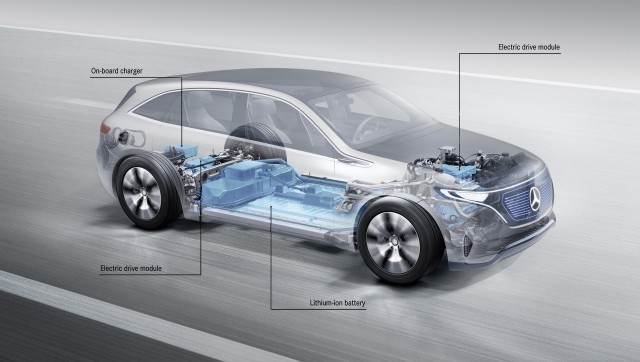
It is expected to ride on Mercedes's dedicated, modular electric-car architecture, dubbed MEA. At the same time, Mercedes is separately developing a new gas-fueled S-Class sedan that will ride on a separate rear-wheel-drive gas platform (MRA), and debut around the same time.

The EQ chassis sits a little higher than the basic S-Class to allow space for the large battery packs under the floor, but it has a much more steeply swept windshield and sleeker profile.
A high tail indicates it could be a hatchback, perhaps like the Tesla Model S, its target competition. It could, however, be just part of the prototype's camouflage.
Among the 10 electric models Mercedes has said it will deliver, the EQS represents the third passenger car, after the EQC small SUV and the EQA small coupe.
It has also revealed prototypes and specs of two commercial electric vans, and is expected to offer a small electric sedan the size of the C-class.

Monday, July 16, 2018

Study Says Daimler Will Overtake Tesla In EV Rank – Model 3 Issues Cited For Fall


German car makers could catch up to Tesla in just a few years

The current state of affairs at the German car industry giants – Daimler AGBMW AG and Volkswagen AG – sort of resembles that first day of boot camp when the hardened drill sergeant comes into the dorm room at 4 in the morning and pulls off the fire alarm. In a nutshell, everybody’s scrambling and for the most part, look like headless chickens trying to make themselves look useful. However, according to Bloomberg, just like the marine recruits, after a few months of proper testing and training, the German car industry is set to reinvent itself as an electric vehicle powerhouse.
According to a consultancy’s ranking of electric automakers, Daimler AG, BMW AG, and Volkswagen AG might soon close by or surpass Tesla in the EV market. The ranking comes from PA Consulting, a consultancy specializing in management consulting, technology and innovation. Their ranking system factors in the strategy, battery technology, culture, supplier networks, partnerships and financial performance into an overall score. While this couldn’t be farther from reality (with the current state of affairs), the sheer might – engineering, design, production and financial aspects of the car industry. With that in mind, the German car makers are on a path to might swivel the odds in their favor within the next few years.
According to the forecast set by consultancy, Tesla is to remain the king of the castle to at least 2021. This is the time when the traditional rivals are set to flood the market with a variety of fully electric models, giving Tesla a run for their money. The forecast doesn’t go easy on Tesla, as it weighs down the California based automaker with a fall to seventh place. The pecking order in 2021 should see Daimler firmly at the helm. The Stuttgart based vehicle industry giant is then closely followed by BMW, the Renault Nissan Mitsubishi alliance and finally, the dieselgate struck, but clearly not that hurt – Volkswagen – filling the list’s last top spot before Tesla.
BMW Concept iX3
“Achieving CO2 targets and improving e-mobility performance go hand in hand,” Thomas Göttle, head of PA Consulting’s automotive business, said in a statement. “For the manufacturers, however, this also involves a great need for action in terms of organization and personnel.”
For Tesla, the highly-touted production issues, matched with an uncertain profit outlook, all played a major key in the lower ranking for the U.S carmaker, according to PA Consulting. However, there’s a long way to go until 2021, and Tesla Motors may well turn the tide. Their production woes are slowly becoming less of a burden, new markets are emerging for the electric car maker and overall, the demand for electric cars is ever growing.
Looks like we’ll find out in 2021 if this prediction turns out to be accurate.

Friday, June 22, 2018

Electric Mercedes SUV Testing in Spain

The upcoming, 100% electric Mercedes SUV is set to be revealed early next year. Mercedes-Benz doesn’t want Tesla and Porsche to get all that sweet, electric PR, though. As such, they’re giving everyone a sneak peek at the new EV in these photos from a hot weather testing session in Almeria, Spain.
Here’s what we know so far: the new Mercedes-Benz EQC sub-brand of electric vehicles will be built in France, with an eye towards the European market. That’s a market, you’ll recall, that’s home to a number of heavily populated, wealthy cities with plans to ban internal combustion cars sooner rather than later. If Mercedes plans for its cars to still be seen and admired there, in other words, it needs to give its city-dwelling customers something to buy.
Beyond that, erm– it looks like the new EQC will have a super big sunroof and huge rims. Understandable, I think, since Mercedes’ customer base seems to have swung away from people who appreciate solid engineering and more towards people who appreciate giant, light-up grille emblems.

Light-up Benz Logos are a Thing

That’s all for me, then. What about you guys? Do you think this is Mercedes’ foot in the door of an all-electric future? Is this a direct result of Tesla disrupting the market? Is this a PR grab to shift attention away from the fact that Mercedes is doubling down on V8 SUVs? Let us know what you think in the comments section at the bottom of the page.

Source | Images: Mercedes-Benz, via Motorpasión

Saturday, September 16, 2017

Mercedes Unveils eCanter Electric Truck, Partners With StoreDot On Fast Charging Batteries

Daimler has unveiled its Fuso branded eCanter electric truck in Manhattan. Mitsubishi Fuso is part of the Daimler Truck Group, along with Freightliner and Mercedes Benz. The eCanter electric light duty delivery truck has been under development for several years and will be manufactured in Tramagal, Portugal. It goes on sale in the US, Europe, and Japan starting later this year, according to a company press release.
Fuso eCanter electric truck

Fuso eCanter Electric Truck

The Fuso eCanter has a range of 100 kilometers and a load capacity up to three and a half tons depending on body type and usage. Its electric powertrain consists of six 420 volt lithium ion battery rated at 13.8 kWh each. In comparison with a conventional diesel truck, its projected operating costs are at least $1,000 less for every 6,000 miles traveled. Seven Eleven Corporation has already agreed to add 25 of the new electric delivery vans to its fleet in Japan and UPS says it will add them to its US fleet of sustainable vehicles.
Marc Llistosella, head of Mitsubishi Fuso Truck and Bus Corporation and Daimler Trucks Asia says, “In times when everybody is talking about electric trucks, we are the first to actually commercialize a series produced all electric truck. Having a long history in alternative drivetrains, we are proud to step into this new era. Our FUSO eCanter comes with years of customer testing, and the assurance of parts, services, and warranty through our global FUSO dealership network.”
“Our new FUSO eCanter now addresses the increasing global deand for products to meet and exceed high CO2 emission standards. It offers an attractive and cost-effective alternative to combustion engines and makes electric trucks key to the future of inner city distribution”, Llistosella added.

StoreDot Partnership

The introduction of the eCanter is only part of the good news coming from Daimler regarding electric trucks this week. It has also partnered Israeli startup StoreDot, which claims it has created a battery like the ones needed for electric trucks that can be recharged in as little as 5 minutes. StoreDot has recently completed a funding round which raised $60 million, thanks in large part by leadership from Daimler according to Venture Beat.
StoreDot’s FlashBattery technology is uniquely suited for commercial vehicles that start and stop repeatedly during daily use because the system maximizes the benefits of regenerative braking. That means a vehicle can travel further before it needs recharging.
Dr. Doron Myersdorf, CEO of StoreDot, says, “Having Daimler, a world leader in the automotive field, as a strategic partner is of significant value to StoreDot. It will accelerate the completion of our development process and the introduction of FlashBattery to the market. Together with Daimler teams, we create synergies that optimize the characteristics of our innovative solutions with the requirements of the electric vehicles of the future.”
If StoreDot can make 5 minute charging the norm, the electric car and truck revolution will be complete.


Monday, February 6, 2017

Fun Super Bowl Ad for Mercedes Celebrates Me Generation, Misses EcoJustice Opportunity

Super Bowl ads this 2017 year range from the fun to the sublime. Mercedes’ Super Bowl commercial, called “Easy Driver,” was created by the ever-clever Joel and Ethan Coen brother team, who are known for their pointed and enduring humor. With Steppenwolf’s “Born to Be Wild” as background music and a cameo appearance by Peter Fonda, the commercial offers a chance for its baby boomer audience to be a bit self-deprecating about angst over youth and those long-lost possibilities for freedom and independence.
What it doesn’t do, however, is call upon that same middle-aged+ audience to think about how a “Me Generation” attitude and sell-out to corporate America produced what seemed unthinkable in the late 1960s and early 1970s: that the former flower child generation would abandon the Earth’s delicate ecosystem and be directly culpable for big contributions to anthropogenic climate change.

With references to the 1969 classic film, “Easy Rider,” the fun Mercedes Super Bowl ad features a bar filled with aging bikers. Long gray beards. Tie dyed shirts. Fringed sleeves. Bulging bellies. Bodies no longer behaving in sync with the mind. Fist fights that go nowhere. One biker holds a lighter flame aloft just a bit too long. Two others hug and intertwine their long necklaces.
When one biker¹ slams open the swinging, Old West-reminiscent saloon doors, he catches everyone’s attention. “Blocked in,” he growls. The bar goes silent. “Blocked in?” is the refrain from the unbelievers.
Outside the bar, with the biker crowd onlooking and a lone eagle’s cry in the distance, we see a silver Mercedes-AMG GT Roadster and, walking toward it, Peter Fonda. He looks to the crowd and comments, “Nice rides.” A wrinkled female biker acknowledges, “Still lookin’ good.”
Fonda slips into the Roadster, beer mugs shake on the bar top, and the Mercedes-AMG GT speeds into the distance in a cloud of dust. The music returns alongside the slogans, “Born to be wild. Built to be wild.” The Mercedes maneuvers around corners and along sagebrush lined roads. Looking ahead, with the sun glinting around him, Fonda throws the audience — wait for it — the peace sign.
According to Ad Age, Drew Slaven, VP-marketing for Mercedes-Benz USA, said the ad’s creative team realized how Easy Rider was all about open air, the love of the drive, and “freedom as a the result of the machine you are on.” Commenting on how the Coen brothers were lured to do the spot, Andy Hirsch, chief creative officer at at Merkley, said: “They were excited that Peter Fonda was doing it too… (It) all came together. It was a great collaboration.”
That collaboration coalesced with the production know-how of the Coen brothers, whose films No Country for Old Men, Fargo, and The Big Lebowski have become cult classics.

Why Mercedes failed to use the Super Bowl to speak out about climate change action

The “Easy Driver” ad is part of Mercedes’ new strategy of giving more marketing attention to AMG, which is its sports car and high-performance sub brand. According to Car and Driver,
In these roadsters, performance is the real point. A 4.0-liter twin-turbo V-8 pairs with a seven-speed automatic, making 469 horsepower in the GT model. With 550 hp, the GT C shaves 0.2 second off the base car’s claimed 3.9-second zero-to-60-mph time. GT C models get rear-wheel steering and a limited-slip differential from the racy GT R coupe. Expect the GT roadsters to arrive in Mercedes-AMG showrooms in fall 2017.
Power. Performance. Speed. What else would a Baby Boomer want?
Shaped by the Cold War, the Baby Boomer generation became adults who were able to experience economic opportunity, and they took full advantage of it. However, they really didn’t bother to preserve the environment for generations to come in the way that many had anticipated. They burned inexpensive fossil fuels and filled the atmosphere with heat-trapping gases. It’s a generation that will probably never pay the costs of averting catastrophic climate change or helping their grandchildren adapt to a warmer world.
Mercedes knows that media messages are all about co-constructing meaning. To call out the upscale Baby Boomer audience which is the target for the identity rejuvenating Mercedes-AMG GT Roadster would mean that Mercedes would probably lose a valuable client share. It’s just easier for Baby Boomers to laugh alongside the Coen brothers than to be made accountable for a generational self-centeredness. Mercedes knows their target audience.

Millennials and attitudes on climate change action

study by Statista in March 2014 looked at the different attitudes on climate change between generations. When asked if they believed that climate change was real and that humans were to blame for most of it, 50 percent of millennials answered yes, whereas Baby Boomers answered 43 percent yes. This Baby Boomer ennui is quite unsettling when taking into account powerful forces like the Koch brothers, oil companies, and lobbyists who devote significant time and financial resource to demonizing environmentalist action, protecting factory farming, and supporting unsustainable industries. Hopefully, we won’t have to wait until millennials control Congress before we have substantive climate action.
Yes, millennials have enjoyed living in a country with the most pro-environment president in decades. They enjoyed a governing administration that demonstrated interest in sensible climate legislation, including the Paris Climate Agreement and the Climate Action Plan. And Mercedes knows that the millennials’ share of new vehicle purchases surged 150 percent between 2010 and 2014.  Looking to cater to the generation’s growing purchasing power to build a future customer base, Mercedes will have to adapt to environmental and marketing trends that a eco-conscious generation not just wants but expects.

Note: Interestingly, Mercedes brand has the naming rights to the new Falcons stadium that opens next season.
¹With only one person of color in the commercial, this critique could easily have gone in another direction and asked why Mercedes and the Coen brothers featured a nearly all-white cast.
Photo credit: zeevveez via Foter.com / CC BY

Wednesday, January 18, 2017

Mercedes, BMW, Toyota To Go On $10 Billion Hydrogen Fuel Binge

Hydrogen as a clean fuel has long been the darling of futurists. A power source that has no waste products other than water vapor and heat? What’s not to like? Hydrogen is the most abundant element in the universe. It’s practically free. Why not use it to power a civilization that creates no carbon, methane, or nitrogen emissions whatsoever?
Mercedes hydrogen fuel GLC
Please don’t start posting nastygrams to me in the comments section yet. I am not a hydrogenophile. I can reel off a dozen reasons why hydrogen is not the magic bullet many people assume it is. But there are a lot of people who see hydrogen as the way out of our fossil fuel pollution mess and more are getting on the hydrogen fuel bandwagon every day.
Mercedes, BMW, and Toyota have just entered into an agreement to spend $10 billion over the next 5 years to spur growth in the hydrogen fueling infrastructure and to pursue hydrogen fuel cell research. The three car makers, together with Honda, Hyundai, Shell, AirLiquide, Linde, and Total, want to lay the groundwork that will make it possible for hydrogen fuel cell cars to go mainstream. They announced their plans this week in Davos, Switzerland.
The companies have named their effort the Hydrogen Council. They believe hydrogen “can play an important role in the transition to a clean, low-carbon, energy system.” The Hydrogen Council also vows to push global governments to accelerate public investment in hydrogen related infrastructure as part of the overall effort to curb greenhouse gases mandated by the Paris climate accords.
People fret about electric car sales but the number of fuel cell cars on the road is minuscule. Toyota leased 1,034 Mirai fuel cell sedans last year. Mercedes is about to start marketing its GLC plug-in hydrogen fuel-cell crossover later this year.
Hydrogen infrastructure is almost nonexistent in the US. Of the 33 publicly accessible hydrogen refueling stations in the country, 30 are in California. In addition, there is one each in Connecticut, Massachusetts, and South Carolina, according to the US Department of Energy. By comparison, there are more than 15,000 electric-vehicle charging stations with almost 40,000 outlets in the US.
You may now begin your anti-hydrogen rants. I’ll start. Why on earth would these companies sink precious resources into selling hydrogen fueled cars? The same companies who are pushing for fuel cell infrastructure have been dragging their feet for years when it comes to EV charging infrastructure. Most of them have embraced the idea of electric cars the way one would hug a porcupine — very slowly and with great reluctance.
There is something wrong with this picture but I can’t quite put my finger on it. Can you help me out?
Source: AutoBlog

Tuesday, December 6, 2016

Mercedes Doubles Down On Electric Car Production

At the Paris auto show earlier this year, Mercedes announced the creation of its new EQ sub-brand for electric cars with a prototype of a 400 horsepower battery electric SUV. At the time, the company said the four pillars of its EQ division would be connected, autonomous, shared, and electric. This week, Thomas Weber, head of research and development for Daimler, announced the automotive group will invest up to $11 billion in electric vehicles. “By 2025 we want to develop 10 electric cars based on the same architecture. For this push we want to invest up to 10 billion euros.”
Mercedes EQ concept
Matthias Lührs, vice president of sales and product management for Mercedes, says his company will introduce a plug-in hybrid version of every single vehicle in the Mercedes-Benz model range by 2020. “From next year onward, we’ll have 10 vehicles as such—the broadest model range of plug-in hybrids in the luxury market,” he said. “And we see huge customer demand in that respect.”
That may be so, but EV sales in many important markets — especially the US — are struggling to capture 1% of the new car market. Lührs believes the keys to success when it comes to selling electric cars are customer demand, infrastructure, and regulations. Mercedes, BMW, Volkswagen, Porsche, Audi, and Ford of Europe are joining forces to address the infrastructure component. Last week they announced a joint undertaking to build a network of high power chargers for electric cars throughout Europe. The system will be based on the CCS charging standard and may feature chargers with up to 150 kW of power. The CCS consortium, which Tesla is a member of, says chargers with power up to 350 kW are possible in the future.
Regulation is something car makers have less direct control over. Emissions rules in Europe are far tougher than in the US and set to ratchet up significantly in the near future. In the US, manufacturers are pressuring the incoming Trump administration to weaken fuel economy rules, but that will have no impact on EU regulators. Rules in China and other countries are also set to get tougher soon. The question no one can answer is, what would happen to demand for electric cars if all those environmental rules were revoked? Would the allure of self driving, connected cars be enough to keep the electric car revolution moving forward?

The latest buzzword in the auto industry is “ecosystem.” No, that has nothing to do with the melting of the polar ice caps or the bleaching of The Great Barrier Reef. It refers to an automotive environment in which the car is seamless connected to the owner, the internet, and digital world. It is now expected that everything will work in harmony — hardware and software, car and smartphone, driving and being driven, owning and sharing. “Connected vehicles, autonomous vehicles, shared services, we call it an ecosystem . . . we see interdependencies,” says Lührs.
“Imagine one day — let’s say, at the latest, in 2025 — there might be a new EQ S-class coming around the corner, and you’re calling it through your EQ app. The car will be picking you up, driving autonomously in the garage, and then picking up the next person. We’re talking about car sharing here — fewer cars on the road, a very friendly ecosystem, and very convenient. You don’t have to call Uber. You call your EQ.”
Tesla has disrupted the automotive world with its innovative electric car strategy, but Mercedes and most other manufacturers are spending as much time chasing Uber as they are Tesla. Everybody in the industry seems convinced we are all perishing to be part of futuristic car pools, where we share our automobiles with each other. The connected, self driving car will be an alternative to traditional public transportation. Instead of jamming ourselves into crowded subway trains twice a day, we will ride along in connected bliss with three or four other sweaty strangers with bad breath.
In the bright, glorious day to come, white supremacists will happily buddy up with Muslims and gays because the cars will be so cool, no one will be able to resist their charms. If that is what Mercedes and other companies are expecting, they may want to take a look at the most recent presidential election in the United States to see how bitterly divided by class, race, and religion the Cradle of Liberty is today. It is unlikely the “cool” factor will have much success breaking down those barriers.
None of that deters Mercedes. It plans to use its Car2Go car sharing service to learn what customers like and don’t like in their cars. That feedback will be incorporated into designing future models. “With the Car2Go brand, we have a very good field where we can test and see what customers are preferring, and then hopefully build on that, and that is part of the whole ecosystem of EQ,” Lührs says.
In all, Mercedes expects to roll out one new electric car every year, starting with the crossover SUV prototype on display in Paris. That car should be in showrooms in 2019, which means the transformation of Mercedes to an all electric car company should be complete by the end of the next decade. It is perhaps no coincidence that 2030 is a date being suggested by several European countries as the date when they intend to ban the sale of cars with combustion engines.
Source: Car and Driver

Tuesday, November 22, 2016

Reviewed: 2017 Toyota Avalon Hybrid

 
2017 Toyota Avalon Hybrid - Review
There are certain cars I look forward to driving all year long. Sometimes they’re tiny and sometimes they’re huge. This year, there was one car in particular that I’ve been looking forward to more than any other: the 2017 Toyota Avalon Hybrid.

The Avalon may seem like a strange car to be enamored with- especially for a writer who regularly encounters high-dollar exotics from Mercedes, Porsche, and Nissan at his day job- but hear me out. For starters, the Toyota Avalon is a seriously nice car. It’s big, roomy, soft, and rides like your grandmother’s old Buick Roadmaster in the best possible way. The Avalon is a land yacht in a time when every car is trying to be a BMW. Beyond that, though, it’s probably the biggest, roomiest, softest, land yachtiest car you can buy today … and it doesn’t saddle you with a luxury nameplate, either.
That’s right. I’m arguing that having a “fashionable” badge like Audi on the nose of the car would actually detract from the experience of driving the 2017 Toyota Avalon. That’s because those badges, fairly or not, say something about the person behind the wheel. They’re fashion statements. They say to the world that you think four plastic rings on the nose of a car is worth a 10-20% markup over what is, mechanically, a virtually identical VW.
Toyota, though? Toyota is beige. It’s a badge that’s so mainstream it hurts. It’s camouflage, in other words. You could be anyone in a Toyota- and you could be a very comfortable anyone in a Toyota Avalon.
That should be enough blatant rear-end affection for Toyota to get me on the Avalon list for 2018, don’t you think? Before we sign off, though, I do want to share a few more thoughts about the latest take on Toyota’s big four-door.

2017 Toyota Avalon Hybrid | About the Car


The car still looks like a catfish. Don’t get me wrong, the 2017 Toyota Avalon is a much better automotive catfish than an Audi A7 or Mercedes-Benz CLA-class, in my opinion, but it’s there. That’s OK, though- the textured metal on the dashboard’s touchable surface more than makes up for any aesthetic complaints by being super fun to touch. The contrast-colored seats in this tester also looked great. Although, I was worried, as my daughter is a bit of a kicky toddler. I needn’t have worried, though- the Toyota Avalon is just big enough that she can’t reach back of the front seats without a serious effort. Enough of an effort, apparently, to make kicking the back of daddy’s seat a chore.
Score another one for the Avalon.
Finally, this is a green car blog, so it should be noted that the Avalon continues Toyota’s history of delivering excellent MPG numbers while in my care. In the case of the Avalon, I fell a bit short of the car’s claimed 40 city / 39 highway. I credit that more to the car’s willingness to quietly hum along at almost 90 MPH with the same sort of calm my Civic exhibits at 50. Which, you know- again: it’s a really nice car.