Showing posts with label Electric SUV. Show all posts

Saturday, November 17, 2018

Rivian teases electric pickup and SUV planned for LA auto show

Rivian R1T electric pickup concept teaser


A new startup automaker, Rivian, plans to beat Tesla to the punch with an electric pickup truck.

After years of stealth, the company is finally poised to reveal its new pickup and SUV at the LA auto show later this month.
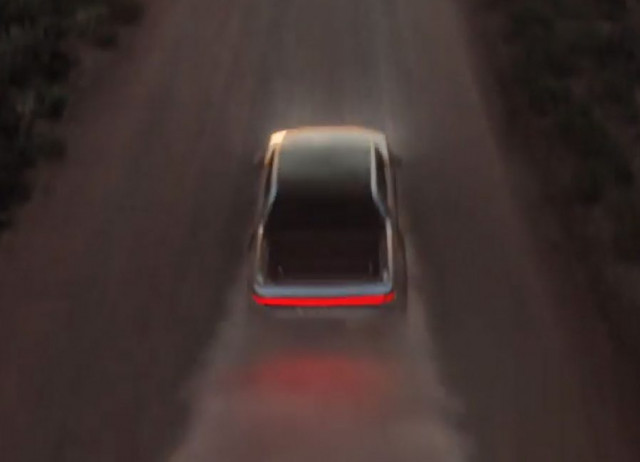
This week, the company set up a media site complete with space for pictures of its upcoming vehicles, and released a teaser video that gives a glimpse what its truck might look like.
Paralleling the four-door R1T pickup debut in LA, Rivian will also show a full-size, three-row, seven passenger SUV called the R1S, based on the same platform.
In May, the company released some target numbers—that in top trim both the electric truck and SUV will have 800 horsepower and will go up to 450 miles on a charge. The most capable model is expected to sell for $90,000.

With a smaller, 80-kilowatt-hour battery pack, the vehicles will have 200 miles of range, with a lower-power motor, and will start at about $50,000
The company claims they will be able to ford 3.5 feet of water and climb a 45-degree incline.
Rivian R1T electric pickup concept teaser


Rivian has bought and begun outfitting a former Mitsubishi factory in Illinois to build the machines and is headquartered in Michigan. It also has engineering centers in Northern and Southern California.
It also said in May that it will build its own battery packs for the trucks (with cells purchased from a supplier) and will also sell stationary battery packs for homes and businesses as Tesla does.

Rivian isn't the only company developing an electric pickup. Tesla chief executive officer Elon Musk has said he is excited about building a pickup and has asked buyers for suggestions about its capabilities. It's not clear how soon Tesla is planning to build a pickup, but it would likely come after the planned Model Y SUV and the second-generation Roadster.
Rivian R1T electric pickup concept teaser


Bollinger Motors is also working on a larger, heavy-duty pickup and SUV. Timing is also uncertain.
While Rivian has not announced when its models will go into production, the easier logistics of preparing its manufacturing site could make it the first with an electric pickup in the U.S. market. Timing could be announced at the trucks' LA show unveiling.

Tuesday, April 25, 2017

Nio ES8 Electric SUV Isn’t Weird And That’s A Good Thing

Nio is a Chinese automotive startup begun by William Li. It was originally known as NextEV but switch its corporate name a few months back. Until the Shanghai auto show, it was known primarily for an extraordinarily fast all electric two seat supercar called the Nio EP9 which was shown circulating at speeds up to 160 mph at the Circuit of the Americas race track in Texas recently. This past week at the Shanghai auto show, Nio showed off a much more prosaic vehicle. Called the ES8, it is reported to be a 7 passenger electric SUV with all wheel drive.
Nio ES8 electric SUV
Details are hard to come by at this point. The ES8 is intended solely for the Chinese market, so far as we know. It rides on a 118 inch wheelbase and is 196 inches long overall. Both the body and the chassis are made entirely aluminum. A range of 300 miles is mentioned, but Asian carmakers often use a very optimistic standard. For now, assume an EPA range of 200 to 220 miles. No battery size was specified for the show car on display in China. Production is set to being later this year.
In a press release, Nio dropped this dollop of information: “The vehicle’s swappable battery will provide a charging experience that surpasses refuelling at gas stations. The manufacturing and supply chain that will produce the ES8 is already in place.” A swappable battery? That is a concept that others, including Tesla, explored a few years ago but dropped after tests proved it was too cumbersome and too costly. How Nio plans to overcome the technical and price concerns remains to be seen.
William Li, the CEO of Nio, told the press in Shanghai. “Today we unveiled our new production vehicle, the NIO ES8 to the China market. It is another statement of our vision and technical and manufacturing capabilities. It is a best-in-class product that showcases what is possible with electric vehicles. I am proud of our relentless focus on vision and action. From track to road, NIO continues to achieve major milestones every year.”
Nio ES8 electric SUV
The most shocking thing about the Nio ES8 is how utterly conventional it looks. Manufacturers are always pulled in opposite directions by the advent of new technology. On the one hand, they want their snazzy new gadget to be instantly recognizable as something new and exciting. Toyota went that way with the second generation Prius (the first generation had all the visual appeal of a lump of bread dough). Chevy started in that direction with the Volt but dialed back the wow factor for the second generation car to make it more appealing to mainstream drivers.
The ES8 is about as mainstream as it gets. An SUV is what the industry refers to as a “two box” design — a space up front for the mechanicals and a large box behind it for passengers and cargo. Every time a manufacturer tries to gussy up an SUV to make it more visually appealing, (the Tesla Model X and the Volkswagen CROZZ are two recent examples) they wind up lowering the amount of stuff the car can conveniently carry. Hauling stuff is theoretically the raison d’etre of any SUV, dating back to the original Ford Explorer.
Car News China carps, “the NIO ES8 needs a bit more crazy.” Beauty is in the eye of the beholder. If a car can carry 7 people and all their gear and do it on battery power alone, that is a “Hurrah!” moment for the industry. We need more cars for mainstream folks and fewer cars for early adopters. Congratulations to Nio for not getting sucked into building a swoopy looking vehicle with no room inside for more than a carton of Kleenex and a miniature poodle.
Source: Cleantechnica  Photo credits: Nio

Tuesday, December 6, 2016

Mercedes Doubles Down On Electric Car Production

At the Paris auto show earlier this year, Mercedes announced the creation of its new EQ sub-brand for electric cars with a prototype of a 400 horsepower battery electric SUV. At the time, the company said the four pillars of its EQ division would be connected, autonomous, shared, and electric. This week, Thomas Weber, head of research and development for Daimler, announced the automotive group will invest up to $11 billion in electric vehicles. “By 2025 we want to develop 10 electric cars based on the same architecture. For this push we want to invest up to 10 billion euros.”
Mercedes EQ concept
Matthias Lührs, vice president of sales and product management for Mercedes, says his company will introduce a plug-in hybrid version of every single vehicle in the Mercedes-Benz model range by 2020. “From next year onward, we’ll have 10 vehicles as such—the broadest model range of plug-in hybrids in the luxury market,” he said. “And we see huge customer demand in that respect.”
That may be so, but EV sales in many important markets — especially the US — are struggling to capture 1% of the new car market. Lührs believes the keys to success when it comes to selling electric cars are customer demand, infrastructure, and regulations. Mercedes, BMW, Volkswagen, Porsche, Audi, and Ford of Europe are joining forces to address the infrastructure component. Last week they announced a joint undertaking to build a network of high power chargers for electric cars throughout Europe. The system will be based on the CCS charging standard and may feature chargers with up to 150 kW of power. The CCS consortium, which Tesla is a member of, says chargers with power up to 350 kW are possible in the future.
Regulation is something car makers have less direct control over. Emissions rules in Europe are far tougher than in the US and set to ratchet up significantly in the near future. In the US, manufacturers are pressuring the incoming Trump administration to weaken fuel economy rules, but that will have no impact on EU regulators. Rules in China and other countries are also set to get tougher soon. The question no one can answer is, what would happen to demand for electric cars if all those environmental rules were revoked? Would the allure of self driving, connected cars be enough to keep the electric car revolution moving forward?

The latest buzzword in the auto industry is “ecosystem.” No, that has nothing to do with the melting of the polar ice caps or the bleaching of The Great Barrier Reef. It refers to an automotive environment in which the car is seamless connected to the owner, the internet, and digital world. It is now expected that everything will work in harmony — hardware and software, car and smartphone, driving and being driven, owning and sharing. “Connected vehicles, autonomous vehicles, shared services, we call it an ecosystem . . . we see interdependencies,” says Lührs.
“Imagine one day — let’s say, at the latest, in 2025 — there might be a new EQ S-class coming around the corner, and you’re calling it through your EQ app. The car will be picking you up, driving autonomously in the garage, and then picking up the next person. We’re talking about car sharing here — fewer cars on the road, a very friendly ecosystem, and very convenient. You don’t have to call Uber. You call your EQ.”
Tesla has disrupted the automotive world with its innovative electric car strategy, but Mercedes and most other manufacturers are spending as much time chasing Uber as they are Tesla. Everybody in the industry seems convinced we are all perishing to be part of futuristic car pools, where we share our automobiles with each other. The connected, self driving car will be an alternative to traditional public transportation. Instead of jamming ourselves into crowded subway trains twice a day, we will ride along in connected bliss with three or four other sweaty strangers with bad breath.
In the bright, glorious day to come, white supremacists will happily buddy up with Muslims and gays because the cars will be so cool, no one will be able to resist their charms. If that is what Mercedes and other companies are expecting, they may want to take a look at the most recent presidential election in the United States to see how bitterly divided by class, race, and religion the Cradle of Liberty is today. It is unlikely the “cool” factor will have much success breaking down those barriers.
None of that deters Mercedes. It plans to use its Car2Go car sharing service to learn what customers like and don’t like in their cars. That feedback will be incorporated into designing future models. “With the Car2Go brand, we have a very good field where we can test and see what customers are preferring, and then hopefully build on that, and that is part of the whole ecosystem of EQ,” Lührs says.
In all, Mercedes expects to roll out one new electric car every year, starting with the crossover SUV prototype on display in Paris. That car should be in showrooms in 2019, which means the transformation of Mercedes to an all electric car company should be complete by the end of the next decade. It is perhaps no coincidence that 2030 is a date being suggested by several European countries as the date when they intend to ban the sale of cars with combustion engines.
Source: Car and Driver

Tuesday, June 7, 2016

CHAdeMO DC fast-charging to run at up to 150 kilowatts, starting in 2017

DC fast charging 2015 Kia Soul EV


As more longer-range electric vehicles go on sale, the charging infrastructure that supports them will need to adapt to bigger batteries.
When it comes to DC fast charging, more powerful charging stations will be needed to charge electric cars with larger-capacity battery packs within a reasonable amount of time.

With that in mind, the consortium behind the CHAdeMO fast-charging standard plans to move toward stations that operate at 150 kilowatts, from the current 50-kW average.
The move to higher-power charging was announced at the CHAdeMO Association General Assembly in Tokyo last week, along with station upgrade plans.
An amendment to the CHAdeMO technical protocol accounting for higher-power charging will be released later this year, while the first 150-kW stations will be installed in 2017, a CHAdeMO Association statement said.
The CHAdeMO protocol and connector set is favored by Asian manufacturers, and is currently used by the Nissan Leaf, Mitsubishi i-MiEV, and Kia Soul EV in the U.S. market.
NRG eVgo electric-car charging station
Plugs and other equipment will remain the same, so cars set up for both the current 50-kW standard and the 150-kW standard will be able to use the same stations.
The stations will switch to a lower-power setting for current cars that are configured only to charge at 50 kW.
The higher power will allow cars with larger battery packs to charge in roughly the same amount of time as cars with smaller packs can on the current system—generally up to 80 percent capacity in 30 minutes.

The move to 150-kW charging also positions CHAdeMO to compete better with other fast-charging standards.
Tesla's "Supercharger" network currently runs at 125 kW, and has been designed to run at up to 150 kW.
Audi and Porsche have also discussed 150-kW charging on the Combined Charging Standard (CCS) for their upcoming electric cars.
2016 Nissan Leaf
2016 Nissan Leaf
Audi will launch an all-electric SUV based on the e-Tron Quattro concept from the 2015 Frankfurt Motor Show in 2018.
Porsche will launch a production version of the Mission E sedan—another 2015 Frankfurt concept—by the end of the decade.

CHAdeMO needs 150-kW stations to compete with the other standards, but it also has plans to potentially leapfrog them.
Officials plan to conduct studies for 350-kW charging, but will only commercialize it if there is sufficient perceived market demand.
A decision on 350-kW charging is expected to be made around 2018.

Saturday, October 10, 2015

Mitsubishi eX Concept Is An Electric SUV

Mitsubishi eX concept
When the Tokyo motor show kicks off later this month, the Mitsubishi eX concept will be revealed to the public for the first time. The all-electric SUV represents Mitsubishi’s vision of a unique vehicle aimed at the fast growing compact SUV market. It uses Mitsubishi’s state of the art EV and all wheel control technologies combined with automated driving, connected car, and active safety systems.
The eX concept is said to offer insight into the future of Mitsubishi design, according to Electric Cars Report. It is viewed as a cross between a sporty crossover for zipping around town and a stylish luxury estate wagon. It features the company’s Dynamic Shield front design language.
The Mitsubishi eX has true four-wheel-drive capability, thanks to its two 70 kilowatt electric motors, one in the front, the other in the rear, and powered by a 45 kWh battery. It will have a range of 250 miles, Mitsubishi says. The company expects improvements in battery technology will double the power of EV batteries in the next 5 years.
The styling of the eX concept is…..interesting. Like many manufacturers today, the company seems determined to compromise utility and load carrying capacity in order to emphasize a low roof line and swoopy looks. Sadly, what remains is a two-seater sports car with room for two tiny humans in back and very little of the utility that is supposed to be the reason for these kind of cars in the first place. The average family sedan could probably carry more people and more stuff than this concept.
Mitsubishi loves to fiddle and diddle with styling instead of bring products to market. It has kept thevery competent Outlander PHEV — one of the first plug-in hybrid SUVs in the world — out of the US market for almost 4 years while it fussed and fretted about the shape of the grille and whether the wheel arches were muscular enough for American tastes.
It could have had the US market to itself all these years, but by the time the company finally gets around to bringing it stateside, it will face a slew of competitors. The Outlander PHEV could have given Mitsubishi the presence in the American market it has craved for decades, but now it has forfeited that opportunity.
Mitsubishi eX concept
Photo Credits: Mitsubishi

Friday, May 1, 2015

Audi Electric SUV Will Be Sporty And Sexy

audi-ev
Audi CEO Rupert Stadler says the upcoming Audi electric SUV will be sporty and sexy, and that it will be “packed with utility.” Industry observers say the new electric SUV from Audi will be designated the Q6. An electric SUV to compete with the Telsa Model X is news, but the big news is about its range.
“When it comes to a battery electric vehicle, it was very clear for us, a range of 500 km is a must,” said Stadler, talking exclusively to  Britain’s Auto Express at the Shanghai Motor Show. Why is that big news? Because 500 kilometers translates into 300 miles. Even though official specifications for the much anticipated Tesla Model X have not been released, that car is based on the Model S chassis. The Model S with the greatest range is the P85D, rated at 265 miles. The newly announced Model S 70D has 240 miles of range.
The Model X will be heavier than the Model S, which invariably means it will have less range. Many think its range will be about 200 miles. If true, that will give the Audi Q6 a big advantage over the Model X in the marketplace. Range for electric vehicles is as important today as cubic inches were back in the heyday of big American V-8 engines.
The Audi Q6 and the Tesla Model X are destined to go head to head with each other for supremacy in the marketplace. No prices for either have been offically announced. Rupert Stadler says, “Believe me, the premium customer is prepared to pay a little bit more to say I’m doing everything well for the environment.”
Stadler is basing most of his hopes for the Audi Q6 on expectations that the infrastructure for recharging electric vehicles will increase dramatically in coming years, especially in China, which is now the biggest automobile market in the world.  “What we are seeing in China at the moment is there are some government decisions that will put [chargers] every 30 miles on 10,000 to 12,000 miles of highways. If this happens, and this will happen, then it could be an accelerator and create some good momentum. Hopefully the Europeans will follow.” He says the best time for the Q6 will be when that increase in charging infrastructure is completed — in 2018 or 2019.
Is Stadler correct in his prediction of a massive increase in charging capability in the next few years? If China is successful building more charge points, will other countries be as well? Certainly the US does not now have a plan to install a charging station every 30 miles.
Assuming all of Stadler’s optimism turns out to be be correct, will the public flock to Audi showrooms to get an electric SUV with the most range or will they flock to Tesla stores because the Model X has those cool “falcon wing” doors? There’s a lot of money riding on the outcome. And it will take a few years before we know the answer.

Thursday, January 21, 2010

ZAP, Jonway Partner to Target China Electric SUV Market

Press Release:

Companies Agree to Develop, Manufacture and Market Electric Compact SUVs and Other Vehicles in China for Worldwide Distribution

US electric vehicle pioneer ZAP (OTCBB: ZAAP) and China auto manufacturer Zhejiang Jonway Automobile Co. Ltd. announced a commercial agreement to produce electric sport utility vehicles (SUVs), cars and other electric vehicles in China for domestic and global distribution.

ZAP and Jonway partnered on the production of the 5-door Jonway A380 SUV, integrating the latest AC propulsion and lithium battery system technologies to produce a high performance mid-range electric vehicle (EV) that ZAP intends to offer to the fleet market in China. Jonway currently manufactures several thousand units per month of its A380 compact SUV in 3- and 5-door models and is expanding its product line with new model sedans and other automobiles.

The agreement with Jonway is part of a multi-phase business plan ZAP is implementing to target the China electric vehicle market. ZAP chose the Jonway partnership in part because last year Jonway produced one of the first vehicles made in China to meet international standards of quality, including ISO 9000, China Compulsory Certification (CCC) and most recently passing certification for import to the European Union. The Taizhou-based automaker markets and sells vehicles in China through a network of over 600 auto dealerships. Jonway has the capacity to produce up to 50,000 vehicles per year currently at its facilities in Taizhou with capacity and support from the government to expand as the business scales.

ZAP and Jonway believe the partnership will leverage ZAP's long-standing history in electric vehicles, experience in systems integration and worldwide sales for a broad range of EVs. Under the exclusive agreement, ZAP and Jonway take the electric drive systems designed by ZAP and integrate them into the reengineered EV SUV that will be produced by Jonway. ZAP will perform research and development of the core technology in Santa Rosa, California and license the technology for this partnership. ZAP and Jonway will jointly market and sell electric vehicles in China, North America and Europe to broaden market reach.

In 2009, China overtook the United States as the world's largest automobile market with sales increasing 46 percent from 2008 to 13.6 million vehicles in 2009, according to the China Association of Automobile Manufacturers.

ZAP hopes to leverage a stimulus from the government for plug-in forms of transportation. The Chinese State Council General Office announced that it intends to raise its annual production capacity to 500,000 all-electric cars, hybrids and buses by the end of 2011. To stimulate the growth, China's Economic Construction Department has put in place a 60,000 RMB, approximately US$8,800, manufacturers subsidy per electric vehicle produced and sold in China.

About Jonway

Jonway is the trade name of Zhejiang Jonway Automobile Co., Ltd., an automobile manufacturer based in Taizhou, Zhejiang, China that currently produces two SUV models, the A380 3-door and the A380 5-door configurations. Zhejiang Jonway Auto is a subsidiary of Jonway Group, which has been a leader in the manufacturing of motorcycles, ATVs and related products for more than 20 years. In 2009, the Company sold more than 120,000 vehicles internationally in the European Union and the United States and has a capacity to build up to 400,000 vehicles annually. The Company recently began producing electric motorcycles and related vehicles. Jonway Group and its subsidiaries also produce motor parts, light building materials, air-compressors and plastic components while managing a portfolio of real estate holdings. Jonway Group owns several manufacturing subsidiaries throughout China with a total manufacturing space of 57.3 hectares employing more than 1,000 personnel.

About ZAP

ZAP is one of the world's oldest electric vehicle providers, having delivered over 117,000 of a broad range of vehicles to more than 75 countries since 1994. ZAP supplies electric trucks and vans to military, government and corporate fleets and is an innovator of electric motorcycles, scooters and ATVs. The Santa Rosa, California based company offers some of the only electric city-speed cars and trucks in production today and is leveraging its accrued technology know-how in developing a cost effective high-speed electric car called the ZAP Alias. For further information visit http://www.zapworld.com.

Safe Harbor Statement

This press release contains forward-looking statements. Investors are cautioned that such forward-looking statements involve risks and uncertainties, including, without limitation, continued acceptance of ZAP's products, increased levels of competition, new products and technological changes, ZAP's dependence upon third-party suppliers, intellectual property rights and other risks detailed from time to time in the ZAP's periodic reports filed with the Securities and Exchange Commission.

Image Available: http://www2.marketwire.com/mw/frame_mw?attachid=1158269