Showing posts with label Honda Clarity FCX. Show all posts

Tuesday, April 10, 2018

Which Honda Clarity would you buy: electric, plug-in hybrid, or fuel cell?

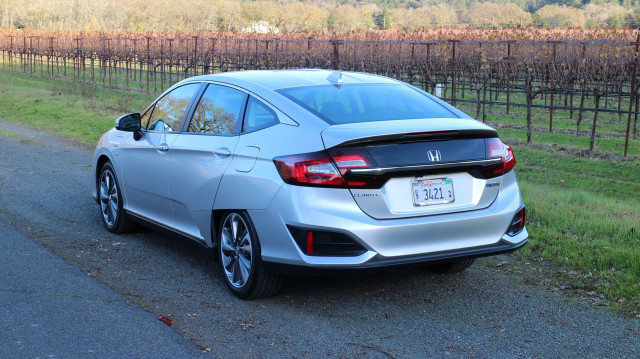
2018 Honda Clarity Plug-In Hybrid drive, Napa Valley, Caifornia, Dec 2017


Honda has adopted an unusual strategy with its Clarity, creating a whole new model for its green car, separate from its mainstream midsized sedan, the Accord. 
While the Accord is available as a conventional hybrid, the Clarity sedan will encompass three models: a battery electric with 89-mile range, a 48-mile plug-in hybrid, and a fuel-cell vehicle (following on the original Clarity FCX).

Beyond the powertrains, all three are essentially identical–give or take a little bit of trunk space and a few digitally rendered gauges.
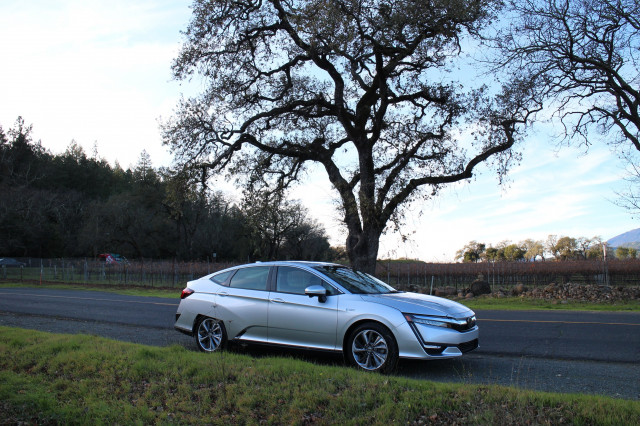
All three seat five, in an especially sleek—and slick—fastback sedan body style with vestigial aero spats over the rear wheels.
All three are now on the market, though the Clarity Fuel Cell is sold only in certain areas of California near hydrogen fueling stations, and the Clarity Electric only in California and Oregon. 

Honda says the plug-in hybrid will be the volume leader by far, especially since it's the only plug-in hybrid other than the Chevrolet Volt (and BMW i3 REx) that offers more than 40 miles of electric range.
The Clarity Electric's 89-mile range, however, looks dated compared with the Chevrolet Bolt at 238 miles, the 2018 Nissan Leaf at 151-miles, and the Tesla Model 3 at 310 miles, to cite a few examples. 

As with previous Honda fuel-cell cars, sales of the Clarity Fuel Cell will be concentrated around urban Orange County, California, where hydrogen filling stations are most prevalent.
The number of retail hydrogen stations in California continues to grow; as of a couple of weeks ago, it reached 33 sites.
2018 Honda Clarity Plug-In Hybrid drive, Napa Valley, Caifornia, Dec 2017


Although the range of choices for all three types of non-petroleum-burning cars also continues to expand, no other green car currently offers such a selection of powertrain options.
It seemed a good opportunity to us to get a direct comparison of what buyers are interested in, independent of factors such as the looks or type of car or who makes it.
Readers can compare head-to-head a short-range plug-in car with a gas range extender, a longer-range traditional electric, or what some consider the holy grail of green cars, a fuel-cell vehicle with more than 360-miles of electric range.
As always, please note that our Twitter polls are far from scientifically valid, due to small sample size and self-selection by those who choose to participate.

Friday, August 25, 2017

This Is How The Decline Of The US Auto Industry Begins — Honda Shifts Focus To China

Conventional wisdom holds that everything we do means we can’t be doing something else. If you are working, you can’t be at the beach. If you devote your free time to being in a garage band, you can’t climb Mt. Everest. And if you are a global car maker like Honda, you must choose whether your priority is making cars for Europeans, Americans, or Chinese customers.


Is America Still Primary?

For decades, Honda has regarded America as its primary market. The way its cars look, the features they offer, the colors they come in, and how they drive down the road have all been determined by the tastes of American customers. But things are changing and one of those things is profit margins. In the US, Honda’s gross profit per vehicle is abut 4.9%. That’s good, but in China, is profit margin last year was an eye popping 9.6%.
Let’s say you are a senior manager at Honda. Which market is going to get the majority of  your attention? “China has a high priority, and I think we will likely put more emphasis on listening to Chinese customer voices going forward,” said Kotaru Shimizu, general manager for sales at Dongfeng Honda Automobile Co., one of Honda’s two joint ventures in China. “The rise of China does throw the conventional wisdom of global resource allocation to the wind,” said James Chao, managing director for the Asia Pacific region at IHS Markit, “especially for global automakers who are only now experiencing the success of the China market and who have traditionally centered their strategic product decisions out of the U.S.”

A Clash Of  Cultures

That clash of culture has already played out within Honda. When the company was designing the current Civic — one of the most successful and long running models in automotive history — designers for the Chinese market wanted a traditional three box sedan. American customers prefer a more two box/fastback/hatchback look. Ultimately, the American preference won out but by the time the next generation Civic gets penned, the priorities might be reversed.
Honda sold 1.64 million vehicles in the US last year. 1.34 million of them were manufactured in America. By contrast, it sold 1.26 million vehicles in China last year. But here is the critical difference. The US market for new cars is expected to fall by almost 3% while growth in China is forecast to exceed 24%. Once again, faced with those statistics, which market would you concentrate your energy on if you were guiding a large multinational corporation?

Alcohol Was Involved

China and Japan have not always had the closest of relationships. The Rape Of Nanking is long in the past but not entirely forgotten. But there is no barrier so high that it cannot be conquered by the application of sufficient quantities of alcohol. Honda CEO Takahiro Hachigo  was vice president of overall operations in China for many years, where he was in charge of leading purchasing, production and r&d. From 2013 to 2016 he was in charge of Honda’s Chinese business before being tapped to lead the company.
Hachigo developed a fondness for Chinese classical literature and schmoozing with his Chinese counterparts. He has fond memories of the time he spent there. “It wasn’t much of a surprise, but I surely did drink a lot,” Hachigo recalled of the evening rituals with Chinese business partners. “I had drinks with them over and over again. Then I started getting along with them. They got drunk and hugged me.” Sometimes business is about more than just money and keeping one’s nose to the grindstone.

Different Strokes For Different Folks

Chinese car buyers have different priorities than Americans do. “American customers value practicality,” said Dongfeng Honda’s Shimizu, who spent several years working in the U.S. “They drive to work every day. So cars are an essential tool for American people.” In China by contrast the car is still primarily a status symbol. Chinese customers are drawn to vehicles such as the Avancier, a for sale in China only Honda model that comes with fake hood vents and wild fender creasing.
In the US, we can see some of that influence already in the cars sold here. Take a close look at the latest Civic and Prius Prime models. Both are swathed in precisely those scoops, clashing character lines, and angles that go off in odd patterns. Before you criticize the trend, remember America’s love affair with tail fins, which influenced the styling of cars built worldwide for years afterward.
“Chinese customers are firstly trend-conscious,” “Automobiles are still seen as an asset, not as a tool. They’d like to show off something,” Shimizu says. They also demand higher quality and more features like more sound insulation and better smartphone connectivity than American buyers. Atsushi Fujimoto, president of Dongfeng Honda says, “They assume that foreign carmakers sell lower quality models in China than those sold in North America. On the contrary, we tell them that we spend more money on making cars for China than those North American models.”

More Chinese Imports?

Despite the bluster and blather favored by America’s #FakePresident, more cars for the American market imported from China are likely. Already, Volvo is bringing in some Chinese made models as is Cadillac with its PHEV CT6 sedan. Ford will shift production of its Focus there soon. It takes more than tweeting to govern, apparently.
Some of the models Honda manufacturers specifically for Chinese customers may also cross the Pacific to US showrooms, especially since many of them are small crossover cute utes that American customers seem to crave. “Smaller SUVs and perhaps even sedans could be led by designers in China,” IHS’s Chao said. “If Honda feels that the small SUV segment has a lot more growth potential in China — it does, I think — then they will allocate more resources towards this effort.”
“We may be making a China-only model, but if this sells well in other regions, we should do so,” Fujimoto says. “Our cars will spread globally instead of saying U.S.-only or China-only models.” CEO Hachigo compares Honda’s strategy to serving up ramen noodles that have the same basic ingredients but using recipes tweaked to local tastes. “We tell them to use this kind of noodle and let them decide the flavor,” he says.

China Pushes For Electric Cars

China is also driving the electric car market forward while US manufacturers drag their feet. “I think electrification will likely get moving faster here than in the U.S.,” said Mitsuru Horikoshi, head of Honda’s China r&d center in Guangzhou, which oversees product development and design for both of Honda’s local joint ventures. “We are working on it now.” In fact, Honda’s first all electric car is widely expected to debut in China in 2018, long before a US equivalent arrives. \
The push for electrics is strongly supported by the Chinese government. Many manufacturers say the government’s demands are impossibly high, but their complaints have fallen on deaf ears in Beijing. In a market with a 24% annual growth rate, the car makers have little choice but to comply, no matter how costly or painful the process may be. And if electrics become commonplace in China, there will be enormous pressure on the companies to amortize the costs by selling them in other markets as well.

China Is Catching Up — Fast

Honda is quick to point out that is is not giving up on the US market. “How long do I think it will take for China to overtake the U.S. market? It won’t be so easy,” Hachigo told reporters after a June tour of Honda’s factories, r&d center, design studio and retail network in China. “It remains an important market to us. Just because China grows more doesn’t necessarily mean that North American models will decline.” That may be so, but they may start to look more like they were designed in China because they will be. \
Source: Automotive News

Monday, February 27, 2017

Honda Clarity EV will only go 80 miles on a single charge

  • White Honda Clarity Fuel Cell
  • Honda Clarity Fuel Cell in white
  • Image Credit: Honda

For Honda's upcoming electric vehicle, size matters. So does price, to a lesser extent. As for range? Not quite as much. Honda will start selling a battery-electric version of its Clarity sedan this spring, and will provide it with a single-charge range of about 80 milesAutomotive News reports. The automaker has yet to announce pricing on the Clarity EV.
Such a single-charge range puts the Clarity EV's range at about a third of the Chevrolet Bolt's 238 miles. Additionally, both BMW and Volkswagen have tweaked the batteries on their i3 and e-Golf EV models to boost distance performance to the 115-to-125-mile range. Hyundai is about to enter the fray with a battery-electric variant of its Ioniq sedan that will have a range of 110 miles.

Long known for its gas-powered vehicles' impressive fuel economy, Honda, compared to Japanese competitors such as Toyota and Nissan, has maintained a relatively small presence in the electrified-vehicle sector. The company, which will also sell a plug-in hybrid version of the Clarity, tells Automotive News that it wants to keep the all-electric reasonably priced. Additionally, the company said the primary complaint about its Fit EV was that model's size, spurring Honda to ensure that the Clarity EV's dimensions were a little more family-friendly. Honda sold 407 Fit EVs in 2014 (sales during the subsequent years were at a trickle), down 28 percent from the 526 it sold in 2013.

Honda last year divulged details of what it calls its Clarity series, which was hatched with the company's limited-production fuel-cell vehicles. Last month, Honda sold 42 Clarity fuel-cell vehicles after moving just eight units all of last year, and two units each in 2015 and 2014.

Related Video:
X

Wednesday, January 18, 2017

Mercedes, BMW, Toyota To Go On $10 Billion Hydrogen Fuel Binge

Hydrogen as a clean fuel has long been the darling of futurists. A power source that has no waste products other than water vapor and heat? What’s not to like? Hydrogen is the most abundant element in the universe. It’s practically free. Why not use it to power a civilization that creates no carbon, methane, or nitrogen emissions whatsoever?
Mercedes hydrogen fuel GLC
Please don’t start posting nastygrams to me in the comments section yet. I am not a hydrogenophile. I can reel off a dozen reasons why hydrogen is not the magic bullet many people assume it is. But there are a lot of people who see hydrogen as the way out of our fossil fuel pollution mess and more are getting on the hydrogen fuel bandwagon every day.
Mercedes, BMW, and Toyota have just entered into an agreement to spend $10 billion over the next 5 years to spur growth in the hydrogen fueling infrastructure and to pursue hydrogen fuel cell research. The three car makers, together with Honda, Hyundai, Shell, AirLiquide, Linde, and Total, want to lay the groundwork that will make it possible for hydrogen fuel cell cars to go mainstream. They announced their plans this week in Davos, Switzerland.
The companies have named their effort the Hydrogen Council. They believe hydrogen “can play an important role in the transition to a clean, low-carbon, energy system.” The Hydrogen Council also vows to push global governments to accelerate public investment in hydrogen related infrastructure as part of the overall effort to curb greenhouse gases mandated by the Paris climate accords.
People fret about electric car sales but the number of fuel cell cars on the road is minuscule. Toyota leased 1,034 Mirai fuel cell sedans last year. Mercedes is about to start marketing its GLC plug-in hydrogen fuel-cell crossover later this year.
Hydrogen infrastructure is almost nonexistent in the US. Of the 33 publicly accessible hydrogen refueling stations in the country, 30 are in California. In addition, there is one each in Connecticut, Massachusetts, and South Carolina, according to the US Department of Energy. By comparison, there are more than 15,000 electric-vehicle charging stations with almost 40,000 outlets in the US.
You may now begin your anti-hydrogen rants. I’ll start. Why on earth would these companies sink precious resources into selling hydrogen fueled cars? The same companies who are pushing for fuel cell infrastructure have been dragging their feet for years when it comes to EV charging infrastructure. Most of them have embraced the idea of electric cars the way one would hug a porcupine — very slowly and with great reluctance.
There is something wrong with this picture but I can’t quite put my finger on it. Can you help me out?
Source: AutoBlog

Tuesday, August 30, 2016

When will hydrogen fuel be available everywhere in the U.S.? Poll results

2015 Hyundai Tucson Fuel Cell, 2016 Toyota Mirai at hydrogen fueling station, Fountain Valley, CA


While you might think that any zero-emission vehicle would be viewed as a good thing, hydrogen fuel-cell vehicles continue to generate opposition among some electric-car fans.
Perhaps viewing them as competition for long-range battery electric vehicles of the sort now planned by virtually every car maker, they produce huge volumes of comments every time we write about them.

Now we have some data to show how well the Twitter followers of Green Car Reports think they can do in the market.
We simply polled those followers about when they thought that hydrogen fuel for vehicles would be available throughout the U.S.
The rough analogy would be as available as gasoline is today, at more than 100,000 separate fueling station locations throughout the 50 states.
The results were revealing.
More than six out of 10 Twitter followers who responded to the poll said hydrogen will "never" be available throughout the U.S.
The remaining 38 percent of votes were split several ways, with the next most common group being "2030 or later," chosen by 20 percent of respondents.

The choice of "2025" got only 12 percent of the votes, and the nearest-term answer, 2020, garnered a measly 6 percent of supporters.
In other words, the readers who responded to the poll really, really don't believe that hydrogen-fueled vehicles will ever become ubiquitous.
Honda Clarity teaser image, April 2016


The difference in zero-emission vehicle powertrains, of course, is that electricity in some form is generally found within a short distance of almost everywhere that cars are parked.
The same can't be said for hydrogen, which must be dispensed at pressures up to 10,000 pounds per square inch from pumps on specialized sites that currently run as high as $2 million per location to build.

We look forward to comparing the results of this poll to our latest poll, running now, which asks the same question—with the same set of date choices—about DC fast-charging instrastructure for electric cars.