Showing posts with label Electric Cars. Show all posts

Monday, March 5, 2018

Electric-car pioneer Paul Scott looks back on 15 years of plugging in

Paul Scott and Barbara with Zero electric motorcycle  [photo: Charles Ryan-Barber]
Paul Scott and Barbara with Zero electric motorcycle [photo: Charles Ryan-Barber]


Most of the U.S. was unaware that modern electric cars got their start in California between 1996 and 2002.
Many of the earliest owners and EV advocates from those days remain involved 20 years later, though their names may be familiar only to a small group of activists.
One of those people is Paul Scott, who's been part of several important events in the early history of modern EVs.

What follows are his words, lightly edited for style and clarity by Green Car Reports.
Life is a journey. I was a young hippy from San Antonio who found a new home in Eugene, Oregon, until a visual effects company offered me a job in Santa Monica, California.
After 23 wonderful years in Eugene, I had little notion of how life-changing that move would be. Shortly after the move, my life changed forever at age 49 when I received some sobering news from my doctor. 
When death knocks at your door, you tend to think about what you have done with your life and what you always wanted to do.
In that moment I decided it was time to get serious about going clean, meaning clean energy. I would get the solar-power system I’d always wanted, so if nothing else, I’d leave a legacy of clean energy.
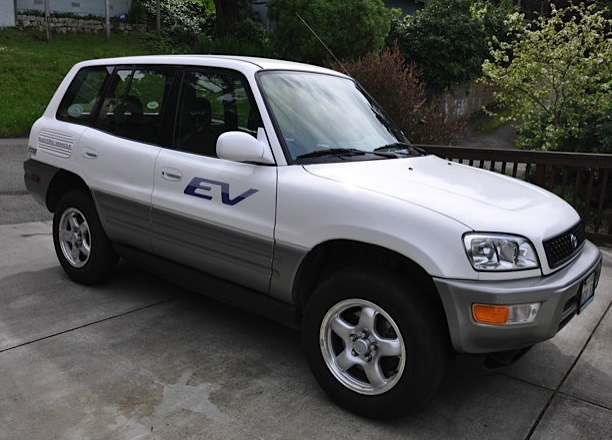
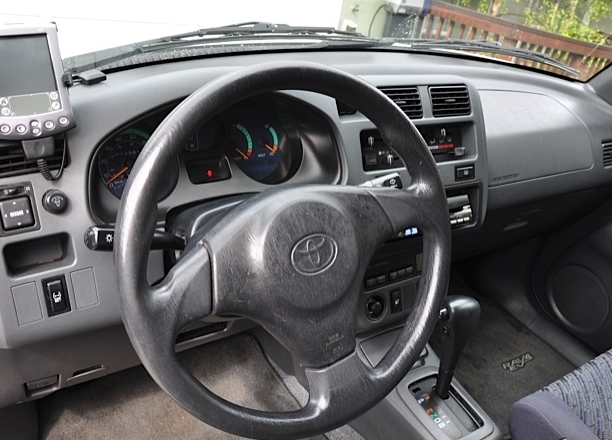
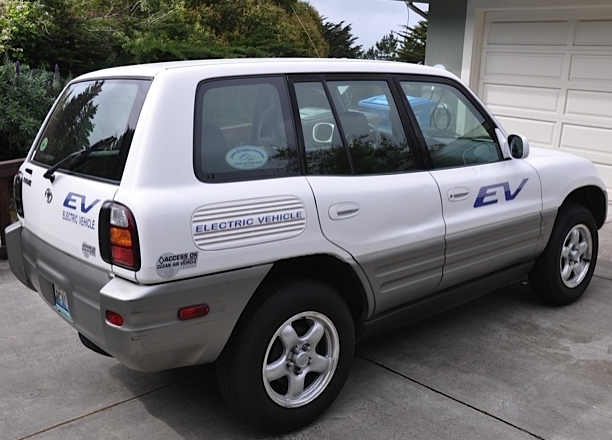
Researching solar panels and installation, I came across an electric-car website talking about the first-generation Toyota RAV4 EV electric car.
I was intrigued, and asked the group if there was any way I could test-drive one. The next day Bob Seldon brought his RAV4 over and let me take it for a spin.
I was floored by how nicely it drove, and Bob encouraged me to buy one. Toyota was willing to sell its electric cars, even then, while other makers were only leasing them—including the General Motors EV1.

I took a deep breath, accepted Bob’s advice, and went for it. On my 50th birthday, the solar-panel installation was completed, and our first electric car arrived a couple of months later on December 21, 2002.
My wife and I were now powering both our home and our car on sunlight. It was an incredible feeling to know we had eliminated most of our personal pollution.
That gave me a new-found passion in my life: clean energy and driving electric.
Cast and crew of 'Who Killed the Electric Car?' at Sundance Film Festival


Around that time, I discovered DontCrush.com, a website sounding the alarm that the manufacturers of those limited numbers of first-generation electric vehicles were taking them back and destroying them.
A group of EV advocates—Doug and William Korthof, Alexandra Paul, Linda Nicholes, Mike Kane, Sherry Boschert, Chelsea Sexton, and Marc Geller— began to organize events to publicize this.
Director Chris Paine had attended nearly all of our meetings, and ended up filiming and documenting our events for almost three years.

We began as a tiny group wanting to save a single vehicle—and our small but mighty team managed to save 200 trucks in the end. That gave us the confidence to go bigger, and we did. 
One day, I received a phone call from Chris Paine, saying his movie—Who Killed The Electric Car?—had been accepted into the Sundance Film Festival.
With that validation there was no looking back.

Thursday, November 23, 2017

Electric Car Sales Surge 63% In Third Quarter

t’s good news, bad news time at Bloomberg New Energy Finance. First the good news. Global electric car sales (including plug-in hybrids) surged 63% in the third quarter of this year and are up 23% since the second quarter. BNEF is now confident EV sales will top 1,000,000 units this year. The bad news? China accounted for almost all those increases.
Sales of electric cars totaled 287,000 in July, August, and September with China responsible for half of them. Sales in other markets are trending up gradually, but nothing like what is happening in China. The increase in EV sales in China can be traced directly to a number of government policies that strongly encourage people to purchase an electric car instead of a conventional car. Many policy makers are worried their own incentive programs are too generous but the Chinese experience makes it clear if you want people to buy electric, you have to make it worth their while.

“The Chinese government is very focused on pushing up EV sales,” says Aleksandra O’Donovan, advanced transport analyst at BNEF and one of the authors of the report. “One reason for that is the local pollution levels in the cities, and a second is for China to build domestic heroes to compete internationally in this market.”
Many countries are sending mixed messages about their electric car policies. On one hand, they are talking about banning conventional cars. On the other, they are complaining incentives are budget busters that disproportionally benefit the wealthy. The main issue is that EVs still cost quite a bit more than the least expensive conventional cars, the ones that many people rely on for daily transportation. Incentives may not make a big difference to wealthy buyers but they can make all the difference for low income drivers who need basic transportation to get back and forth to work.
China proves electric car incentives work. The only question is, can governments afford them? The factor that could make incentives unnecessary is battery prices. Batteries make up a large part of the price of electric cars. The less they cost, the more affordable those cars will be and the less the need will be for incentives.

Friday, August 25, 2017

This Is How The Decline Of The US Auto Industry Begins — Honda Shifts Focus To China

Conventional wisdom holds that everything we do means we can’t be doing something else. If you are working, you can’t be at the beach. If you devote your free time to being in a garage band, you can’t climb Mt. Everest. And if you are a global car maker like Honda, you must choose whether your priority is making cars for Europeans, Americans, or Chinese customers.


Is America Still Primary?

For decades, Honda has regarded America as its primary market. The way its cars look, the features they offer, the colors they come in, and how they drive down the road have all been determined by the tastes of American customers. But things are changing and one of those things is profit margins. In the US, Honda’s gross profit per vehicle is abut 4.9%. That’s good, but in China, is profit margin last year was an eye popping 9.6%.
Let’s say you are a senior manager at Honda. Which market is going to get the majority of  your attention? “China has a high priority, and I think we will likely put more emphasis on listening to Chinese customer voices going forward,” said Kotaru Shimizu, general manager for sales at Dongfeng Honda Automobile Co., one of Honda’s two joint ventures in China. “The rise of China does throw the conventional wisdom of global resource allocation to the wind,” said James Chao, managing director for the Asia Pacific region at IHS Markit, “especially for global automakers who are only now experiencing the success of the China market and who have traditionally centered their strategic product decisions out of the U.S.”

A Clash Of  Cultures

That clash of culture has already played out within Honda. When the company was designing the current Civic — one of the most successful and long running models in automotive history — designers for the Chinese market wanted a traditional three box sedan. American customers prefer a more two box/fastback/hatchback look. Ultimately, the American preference won out but by the time the next generation Civic gets penned, the priorities might be reversed.
Honda sold 1.64 million vehicles in the US last year. 1.34 million of them were manufactured in America. By contrast, it sold 1.26 million vehicles in China last year. But here is the critical difference. The US market for new cars is expected to fall by almost 3% while growth in China is forecast to exceed 24%. Once again, faced with those statistics, which market would you concentrate your energy on if you were guiding a large multinational corporation?

Alcohol Was Involved

China and Japan have not always had the closest of relationships. The Rape Of Nanking is long in the past but not entirely forgotten. But there is no barrier so high that it cannot be conquered by the application of sufficient quantities of alcohol. Honda CEO Takahiro Hachigo  was vice president of overall operations in China for many years, where he was in charge of leading purchasing, production and r&d. From 2013 to 2016 he was in charge of Honda’s Chinese business before being tapped to lead the company.
Hachigo developed a fondness for Chinese classical literature and schmoozing with his Chinese counterparts. He has fond memories of the time he spent there. “It wasn’t much of a surprise, but I surely did drink a lot,” Hachigo recalled of the evening rituals with Chinese business partners. “I had drinks with them over and over again. Then I started getting along with them. They got drunk and hugged me.” Sometimes business is about more than just money and keeping one’s nose to the grindstone.

Different Strokes For Different Folks

Chinese car buyers have different priorities than Americans do. “American customers value practicality,” said Dongfeng Honda’s Shimizu, who spent several years working in the U.S. “They drive to work every day. So cars are an essential tool for American people.” In China by contrast the car is still primarily a status symbol. Chinese customers are drawn to vehicles such as the Avancier, a for sale in China only Honda model that comes with fake hood vents and wild fender creasing.
In the US, we can see some of that influence already in the cars sold here. Take a close look at the latest Civic and Prius Prime models. Both are swathed in precisely those scoops, clashing character lines, and angles that go off in odd patterns. Before you criticize the trend, remember America’s love affair with tail fins, which influenced the styling of cars built worldwide for years afterward.
“Chinese customers are firstly trend-conscious,” “Automobiles are still seen as an asset, not as a tool. They’d like to show off something,” Shimizu says. They also demand higher quality and more features like more sound insulation and better smartphone connectivity than American buyers. Atsushi Fujimoto, president of Dongfeng Honda says, “They assume that foreign carmakers sell lower quality models in China than those sold in North America. On the contrary, we tell them that we spend more money on making cars for China than those North American models.”

More Chinese Imports?

Despite the bluster and blather favored by America’s #FakePresident, more cars for the American market imported from China are likely. Already, Volvo is bringing in some Chinese made models as is Cadillac with its PHEV CT6 sedan. Ford will shift production of its Focus there soon. It takes more than tweeting to govern, apparently.
Some of the models Honda manufacturers specifically for Chinese customers may also cross the Pacific to US showrooms, especially since many of them are small crossover cute utes that American customers seem to crave. “Smaller SUVs and perhaps even sedans could be led by designers in China,” IHS’s Chao said. “If Honda feels that the small SUV segment has a lot more growth potential in China — it does, I think — then they will allocate more resources towards this effort.”
“We may be making a China-only model, but if this sells well in other regions, we should do so,” Fujimoto says. “Our cars will spread globally instead of saying U.S.-only or China-only models.” CEO Hachigo compares Honda’s strategy to serving up ramen noodles that have the same basic ingredients but using recipes tweaked to local tastes. “We tell them to use this kind of noodle and let them decide the flavor,” he says.

China Pushes For Electric Cars

China is also driving the electric car market forward while US manufacturers drag their feet. “I think electrification will likely get moving faster here than in the U.S.,” said Mitsuru Horikoshi, head of Honda’s China r&d center in Guangzhou, which oversees product development and design for both of Honda’s local joint ventures. “We are working on it now.” In fact, Honda’s first all electric car is widely expected to debut in China in 2018, long before a US equivalent arrives. \
The push for electrics is strongly supported by the Chinese government. Many manufacturers say the government’s demands are impossibly high, but their complaints have fallen on deaf ears in Beijing. In a market with a 24% annual growth rate, the car makers have little choice but to comply, no matter how costly or painful the process may be. And if electrics become commonplace in China, there will be enormous pressure on the companies to amortize the costs by selling them in other markets as well.

China Is Catching Up — Fast

Honda is quick to point out that is is not giving up on the US market. “How long do I think it will take for China to overtake the U.S. market? It won’t be so easy,” Hachigo told reporters after a June tour of Honda’s factories, r&d center, design studio and retail network in China. “It remains an important market to us. Just because China grows more doesn’t necessarily mean that North American models will decline.” That may be so, but they may start to look more like they were designed in China because they will be. \
Source: Automotive News

Monday, July 10, 2017

BNEF Predicts Electric Cars Will Account For More Than Half Of All New Car Sales By 2040

Bloomberg New Energy Finance has a new prediction about electric cars — they will account for more than half of all new car sales globally by 2040 and account for a third of all light duty vehicles on the road. The latest report was put together by an advanced team of BNEF analysts and takes several factors into account. Its predictions are significantly more optimistic than the last BNEF report just one year ago, which projected sales of electric cars would reach 35% of the market by 2040.

It’s The Economics, Stupid

First and foremost, the experts expect the price of batteries, electric motors, and other components for electric cars to continue falling as volumes increase. By contrast, tougher emissions rules may actually result in higher prices for internal combustion engines as they struggle to remain relevant in a changing world. Another factor is that electric cars have lower lifetime operating costs than conventional cars.
Yet another matter is the number of mainstream manufacturers who are rushing new electric cars to market. Just this week, Volvo announced that all its new cars will have a battery and electric motor by 2019. Mercedes, Audi, and Volkswagen are hot on the electric cars trail as well.
Chevrolet will have the new Chevy Bolt on sale in all 50 states within a few weeks and has a backlog of orders in Norway and South Korea. Don’t discount the Chinese auto companies. They sell few cars in the US at present (and may sell none if President Tweet has his way) but they have every intention of exporting to global markets in coming years. If the BNEF prediction is correct, the world will use 8 billion fewer barrels of oil in 2040 for the transportation sector while global demand for electricity will grow by 5% from today’s level.

A Momentous Inflection Point

Colin McKerracher, is the leader of the advanced transport analysis team at BNEF. He says, “We see a momentous inflection point for the global auto industry in the second half of the 2020s. Consumers will find that upfront selling prices for EVs are comparable or lower than those for average ICE vehicles in almost all big markets by 2029.” That inflection point will be similar to the stunning drop in prices for renewable energy in the past several years. Renewables are now less expensive than coal, oil, natural gas, or nuclear power in many parts of the world and getting cheaper almost by the hour.
The BNEF forecast predicts EV sales worldwide will grow steadily in the next few years, from 700,000 in 2016 to 3 million by 2021. At that point, they will account for nearly 5% of light duty vehicle sales in Europe, up from a little over 1% now, and around 4% in both the US and China. While that is good news, the analysts expect big changes will begin near the end of the next decade when the purchase price of electric cars falls below that of conventional cars.
Countries that have made early progress in the sale of electric cars, such as Norway, France, the Netherlands, and the UK, are expected to be among the leaders in 2040. Emerging economies such as India are not expected to see significant EV sales until late in the next decade, despite that country’s pledge that all new cars sold there will be electric by 2030.
Jon Moore, chief executive of BNEF, said that the growth in EV market share “will come about during a time when the power system is also undergoing a revolution, towards cleaner, more distributed generation. This means that not only do EVs surge, but their emissions profile improves over time.”
BNEF’s forecast is based on analyzing the relative economics of electric cars and conventional cars. It assumes that current incentives will continue until their scheduled expiration date but does not assume the introduction of any new incentives. BNEF analyzed the automobile market not just by country but also by market segment, including everything from small sedans to SUVs and large family cars.

Infrastructure Lags

Salim Morsy, senior analyst on BNEF’s advanced transport team and lead author of the report, commented, “There is a credible path forward for strong EV growth, but much more investment in charging infrastructure is needed globally. The inability to charge at home in many local and regional markets is part of the reason why we forecast EVs making up just over a third of the global car fleet in 2040, and not a much higher figure.”
The team included the rise in autonomous vehicles and ridesharing in their calculations. It believes the impact of autonomous driving will be limited in the next 10 years but will play an increasing role in the market after 2030. By 2040, it forecasts 80% of all autonomous vehicles being used in ridesharing service will by electrics due to lower operating costs.

Friday, June 9, 2017

IEA Says There Are Now More Than 2 Million Electric Cars In The World

The number of electric cars in the world has doubled since this time a year ago, according to the International Energy Agency. That’s the good news. The not so good news is that electric cars still only account for 0.2% of all the cars in the world. The rest are conventional vehicles that flit along the highways and byways of the world, spewing who knows what out their tail pipes.
sales of electric cars
Let’s get back to the good news. Sales of electric cars are accelerating and anyone who understands exponential growth can see that it won’t be long before the total number of electric cars in the world begins to shift from negligible to significant.
The latest IEA report says, “China was by far the largest electric car market, accounting for more than 40 percent of the electric cars sold in the world and more than double the amount sold in the United States. It is undeniable that the current electric car market uptake is largely influenced by the policy environment.”
The number of electric cars available to consumers is also experiencing dramatic growth. Automakers from Mercedes, to Volkswagen, to Hyundai are working furiously to bring more cars with plugs to market. Emissions regulations are spurring growth as well.
Just a few years ago, car companies thought they could meet tough new emissions rules in Europe with clean diesel technology. That idea exploded in the wake of the diesel emissions scandal that washed over Volkswagen in September of 2015.
Since then, prosecutors in Germany, France, and South Korea have begun investigating diesel cheating by other manufacturers, including Mercedes Benz. It is now apparent that only adding electric motors will allow cars intended for sale in Europe to meet those emissions standards.
Tesla also deserves tremendous credit for making electric cars cool. It has at least 500,000 reservations worldwide for its Model 3 midsize sedan that goes into production in a few weeks. Countries like India are toying with laws prohibiting the sale of cars with internal combustion engines as early as 2030.
The electric car revolution is gathering speed. It’s time to get on board or get left behind.
Source: Bloomberg

Monday, May 29, 2017

What Is The Cheapest Electric Car In The States?

Are you looking for the cheapest electric car you can buy in the US? If so, the first thing you need to do is define your terms. There is great debate about whether a plug-in hybrid like the Chevy Volt is truly an electric car. To purists, anything with a gasoline range-extending engine is not really an electric, even though it may have enough range to meet the driving needs of 90% of Americans 90% of the time. Rather than add fuel to that debate, this article will simply focus on cars that operate exclusively on battery power. Look for a subsequent story on plug-in hybrid car prices in the near future. But first a few caveats.
Solo cheapest electric car

Neighborhood Electric Vehicles

Neighborhood Electric Vehicles are very popular and there are dozens of models available, but they are limited by law to roads with a speed limit of 35 mph or less and are banned from use on highways. While they fit the needs of many people and there are whole communities built to accommodate them, they are really glorified golf carts. In fact, some actually ARE golf carts! Since they are not designed to leave the area where they are used most frequently, they are not included in this article.

Compliance Cars

Many of the electric cars sold in the US are so-called “compliance cars” intended to meet the requirements for zero-emissions vehicles established by the California Air Resources Board. The Fiat 500e is a perfect example. It is available only in California and one or two other states. Availability of other cars like the Ford Focus Electric may be extremely limited in most states. You can probably buy one in Oshkosh, but don’t expect your local dealer to have any in inventory.

The Cheapest Electric Car Will Presumably Be The …

Electra Meccanica Solo16.1 kWh battery, $15,500, 100 mile range
cheapest electric car one seat
Priced at $15,500, the Electra Meccanica Solo is basic transportation for one person. This all-electric trike has an 82 horsepower electric motor and top speed of 80 miles per hour. The manufacturer claims a range of 100 miles. It has a 16.1 kWh battery, which is enough to qualify for a $5,000 federal tax credit. 0–60 acceleration is said to be under 8 seconds.
The Solo is no-frills transportation, but it does have 10 cubic feet of cargo space behind the driver. To put that into perspective, the soon-to-be released Tesla Model 3 has only 14 cubic feet available to haul stuff around.
There is a catch, however. The Solo is not yet in production. Although, the company says it will begin building cars early in 2018. It is accepting advance reservations now. A $250 refundable deposit is required.
Is it worth waiting a year to get the cheapest electric car on the market? Is a single seat vehicle adequate for your needs? Will the car really be produced? Only you can answer those questions.

Until Then … The Cheapest Electric Car Is …

The 2017 Smart ForTwo Electric Drive — $23,80068 miles of range, 107 MPGe, 55 kW motor
cheapest electric car 2 seats
The Smart Fortwo electric coupe goes the Solo one better. It seats two people, but has a smaller battery and less range. Still, it is available now and wins the award for the cheapest electric car you can buy in America today. Having the extra seat is a big plus, but the Smart Fortwo is still a diminutive vehicle that may not be suitable for all drivers. If you want cheap, you have to make some sacrifices.

What Is The Cheapest Real Electric Car?

So far, this article has focused on precisely what it says in the title — the cheapest electric car you can buy. The Solo and the Smart Fortwo Electric Drive qualify, but each has drawbacks that may make them unsuitable to mainstream drivers. When it comes to “real cars” that real people can drive in the real world, here are the cars you should be looking at. Keep in mind that not all of them will be available in all areas.
2017 Hyundai Ioniq Electric — $29,50028 kWh battery, 124 miles (EPA), 136 MPGe, 88 kW motor
The Hyundai Ioniq is the cheapest electric car in America with room for 5 passengers. It is also a 5 door hatchback design, which means people can bring their stuff with them when they go places in it. Sales have just begun in the US, so availability may be limited in some areas, but the Hyundai Ioniq Electric will be offered in all 50 states. A version with a larger battery and more range is in the works but won’t be here until next year.
2017 Volkswagen e-Golf — $29,81535.8 kWh battery, 124 mile range, 119 MPGe, 100 kW motor
VW e-Golf
The e-Golf comes with a larger battery for more range. It is the electric version of the tried and true VW Golf, one of the most successful car models of all time. The e-Golf can be had with emergency braking and parking assist. The price, as you can see, is practically the same as the Hyundai Ioniq Electric.
2017 Ford Focus Electric — $29,99533.5 kWh battery, 115 miles, 107 MPGe, 107 kW motor
The Ford Focus Electric is comparable to the two models above and priced almost the same as well. It may be difficult to find outside of California, but that’s the case for the e-Golf as well and also for the Ioniq Electric until production ramps up.
2017 Nissan LEAF — $31,54530 kWh battery, 107 miles, 112 MPGe, 80 kW motor
Nissan LEAF
The LEAF also got a larger battery for 2017. That increased the price, but the extra 30 miles of range should give drivers more peace of mind and freedom. The LEAF is not the most stylish of vehicles, but people who own them are quite pleased with the ride and handling — and the generous amount of interior room. More LEAFs have been sold worldwide than any other electric car in history. With a great balance between size, range, price … and availability, it’s no surprise that the LEAF continues to see solid sales. That said, much of that is claimed to be due to handsome discounts Nissan has been offering, discounts that may well make the car the cheapest electric car on the market in many regions.
2017 Fiat 500e — $32,78024 kWh battery, 84 miles, 112 MPGe, 83 kW motor
The electric version of the fun-to-drive Fiat 500 is strictly a compliance car available only in California and Oregon. Fiat often has special promotions on the 500e, like ultra-low lease rates designed to move them off dealer lots in order to make the people at CARB happy. This is the car that FCA head Sergio Marchionne once begged people not to buy because he says his company loses over $14,000 on every one it sells. That’s a dubious claim as production/sales ramp up and the R&D expenses get spread beyond more models, but you get the point — Sergio doesn’t want to sell EVs. That’s why it’s been a surprise that the 500e is sometimes the cheapest electric car on the California market (with discounts).
2017 Kia Soul EV — $32,80027 kWh battery, 93 miles (EPA), 105 MPGe, 81 kW motor
The Kia Soul is not available in all states, but it is the same cute, cuddly vehicle that Kia introduced to the market several years ago with a highly successful ad campaign featuring hip, happy hamsters. If the Kia Soul is your cup of tea and you can live with limited range, it may be just the car for you.
2017 Chevy Bolt — $37,49560 kWh battery, 238 miles, 119 MPGe, 150 kW motor
The first all-electric car from Chevrolet with long range is wrapped in an attractive 5 door hatchback crossover-style body. It has almost as much range as a base Tesla Model S and has won several awards for its advanced engineering. Base models lack many safety systems and high-speed charging capability is an $800 extra, but for the money, it is a very attractive package. It is considered the first long-range, fully electric “affordable” car.
2017 Mercedes-Benz B250e — $40,82528 kWh battery, 87 miles, 84 MPGe, 132 kW motor
The battery-electric version of the Mercedes B-Class, the B250e, is overpriced for what is has to offer. It is an example of another compliance car where the manufacturer tried to shoehorn an electric battery and powertrain into an existing gas model to save money. It shows. Although it is a 5 door hatchback vehicle, the battery takes up much of the available cargo space behind the rear seat.
2017 BMW i3 — $43,39522–33 kWh battery, 81–114 miles, 118–124 MPGe, 125 kW motor
The BMW i3 is a miracle of modern technology and engineering. It features a carbon-fiber chassis that provides a safety cell around the occupants. It also is the only non-Tesla car that currently offers customers a choice of battery size. Pick the version (and the price) that fits your needs. The i3 is also available with a two-cylinder range extender to eliminate range anxiety. Its styling is offbeat and it drives like a BMW should.

What About Tesla?

The Tesla Model S sedan and Model X SUV cost too much money to be included in this discussion. The midsize Model 3 is supposed to go into production in July of this year, but if you don’t already have a reservation, you probably won’t be able to buy one and have it delivered until late 2018 or early 2019. The company has about 500,000 reservations for the Model 3 worldwide. Although the base price is $35,000, the expectation is that the average selling price with options will be closer to $42,000, according to Mr. Elon Musk. But that’s just a rough guess, and we don’t know what the average selling price of any other electric cars is.

Conclusion

“You get what you pay for” has never been more true than when it comes to electric cars. The least expensive models come with few options and limited range. Many are only available in California and a few other states. The good news is that there are now two “real” electric cars that are available nationwide with prices starting under $30,000. Both are eligible for the full federal tax credit of $7,500. That means a careful shopper like you could park a brand new electric car in your driveway that has a net cost to you of $22,500 … before other incentives, like California, Colorado, and a few other states offer.
But be aware, you only get to take full advantage of that federal tax credit if you have a federal tax liability of $7,500 or more. If your total federal tax bill is $4,000, that’s all the credit you can get and you cannot carry any unused portion over to subsequent years.
Shop carefully and make sure you are getting all the car you need for the price you are willing to pay. A Solo or Smart Fortwo may be cheap, but if you need to transport three or more people on a regular basis, that low price is not going to leave you feeling happy about your buying decision.