Showing posts with label hydrogen. Show all posts

Friday, July 27, 2018

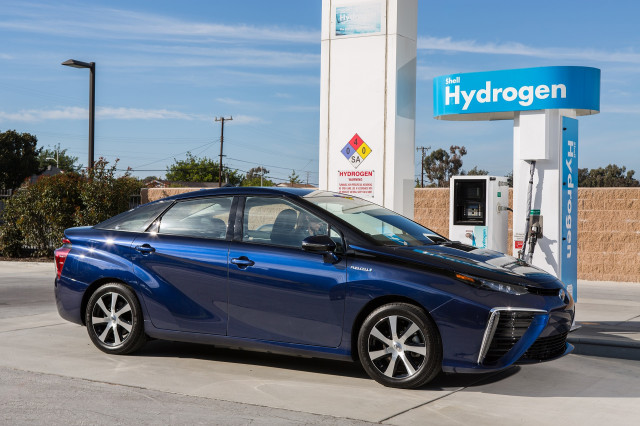
Hydrogen supply shortage leaves fuel cell cars gasping in California

2018 Toyota Mirai
2018 Toyota Mirai


The biggest challenge to driving a fuel-cell car is finding fuel.
Automakers who sell fuel-cell models—Toyota, Honda, and Hyundai for now—have made progress in getting 33 hydrogen fueling stations built around Los Angeles and San Francisco.

It's not helping drivers this week though. According to a photo tweeted by user Paolo NonVTEC Acoba, the hydrogen pumps around LA are out of fuel.
A large sign on a hydrogen pump in LA, dated last Thursday and addressed to Toyota Mirai owners, reads: "Be advised: Hydrogen delivery issues everywhere. Don't take chances, top off frequently. Toyota hotline says dealers know, will comp you for rental car."
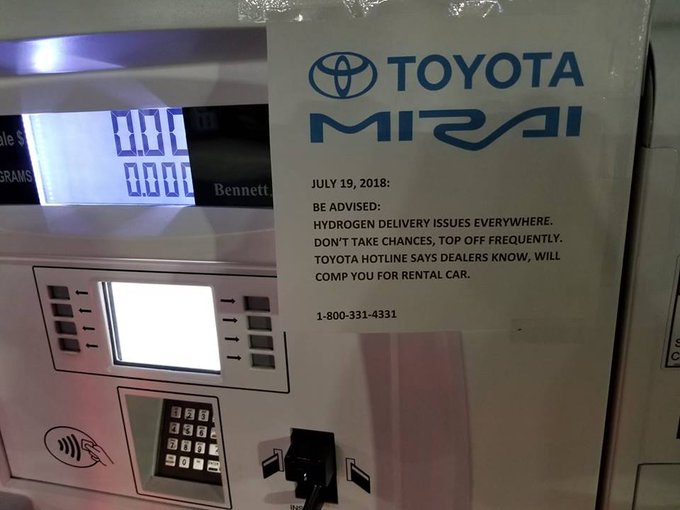
Bleak situation for Hydrogen car owners in Southern California. They're suffering their own micro energy crisis.
It may be easy to advise drivers to top off frequently; not so easy to do if all the surrounding stations are out of fuel.
"Toyota is aware that certain fuel-cell vehicle owners in the Los Angeles area are currently experiencing refueling challenges because of limited hydrogen supply at several local fueling stations. While the station operator works to resolve this short-term issue, we are working with our Mirai (fuel-cell car) customers to help identify alternative fueling options, including as a temporary measure, opening our commercial hydrogen fueling station at the Port of Long Beach...We sincerely regret the current inconvenience for our customers," Toyota said in a statement emailed to Green Car Reports.
It's not immediately clear from the statement whether Toyota is offering rental cars for Mirai owners.

The problem has been traced to a problem with hydrogen supplies delivered by chemical provider Air Products.
"We are actively working to resolve this unexpected disruption, which has been caused by a contemporaneous series of unrelated issues at several liquid hydrogen production and supply sites. We are addressing the matter as rapidly as we can and are hopeful to have the situation remedied and have restored regular hydrogen supply in the early days of August. We regret any inconvenience that may have resulted.... We regret any inconvenience fueling customers may be currently experiencing, and reassure you we are focused on resolving the issue as soon as possible," Air Products spokesman Arthur George said in an email.

Securing a a clean, affordable, and reliable, source of sufficient hydrogen supplies has always been the biggest challenge for fuel cell cars, and this shortage could give potential fuel-cell car buyers pause, just as the cars—and pumps to fuel them—are becoming more widely available.

Tuesday, April 10, 2018

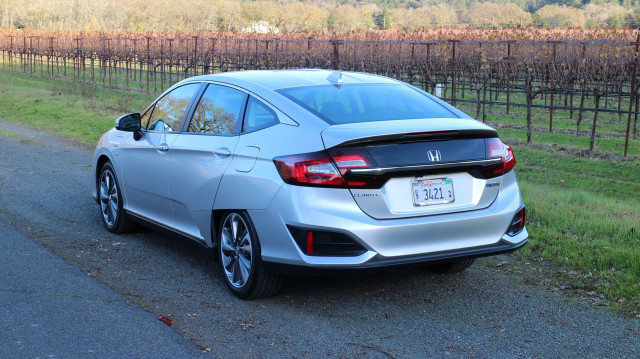
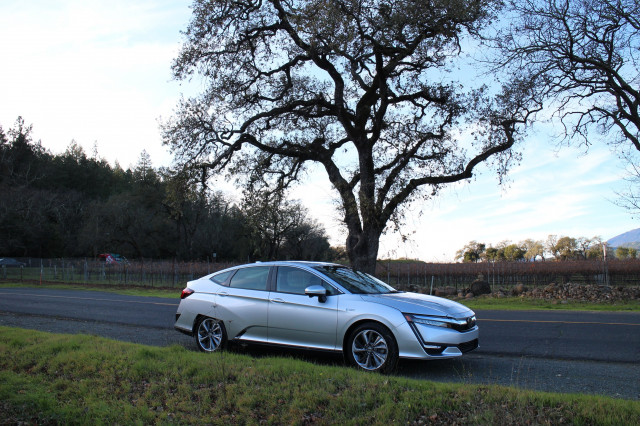
Which Honda Clarity would you buy: electric, plug-in hybrid, or fuel cell?

2018 Honda Clarity Plug-In Hybrid drive, Napa Valley, Caifornia, Dec 2017


Honda has adopted an unusual strategy with its Clarity, creating a whole new model for its green car, separate from its mainstream midsized sedan, the Accord. 
While the Accord is available as a conventional hybrid, the Clarity sedan will encompass three models: a battery electric with 89-mile range, a 48-mile plug-in hybrid, and a fuel-cell vehicle (following on the original Clarity FCX).

Beyond the powertrains, all three are essentially identical–give or take a little bit of trunk space and a few digitally rendered gauges.
All three seat five, in an especially sleek—and slick—fastback sedan body style with vestigial aero spats over the rear wheels.
All three are now on the market, though the Clarity Fuel Cell is sold only in certain areas of California near hydrogen fueling stations, and the Clarity Electric only in California and Oregon. 

Honda says the plug-in hybrid will be the volume leader by far, especially since it's the only plug-in hybrid other than the Chevrolet Volt (and BMW i3 REx) that offers more than 40 miles of electric range.
The Clarity Electric's 89-mile range, however, looks dated compared with the Chevrolet Bolt at 238 miles, the 2018 Nissan Leaf at 151-miles, and the Tesla Model 3 at 310 miles, to cite a few examples. 

As with previous Honda fuel-cell cars, sales of the Clarity Fuel Cell will be concentrated around urban Orange County, California, where hydrogen filling stations are most prevalent.
The number of retail hydrogen stations in California continues to grow; as of a couple of weeks ago, it reached 33 sites.
2018 Honda Clarity Plug-In Hybrid drive, Napa Valley, Caifornia, Dec 2017


Although the range of choices for all three types of non-petroleum-burning cars also continues to expand, no other green car currently offers such a selection of powertrain options.
It seemed a good opportunity to us to get a direct comparison of what buyers are interested in, independent of factors such as the looks or type of car or who makes it.
Readers can compare head-to-head a short-range plug-in car with a gas range extender, a longer-range traditional electric, or what some consider the holy grail of green cars, a fuel-cell vehicle with more than 360-miles of electric range.
As always, please note that our Twitter polls are far from scientifically valid, due to small sample size and self-selection by those who choose to participate.

Sunday, January 29, 2017

Harvard Researchers Create Metallic Hydrogen In The Lab - VIDEO

Okay, file this under “Far out science news that may or may not be true and even if it is, so what?” Two researchers at Harvard University report that they have successfully created metallic hydrogen in laboratory conditions. Why is that a big deal? Well, first of all, it is one of those things that physicists always talk about among themselves as being theoretically possible. They just have never been able to do it.
metallic hydrogen
Microscope images showing how hydrogen evolves from liquid hydrogen (200 GPa pressure), into “black” hydrogen and finally into metallic hydrogen at about 495 GPa pressure. Photo credit: Harvard University
Second, if there is such a thing as metallic hydrogen, it will upend science and technology in fundamental ways. It will be a room temperature superconductor, which means it could transform electronics. Anything and everything having to do with electricity — electric motors, maglev systems, and computers — would be orders of magnitude faster.
Supercomputers that are 10 times faster than anything available today would be possible. The Hyperloop would move a big step closer to reality with its ability to move people and things around the world faster than anyone ever thought possible. Metallic hydrogen could also be an ultra-dense rocket fuel, powering trips to Mars and other planets in ways never before imagined. The electrical grid would become many times more efficient, maximizing the power that can be created and distributed from renewable energy sources.
There’s only one problem. To make metallic hydrogen requires tremendous pressures and no one is sure what will happen when that pressure is removed. Will there be a bit of actual metal that can be touched and worked with or will the hydrogen just revert to its gaseous state? No one knows, least of all the scientists who conducted the experiment. Suffice it to say the announcement has met with significant skepticism from the scientific community.
Harvard professor Isaac Silvera and postdoctoral fellow Ranga Dias say they created metallic hydrogen by placing it under previously unimaginable pressure — 495 gigapascal or more than 71.7 million pounds per square inch. Let’s put that into perspective. The pressure at the center of the earth is a mere 365 gigapascal. It is 4.9 million times the pressure at the Earth’s surface and equivalent to the pressure of the water over your head if you had the misfortune to be standing at the bottom of an ocean that is 49,150 kilometers deep.
“This is the Holy Grail of high pressure physics,” Silvera said of the quest to find the material. “It’s the first ever sample of metallic hydrogen on Earth, so when you’re looking at it, you’re looking at something that’s never existed before.” He goes on to say, “One prediction that’s very important is metallic hydrogen is predicted to be meta-stable. That means if you take the pressure off, it will stay metallic, similar to the way diamonds form from graphite under intense heat and pressure, but remain diamonds when that pressure and heat are removed.” Maybe. That’s the part that hasn’t been proven yet.
The researchers are enthusiastic about the potential for metallic hydrogen. “It takes a tremendous amount of energy to make metallic hydrogen,” Silvera explains. “And if you convert it back to molecular hydrogen, all that energy is released, so that would make it the most powerful rocket propellant known to man, and could revolutionize rocketry.” In theory, metallic hydrogen would have more than 4 times the power of the most powerful rocket fuel known to science. “That would easily allow you to explore the outer planets,” Silvera said. “We would be able to put rockets into orbit with only one stage, versus two, and could send up larger payloads, so it could be very important.”
“Junk science,” says physicist Eugen Gregoryantz at the University of Edinburgh according to a report in Norwegian news source Side 3. He thinks the experiment has several flaws. Others are taking a wait and see attitude. “If this is true, then it will be fantastic. This is something we’ve been working towards for decades,” says Carnegie Mellon researcher Reinhard Boehler.  In fact, the existence of metallic hydrogen was originally postulated more than 100 years ago.
Is there anything to this story other than a topic of conversation at the next International Congress of Nerds? Maybe not, but as the head of the US Patent Office famously declared on New Year’s Eve, 1899, “Everything that can be invented has now been invented.” Minds are like parachutes. They only work when they are open. This may not be anything that affects your life or mine today or even in the foreseeable future but that doesn’t mean it won’t affect the lives of future generations.

Wednesday, January 18, 2017

Mercedes, BMW, Toyota To Go On $10 Billion Hydrogen Fuel Binge

Hydrogen as a clean fuel has long been the darling of futurists. A power source that has no waste products other than water vapor and heat? What’s not to like? Hydrogen is the most abundant element in the universe. It’s practically free. Why not use it to power a civilization that creates no carbon, methane, or nitrogen emissions whatsoever?
Mercedes hydrogen fuel GLC
Please don’t start posting nastygrams to me in the comments section yet. I am not a hydrogenophile. I can reel off a dozen reasons why hydrogen is not the magic bullet many people assume it is. But there are a lot of people who see hydrogen as the way out of our fossil fuel pollution mess and more are getting on the hydrogen fuel bandwagon every day.
Mercedes, BMW, and Toyota have just entered into an agreement to spend $10 billion over the next 5 years to spur growth in the hydrogen fueling infrastructure and to pursue hydrogen fuel cell research. The three car makers, together with Honda, Hyundai, Shell, AirLiquide, Linde, and Total, want to lay the groundwork that will make it possible for hydrogen fuel cell cars to go mainstream. They announced their plans this week in Davos, Switzerland.
The companies have named their effort the Hydrogen Council. They believe hydrogen “can play an important role in the transition to a clean, low-carbon, energy system.” The Hydrogen Council also vows to push global governments to accelerate public investment in hydrogen related infrastructure as part of the overall effort to curb greenhouse gases mandated by the Paris climate accords.
People fret about electric car sales but the number of fuel cell cars on the road is minuscule. Toyota leased 1,034 Mirai fuel cell sedans last year. Mercedes is about to start marketing its GLC plug-in hydrogen fuel-cell crossover later this year.
Hydrogen infrastructure is almost nonexistent in the US. Of the 33 publicly accessible hydrogen refueling stations in the country, 30 are in California. In addition, there is one each in Connecticut, Massachusetts, and South Carolina, according to the US Department of Energy. By comparison, there are more than 15,000 electric-vehicle charging stations with almost 40,000 outlets in the US.
You may now begin your anti-hydrogen rants. I’ll start. Why on earth would these companies sink precious resources into selling hydrogen fueled cars? The same companies who are pushing for fuel cell infrastructure have been dragging their feet for years when it comes to EV charging infrastructure. Most of them have embraced the idea of electric cars the way one would hug a porcupine — very slowly and with great reluctance.
There is something wrong with this picture but I can’t quite put my finger on it. Can you help me out?
Source: AutoBlog

Thursday, December 29, 2016

Free Energy, $10 A Barrel Oil By 2025 Says French Utility Company

“The promise of quasi-infinite and free energy is here,” says Thierry Lepercq, head of research, technology and innovation for Engie SA. He thinks the cost of solar power will drop below $10 a megawatt-hour ($0.01 per kWh) before 2025 in the world’s sunniest places. Engie recently conducted a “very deep modeling” of the Provence-Alpes-Cote d’Azur region of France, which has about 5 million inhabitants. The study showed those regions could run entirely on renewable energy for about 20% less than the price of electricity today. Engie executive predicts free energy
Lepercq also predicts that oil will drop to around $10 a barrel by 2025. “Even if oil demand continues to climb until 2025, its price could drop to $10 if markets anticipate a significant fall in demand,” Lepercq said at his office near Paris. “Solar, battery storage, electrical and hydrogen vehicles, and connected devices are in a ‘J’ curve,” he said. “Hydrogen is the missing link in a 100 percent renewable energy system, but technological bricks already exist.”
A big supporter of hydrogen power, Lepercq thinks hydrogen may be as cheap as liquefied natural gas in less than 10 years. “We’ll have the possibility to transport energy (liquid hydrogen) that’s produced very cheaply in remote places,” Lepercq said. He is encouraged by the construction of the first liquefied hydrogen carrier by Kawasaki Heavy Industries Ltd. as part of a Japanese plan to import hydrogen from Australia and believes “hundreds” more will be launched in the coming decade.
Engie was once the natural gas monopoly holder in France. Over the past decade, it has invested in renewables while it selling off coal fired plants and exploration assets to shield itself from commodity price swings. It is now the world’s largest non-state owned power producer with operations around the globe. In September, Engie bought a stake in Heliatek, a German start-up developing photovoltaic films that can be applied to the exterior of buildings. It also acquired an interest in Symbio FCell, a French manufacturer of fuel cells that convert hydrogen into electricity to run vehicles.
The company plans to spend more than $1.5 billion by 2018 on technologies including grid-scale battery storage, hydrogen output, “mini-grids” that serve small clusters of homes, and smart buildings that link up heating, lighting and IT systems to save energy and cut costs. “In the months to come, we expect to announce the first major steps of projects, investments, partnerships and potential acquisitions” in these areas, said Lepercq, a former banker and entrepreneur. In 2006, he co-founded Solairedirect, a solar developer that was bought by Engie in 2015. “We’re talking about technology platforms in which massive value can be created from comparatively small investment.”
For decades, futurists have been predicting a time when electricity would be “too cheap to meter.” If Lepercq is correct, that time is less than 10 to 15 years away.
Source: Bloomberg

Sunday, November 20, 2016

2017 Honda Clarity Fuel Cell to lease for $369 a month

2017 Honda Clarity Fuel Cell


The clock is ticking, but we may still see a third hydrogen fuel-cell car go on sale in certain regions of California—alongside the Hyundai Tucson Fuel Cell and Toyota Mirai—before the end of the year.
The 2017 Honda Clarity Fuel Cell will be available through certain California dealerships before the year is out, its maker says.

Honda now says the Clarity Fuel Cell will be available to lease at $369 a month, for 36 months.
This lease requires customers to put down $2,499 and the first month's payment at signing.
It also includes a mileage allowance of 20,000 miles a year, and a few perks.
Honda is offering customers "up to $15,000" of free hydrogen, 21 days of Avis Luxury Rental car rentals (within the state of California), and 24/7 roadside assistance.
2017 Honda Clarity Fuel Cell


Leasing will only be available to California residents who live or work near one of the 12 Honda dealerships designated to sell the Clarity Fuel Cell.
That contingent includes six dealerships in Southern California, five in the Bay Area, and one in the state capital of Sacramento.
Honda—along with Hyundai and Toyota—only plans to sell fuel-cell cars in California for the time being because it is the only state with a substantial network of fueling stations.

In a press release announcing the lease, Honda said the car would arrive at dealerships "by the end of 2016," and advised interested consumers to sign up on the Clarity Fuel Cell web page "for the opportunity to become a Clarity Fuel Cell customer."
Given that Honda previously said the Clarity Fuel Cell would carry a price of "around $60,000," the $369-a-month lease represents fairly aggressive pricing.
Toyota recently lowered its Mirai lease rate from $499 a month to $349 a month (the car has a base price of $58,365).
2017 Honda Clarity Fuel Cell


That led to a spike in sales, with most of the cars going to Toyota employees.
The Clarity Fuel Cell's EPA-rated 366-mile range far outstrips the Mirai's 312-mile range, as well as the 265-mile range of the Hyundai Tucson Fuel Cell.

In addition to the fuel-cell model, Honda also plans to offer plug-in hybrid and battery-electric versions of the Clarity—providing the first real-world market test of consumer preferences among alternative powertrains.
The other two models will go on sale next year.