Showing posts with label Clarity FCEV. Show all posts

Friday, July 27, 2018

Hydrogen supply shortage leaves fuel cell cars gasping in California

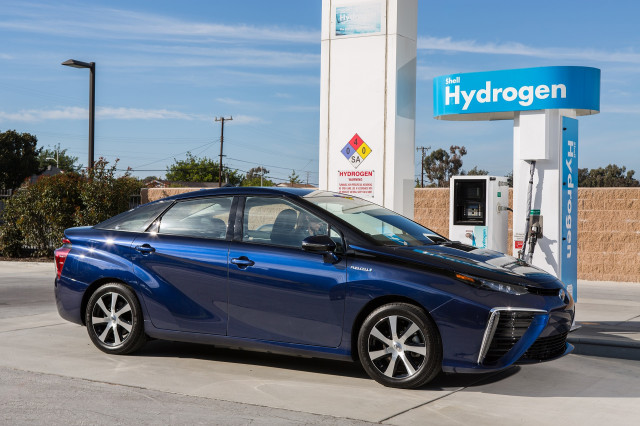
2018 Toyota Mirai
2018 Toyota Mirai


The biggest challenge to driving a fuel-cell car is finding fuel.
Automakers who sell fuel-cell models—Toyota, Honda, and Hyundai for now—have made progress in getting 33 hydrogen fueling stations built around Los Angeles and San Francisco.

It's not helping drivers this week though. According to a photo tweeted by user Paolo NonVTEC Acoba, the hydrogen pumps around LA are out of fuel.
A large sign on a hydrogen pump in LA, dated last Thursday and addressed to Toyota Mirai owners, reads: "Be advised: Hydrogen delivery issues everywhere. Don't take chances, top off frequently. Toyota hotline says dealers know, will comp you for rental car."
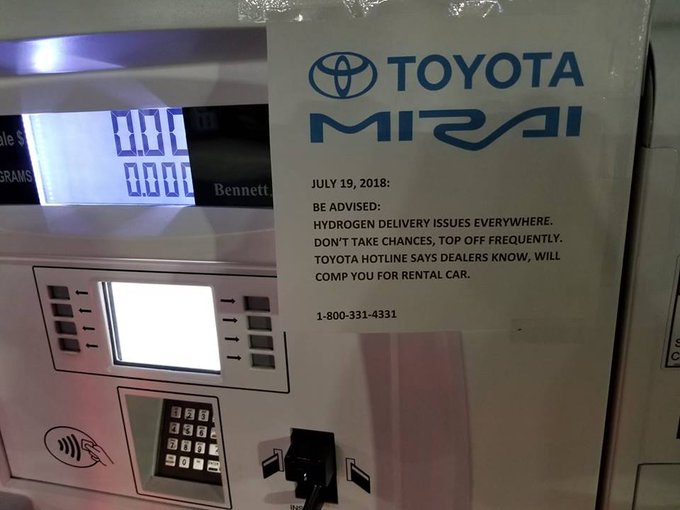
Bleak situation for Hydrogen car owners in Southern California. They're suffering their own micro energy crisis.
It may be easy to advise drivers to top off frequently; not so easy to do if all the surrounding stations are out of fuel.
"Toyota is aware that certain fuel-cell vehicle owners in the Los Angeles area are currently experiencing refueling challenges because of limited hydrogen supply at several local fueling stations. While the station operator works to resolve this short-term issue, we are working with our Mirai (fuel-cell car) customers to help identify alternative fueling options, including as a temporary measure, opening our commercial hydrogen fueling station at the Port of Long Beach...We sincerely regret the current inconvenience for our customers," Toyota said in a statement emailed to Green Car Reports.
It's not immediately clear from the statement whether Toyota is offering rental cars for Mirai owners.

The problem has been traced to a problem with hydrogen supplies delivered by chemical provider Air Products.
"We are actively working to resolve this unexpected disruption, which has been caused by a contemporaneous series of unrelated issues at several liquid hydrogen production and supply sites. We are addressing the matter as rapidly as we can and are hopeful to have the situation remedied and have restored regular hydrogen supply in the early days of August. We regret any inconvenience that may have resulted.... We regret any inconvenience fueling customers may be currently experiencing, and reassure you we are focused on resolving the issue as soon as possible," Air Products spokesman Arthur George said in an email.

Securing a a clean, affordable, and reliable, source of sufficient hydrogen supplies has always been the biggest challenge for fuel cell cars, and this shortage could give potential fuel-cell car buyers pause, just as the cars—and pumps to fuel them—are becoming more widely available.

Thursday, October 9, 2014

Massive New $50 Million SolarCity-Honda Megadeal Could Open FCEV Door

With barely a pause for breath after its groundbreaking MyPower solar financing announcement earlier this week, the leading solar company SolarCity is out with another megadeal. This one involves Honda in a $50 million venture to finance solar projects for Honda and Acura customers and dealerships in the U.S.
The new SolarCity-Honda deal actually adds $50 million to an existing $65 million solar financing pot that the two companies established last year, so it’s not exactly new as in never-before new.  However, when we first covered the launch of the partnership back in 2013 we skipped over an interesting angle that just occurred to us this minute.
Yep, that would be the f-word, as in fuel cell electric vehicles.

new SolarCity Honda deal FCEV
Fuel cell for FCX Clarity fuel cell electric vehicle (cropped) courtesy of Honda.

The New SolarCity-Honda Deal

The new $50 million SolarCity-Honda deal, announced just yesterday at the SXSW Eco conference in Texas, aims to drive the cost of on site solar power down to the affordability level by making the now-familiar power purchase agreement (PPA) platform available for a limited time to eligible Honda and Acura customers and dealers.
Under a PPA, property owners pay no money up front for their solar installation. They simply pay for the solar electricity they use on a monthly basis, which is typically less than what they would pay for grid-supplied electricity. The installer owns and maintains the hardware.
That MyPower SolarCity announcement from earlier this week added a new twist, which enables the property owner to lower their monthly payments by exercising a prepayment option.

SolarCity, Honda, And Your Solar Powered House

So, here’s where it gets interesting. For those of you new to the topic, among other high profile ventures the chairman of SolarCity is Elon Musk, who is also co-founder and CEO of Tesla Motors.
Tesla has focused like a laser on manufacturing superstar-quality plug in electric vehicles based on lithium-ion battery technology, so whatever SolarCity does to push the market for low cost, distributed solar energy give an assist to the market for Tesla Motors as well as other plug in EV manufacturers.
 
In terms of the Honda partnership, both SolarCity and Tesla stand to benefit from the solar-powered, EV-friendly house that Honda is demonstrating on the campus of UC-Davis in California (Ford and KB Home have also teamed up in a similar solar-EV home venture, btw, which is already being marketed in that state.)

SolarCity, Honda, and FCEVs

Keep in mind that fuel cell electric vehicles are EVs, too, and you can see how this will get even more interesting for Honda.
Here’s the pitch about that extra $50 million in solar financing from Honda’s press release (emphasis added):
Envisioning a future in which personal mobility products will be powered in large part by renewable energy, the two companies have begun implementing co-marketing programs that specifically encourage owners of either solar powered homes or plug-in electric vehicles to adopt the complementary product.
In case you’re wondering why Honda didn’t just come right out and say plug in electric vehicles or BEVs (fancyspeak for battery electric vehicles), that’s probably because along with its BEV lineup, Honda is one of the two leading automotive fuel cell patent holders globally.
Aside from getting ready to launch its new Clarity FCEV, Honda has teamed up with the other fuel cell patent leader, GM, in a major next-generation fuel cell and hydrogen production collaboration. That could end up leveraging the massive potential of the US Army market, given GM’s fuel cell demo project with the Army in Hawaii.
This is just a wild guess but given the advances in solar-powered hydrogen production, we’re also thinking that when Honda and GM say “next-generation” what they mean is sustainably sourced hydrogen.
Shorter version: SolarCity’s strategy of a seamless hookup between the EV market and distributed solar energy will eventually benefit FCEV owners as well as BEVs.
As for where all those FCEV owners might be, aside from the Army you can start with California, which is already a marketing hotspot for SolarCity and Tesla. FCEVs are in the state’s master plan for pushing the EV market forward, and construction is already under way on a network of hydrogen fueling stations in the state.
As with BEV charging stations, hydrogen fueling stations can be installed at some existing service stations, as demonstrated by a recent study by Sandia National Laboratories.
Add distributed, solar-powered hydrogen production and fueling to that network, and the issue of FCEV fueling convenience starts to drift away.
Did we mention that Honda already has a home-scaled, solar-powered hydrogen fueling station in the works?
Well, we just did. But if it’s starting to look like the SolarCity-Honda deal could end up undercutting Tesla’s BEV market, that’s way off in the future if ever at all.


Source: Gas 2.