Chinese manufacturer Yutong is placing 22 hydrogen fuel cell buses into service in Zhengzhou (two now, 20 to follow) as well as the first batch of 25 units to Zhangjiakou.
As the host city of the 24th Winter Olympic Games, Zhangjiakou aims to create a green winter Olympics and is committed to taking the lead in applying leading-edge hydrogen fuel cell buses. The delivered vehicles are the 3rd-generation hydrogen fuel cell bus independently developed by Yutong.
The vehicle features a 500-kilometer (311-mile) driving range and only 10~15 min hydrogen refueling time. The vehicle can achieve startup at the temperature as low as -30 °C, which is well adapted to cold weather.
As of July this year, the reliability verification mileage for Yutong hydrogen fuel cell buses has exceeded 90,000 kilometers, effectively verifying the reliability of fuel cell system, hydrogen system, DC/DC voltage converters and integrated vehicle control.
In addition, the vehicle has been fully upgraded with a 360° surround view system, air suspension system, barrier-free access and more.
The buses are equipped with four hydrogen leakage sensors. When the hydrogen concentration reaches 1.6%, the alarm is triggered. When it reaches 2%, the hydrogen supply will be cut off, and the alarm on the dashboard will alert the driver to take corresponding measures as soon as possible.
In addition, the vehicle is also provided with two sets of video surveillance systems, and totally seven cameras are available to provide an overall surveillance so as to ensure the safety of the vehicle.
Check out Toyota’s official press release, below, then let us know what you think of Toyota’s latest push for a slice of the over-the-road trucking market in the comments section at the bottom of the page.
Toyota Doubles-Down on Zero Emissions Heavy-duty Trucks
Traverse City — Toyota today unveiled the second iteration of its hydrogen fuel cell electric Class 8 truck before a crowd of media and industry leaders during the Center for Automotive Research (CAR) Management Briefing Seminars in Northern Michigan.
The new truck, known internally as “Beta,” expands on the capabilities of Toyota’s first Project Portal test vehicle by increasing the estimated range to more than 300 miles per fill. The truck also enhances versatility and maneuverability with the addition of a sleeper cab and a unique fuel cabinet combination that further increases cab space without increasing wheelbase.
Since it first began operation in April 2017, the Project Portal “Alpha” truck has logged nearly 10,000 miles of testing and real-world drayage operations in and around the Ports of Long Beach and Los Angeles while emitting nothing but water vapor. The Beta vehicle will begin drayage operations in the fall, increasing the Ports’ zero emission trucking capacity and further reducing the environmental impact of drayage operations.
Lessons Learned: Increased Range, Improved Process
Project Portal 2.0 builds on the lessons learned from the launch of the Alpha vehicle in 2017. The first heavy-duty truck was the result of a true skunkworks effort within Toyota that moved from initial concept to a fully-capable drayage truck driving silently out of a Michigan garage in just over a year. Engineers and technicians worked long hours to reconfigure the wire harnesses, electronics and other components of two off-the-lot Mirai fuel cell electric cars to create one of the world’s first OEM-built zero-emission heavy trucks.
The results of their work continue to impress. With a gross combined weight capacity of 80,000 lbs. and a driving range of more than 200 miles per fill, the 670-plus horsepower Alpha truck produces 1325 pound-feet of torque from two Mirai fuel cell stacks and a 12kWh battery. Project Portal Beta maintains these torque and horsepower numbers while also extending the range of the vehicle and pushing forward on other key performance metrics.
“By evaluating the first truck in our test facilities and on the actual roads in the LA area, we made a list of improvements for the Beta truck build process and performance enhancements,” said Andrew Lund, chief engineer for the project. He continued, “We needed to move beyond a proof of concept, which the first truck accomplished, to something that is not only better than the original but is also more commercially viable.”
A Step Toward the Future, Reflections From the Past
The story of Project Portal’s inception and evolution follows the long tradition of Toyota innovation that dates to the company’s entry into the automotive space. The first Toyota (then Toyoda) sedan, the A1, was produced in much the same manner as the original Project Portal truck- through experimentation, trial and error, and a lot of sweat. Once completed in 1935, the A1 was tested by the company’s founder, Kiichiro Toyoda, and then refined into their first commercially available car, the Toyoda AA. Likewise, through the lessons learned with the first truck, Project Portal 2.0 is more refined, functional, and capable. Also, just as the AA started Toyota on a path as an automotive leader, Project Portal is expanding Toyota’s already robust environmental leadership to the next level. Going forward, Toyota remains committed to supporting the development of a consumer-facing hydrogen infrastructure to realize the potential of fuel cell vehicles.
A Drop of Hydrogen in the Bucket
Over 16,000 pollution-emitting trucks are working in Ports of Long Beach and Los Angeles, a number that is estimated to balloon to 32,000 by 2030. More than 43,000 drayage trucks are in operation at ports across the United States, contributing significant amounts of carcinogens, diesel particulate matter (DPM) and other pollutants into the air of port communities and surrounding neighborhoods.
“Our goal with the first truck was to see if it could be accomplished, and we did that,” said senior manager for Toyota’s North American Electrified Vehicle & Technologies Office, Craig Scott. “This time we’re looking at commercial viability. We want to help make a difference—a significant difference when it comes to the air quality not only in the LA area, but across the U.S. and around the globe.”
More Than Just Trucks
This announcement is a continuation of Toyota’s Environmental Challenge 2050 efforts to eliminate CO2 emissions from its Toyota Logistics facility at the Port of Long Beach. Toyota has previously announced the construction of the Tri-Gen facility which will be the first megawatt-sized carbonate fuel cell power generation plant with hydrogen fueling in the world. The 100% renewable plant will use agricultural waste to generate water, electricity, and hydrogen that will support Toyota Logistics Services’ (TLS) operations at the Port of Long Beach.
Chevrolet’s two plug-in cars with the similar names – the Volt and Bolt – got off to tepid sales starts this year, with the Bolt doing comparatively better.
General Motors reported 1,177 Bolt EVs sold in January, a mild 1.3-percent increase over last year’s 1,162, whereas the Volt EREV saw 713 deliveries, a 55.7-percent decline over January 2017’s 1,611.
The Bolt’s number, while up, also comes against the fact that it is now nationally available, and a year ago at this time it was not, but still early in its schedule of rolling out to the nation. Sales of the 238-mile range electric car had started in Oregon and California in December 2016, and so, its availability was less. A 1.3-percent year-over-year increase therefore is not a super-sized uptick.
By contrast, the Volt, which was nationally available a year ago is purely down. It also finished 2017 a bit behind the Bolt with 20,349 sales to the Bolt’s 23,297. The Bolt was the second-best selling plug-in car in the U.S. behind an estimated 26,500 deliveries of the Tesla Model S. The Volt placed fifth behind the Tesla Model S, Bolt, Tesla Model X, and Prius Prime.
What lies ahead this year for the two cars saleswise is an open question.
Their slow starts in a historically slow sales month are not necessarily any real indicator, but a lower-priced all-new Nissan Leaf, potentially Tesla’s Model 3 which is still supposed to increase production to fill a big backlog, and other cars will also vie for mindshare.
Green car analyst Alan Baum is not projecting more than 25,000 for either one, but as is always true, no one actually knows the future.
As the United Kingdom joins other countries in committing to a future ban on fossil-fuel vehicles, commercial fleet operators that rely on diesel vehicles are left in a bit of a pickle.
Nissan has an answer in its zero-emission eNV200 electric cargo van, but its small dimensions leave a lot to be desired for commercial operators that need something a little, errrm, bigger.
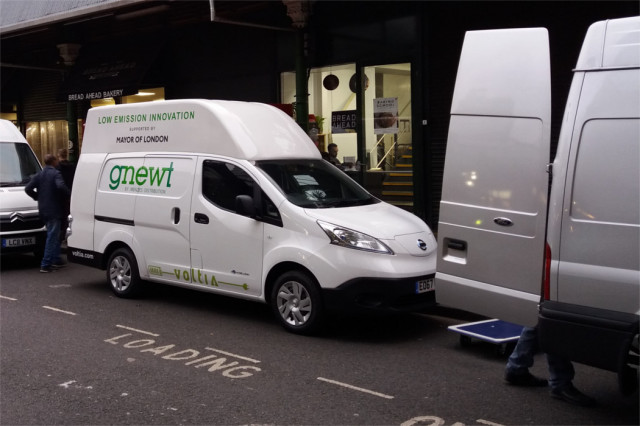
Thankfully, a European company specializing in electric van fleet implementations is doing what Nissan hasn't: adding more van to the van.
Voltia is now offering upsized versions of the eNV200 that expand the base van's cargo capacity from 140 cubic feet (4 cubic meters) to up to approximately 280 cubic feet (8 cubic meters).
It's called the Nissan-Voltia eNV200 MAXI and it offers operators up to 87 miles (140 kilometers) of range on a single charge (on the European test cycle), using the same running gear as the stock eNV200.
The conversion, which is similar to other van "upfitter" solutions, adds a higher roof and extends the length of the eNV200 to increase its cargo volume.
Voltia will sell you a complete van for 31,900 EUR ($37,600), which includes the the cost of the e-NV200 base vehicle and retains the full Nissan factory warranty.
Voltia's partner and client, Gnewt Cargo, plans to lease 33 electric vans, with partial funding provided by the UK Department of Transport and the Office for Low Emission Vehicles.
The total lease cost will be GBP 1.65 million ($2.2 million), of which the government will pay GBP 1.11 million ($1.48 million) to Gnewt. The vehicles will be used for "last-mile logistics."
Voltia is currently taking preorders on an updated version of the van that uses the e-NV200's forthcoming 40-kilowatt-hour battery pack, the same one found in the new 2018 Nissan Leaf.
Color Line, one of Norway’s largest ferry companies, has signed a letter of intent with Ulstein Verft to build the world’s largest battery electric hybrid ferry. The 525 foot long Color Hybrid will carry 2,000 passengers and 500 cars and will operate between Sandefjord and Stromstad. It is expected to use only electric power in Sanderfjord itself and near the docks at either end of the route.
Gunvor Ulstein, CEO for Ulstein Verft says, “This is an important milestone for us and we are very pleased to have been selected to partner on this incredible project. We look forward to working with Color Line. The new ferry will be built Fosen Yard in Norway. “We are in the final stages, but there are only a few formalities remaining and some technical clarifications must be in place before the contract can be signed,” says shipyard boss Kristian Sætre. Fosen Yard has designed the new ferry in close cooperation with Ulstein Verft and Color Line
“The signing of the MoU represents a significant step to realize the world’s largest plug-in hybrid ship, and it is very gratifying that Norwegian shipbuilding industry has proved competitive internationally, says Trond Kleivdal of Color Line.
The batteries on board will be charged at the Sandefjord dock using the French NG3 plug to connect to shore power, which is the same plug used on similar ferries. The battery pack size is not yet finalized but will be larger than 4 MWh. It will be capable of powering the ferry without assistance from the onboard diesel engine for a total of 30 minutes. The batteries can be recharged by the diesel engine while underway if necessary.
Design manager Per Edvin Tande of Fosen Yard says the Color Hybrid will use a new hull design. “There is a new and improved hull design which benefits from our experience and knowledge gained on past projects. Energy and environment concerns are the driving design factors for the equipment on board the new ferry,” says Tande.
“Our ambition is to be a leader in European short sea shipping and Color Hybrid’is a proof of this,” says Trond Kleivdal of Color Line. “Color Line is currently the only company in the international passenger and freight business to use only ships registered in Norway and owned by a Norwegian company. The focus on our new ships will be environmental technology.” The Color Hybrid will be approved for use in the United States thanks to its adherence to modern technological standards promulgated by the Norwegian government.
Okay, file this under “Far out science news that may or may not be true and even if it is, so what?” Two researchers at Harvard University report that they have successfully created metallic hydrogen in laboratory conditions. Why is that a big deal? Well, first of all, it is one of those things that physicists always talk about among themselves as being theoretically possible. They just have never been able to do it.
Microscope images showing how hydrogen evolves from liquid hydrogen (200 GPa pressure), into “black” hydrogen and finally into metallic hydrogen at about 495 GPa pressure. Photo credit: Harvard University
Second, if there is such a thing as metallic hydrogen, it will upend science and technology in fundamental ways. It will be a room temperature superconductor, which means it could transform electronics. Anything and everything having to do with electricity — electric motors, maglev systems, and computers — would be orders of magnitude faster.
Supercomputers that are 10 times faster than anything available today would be possible. The Hyperloop would move a big step closer to reality with its ability to move people and things around the world faster than anyone ever thought possible. Metallic hydrogen could also be an ultra-dense rocket fuel, powering trips to Mars and other planets in ways never before imagined. The electrical grid would become many times more efficient, maximizing the power that can be created and distributed from renewable energy sources.
There’s only one problem. To make metallic hydrogen requires tremendous pressures and no one is sure what will happen when that pressure is removed. Will there be a bit of actual metal that can be touched and worked with or will the hydrogen just revert to its gaseous state? No one knows, least of all the scientists who conducted the experiment. Suffice it to say the announcement has met with significant skepticism from the scientific community.
Harvard professor Isaac Silvera and postdoctoral fellow Ranga Dias say they created metallic hydrogen by placing it under previously unimaginable pressure — 495 gigapascal or more than 71.7 million pounds per square inch. Let’s put that into perspective. The pressure at the center of the earth is a mere 365 gigapascal. It is 4.9 million times the pressure at the Earth’s surface and equivalent to the pressure of the water over your head if you had the misfortune to be standing at the bottom of an ocean that is 49,150 kilometers deep.
“This is the Holy Grail of high pressure physics,” Silvera said of the quest to find the material. “It’s the first ever sample of metallic hydrogen on Earth, so when you’re looking at it, you’re looking at something that’s never existed before.” He goes on to say, “One prediction that’s very important is metallic hydrogen is predicted to be meta-stable. That means if you take the pressure off, it will stay metallic, similar to the way diamonds form from graphite under intense heat and pressure, but remain diamonds when that pressure and heat are removed.” Maybe. That’s the part that hasn’t been proven yet.
The researchers are enthusiastic about the potential for metallic hydrogen. “It takes a tremendous amount of energy to make metallic hydrogen,” Silvera explains. “And if you convert it back to molecular hydrogen, all that energy is released, so that would make it the most powerful rocket propellant known to man, and could revolutionize rocketry.” In theory, metallic hydrogen would have more than 4 times the power of the most powerful rocket fuel known to science. “That would easily allow you to explore the outer planets,” Silvera said. “We would be able to put rockets into orbit with only one stage, versus two, and could send up larger payloads, so it could be very important.”
“Junk science,” says physicist Eugen Gregoryantz at the University of Edinburgh according to a report in Norwegian news source Side 3. He thinks the experiment has several flaws. Others are taking a wait and see attitude. “If this is true, then it will be fantastic. This is something we’ve been working towards for decades,” says Carnegie Mellon researcher Reinhard Boehler. In fact, the existence of metallic hydrogen was originally postulated more than 100 years ago.
Is there anything to this story other than a topic of conversation at the next International Congress of Nerds? Maybe not, but as the head of the US Patent Office famously declared on New Year’s Eve, 1899, “Everything that can be invented has now been invented.” Minds are like parachutes. They only work when they are open. This may not be anything that affects your life or mine today or even in the foreseeable future but that doesn’t mean it won’t affect the lives of future generations.
We’re just three days into 2017, and Ford has already put out what could be the biggest announcement of the year by declaring that it will build a hybrid Mustang by 2020. Ford’s future electrification plans go much deeper than that, but a the promise of a hybrid Mustang will be a divisive issue among performance car fans of every brand.
Indeed, the addition of a hybrid drivetrain to the iconic Mustang will be the first application to a mass-produced sports car from any of the major automotive brands. Sure, there are cars like the McLaren P1 and LaFerrari that utilize complicated hybrid drivetrains derived from Formula 1 technology, but those vehicles also come with seven-figure price tags.
The question becomes, then, what form does a hybrid Mustang take? There are essentially two options; pair it with a small turbocharged engine to offer V8-matching performance, or add it to a V8 model in lieu of a supercharger on, say, a GT500 model. Ford has slowly been inching its way towards a future V8 engines are few and far between, with the 3.5 liter EcoBoost motor now proving more popular than the 5.0 V8 in the popular F-150. Might the Mustang go down the same path?
Ford’s electrication plans go far beyond the Mustang, with a dozen other electrified vehicles in the pipes that include a F-150 Hybrid, a Transit Connect Hybrid, and an all-electric SUV with 300-miles of driving range. Ford plans to invest $700 million into its Flat Rock Assembly Plant, where the Mustang is currently made, to facilitate these electrification plans. This is part of Ford’s promised $4.5 billion electrification plan, with the Mustang Hybrid due out by 2020.
“Our investments and expanding lineup reflect our view that global offerings of electrified vehicles will exceed gasoline-powered vehicles within the next 15 years,” said CEO Mark Fields. It’s particularly interesting that Ford is making this investment despite the election of Donald Trump, who has promised to rollback the gas mileage and emissions standards passed by the Obama administration.
After watching Ford flounder through gas mileage lawsuits and half-assed compliance cars, it looks like the Blue Oval might finally take electrification seriously.
In the world of oil, Saudi Arabia is the tail that wags the dog. For several years, it has stubbornly refused to cut oil production in the face of falling oil prices in order to maintain its dominant share of the oil market. It is also part of a strategy to drive tar sands and fracking producers out of business. Those non-traditional sources of oil are far more costly than pumping from reserves under the Arabian desert.
At the end of November, OPEC and other oil producing nations agreed to cut global oil production by 1.2 million barrels a day at a meeting in Vienna, according to OPEC Conference President and Qatar energy minister Mohammed Bin Saleh Al-Sada. That agreement sent oil prices above $50 a barrel for the first time in years. Higher oil prices will eventually lead to higher prices for gasoline.
“This is a much bigger cut than most people thought we’d get and could send the oil price up to between $56 to $60 per barrel,” say Bob Minter, investment strategist at Aberdeen Asset Management. The agreement takes effect on January 1 and is set to expire after 6 months.
Gas prices typically fall in the winter months when people drive fewer miles. But that may not be true this year. “Something we have not seen very often is that gas prices have been rising during the month of December,” said Patrick DeHaan, senior petroleum analyst at GasBuddy.com. “I think we’ll continue to see prices picking up.” Gasoline prices averaged $2.21 per gallon nationwide as of December 12, according to GasBuddy. That was up 3.8 cents from November’s average and up 19.8 cents from a year ago.
Rising gas prices could send shivers through the wallets of Americans who have doubled down on large gas sucking trucks and SUV’s during the past two years. USA Today predicts the price of gasoline could rise to around $3.00 a gallon by the spring of 2017. If so, Americans will be paying almost 50% more for gas than they did during the same period this year.
“With this era of low gas prices, many Americans were trading in their vehicles, selling their vehicles, buying new vehicles that have been less fuel-efficient,” DeHaan said. “If gas prices do start to inch up, there’s a lot of Americans that bought a new vehicle in the last two years during this climate of low gas prices, so it may affect them more.”
The question now is whether the announced cuts will ever actually take place. Massive cheating is the rule rather than the exception among oil producing nations. The agreement could fall apart even before it expires June 30 if member nations continue to slit each others’ throats to increase their share of the world market.
Americans seem to think they have a God given right to cheap gasoline, regardless of any consequences that may flow from their gluttony. If gas prices spike, there will be a chorus of protests from the populace demanding the government “do something.” That would be the same government that many Americans say they despise and vilify for its meddling in the free market. Interesting how hypocrisy is something we can always see in others but seldom in ourselves.
UPS has begun using its hybrid eBike tricycle to make deliveries in Portland, Oregon. The eBike has a battery and an electric motor and can be operated on battery power or pedal power alone or a combination of both. “Early in our 109 year history, UPS operated as a bike messenger company,” says Mark Wallace, UPS senior vice president global engineering and sustainability. “While we have evolved and developed a vast network of ground and air vehicles, the bicycle may be making a comeback as we navigate through crowded urban areas and continue our focus on environmental sustainability.”
UPS is a leader in developing innovative strategies to make its business more sustainable. By the end of this year, UPS will have invested more than $750 million in alternative fuel and advanced technology vehicles and fueling stations around the world since 2009. Many of those vehicles are “rolling laboratories.” and UPS has 7,700 low emission vehicles in its test fleet. Its goal is to find out what vehicles work best in various situations. Developing the eBike is part of the company’s commitment to reducing carbon emissions as city populations and e-commerce grow. Reducing congestion and noise in cities are also part of the company’s focus.
In addition to the eBike, UPS is evaluating vehicles that run on natural gas, renewable natural gas, and propane in various places around the world. One of its recent experiments involves plug-in hybrid electric delivery vans with powertrains provided by Workhorse. Those trucks operate solely on electric power but have a 2 cylinder range extender engine onboard to keep the battery charged and prevent drivers being stranded while making their rounds.
During the testing phase for the eBike, UPS will evaluate the reliability, design, integration to the city’s infrastructure, and acceptance of the vehicle. If successful, the company will expand its eBike testing program next year. It thinks the eBike prototype could become an important part of its delivery fleet in other US cities. UPS is already using bicycles for certain deliveries in Portland, weather permitting. The eBike offers drivers more weather protection than a conventional bicycle.
The eBike concept was first used in the city of Hamburg, Germany in 2012 as part of an experiment designed to develop new sustainable methods for delivering goods in urban areas. UPS placed four containers at central locations in the city for interim storage of packages. From these points, deliveries were made on foot or via elecronically assisted tricycles known as “Cargo Cruisers.” These alternate delivery solutions helped ease traffic congestion and reduce emissions each working day. Deemed a success, the Hamburg program was extended for another two years in February 2015.
On November 14, Alaska Airlines flew a Boeing 737-800 airliner from Seattle to Washington, DC using jet fuel that contained 20% biofuel made from forest residuals — the limbs and branches that remain after the harvesting of managed forests. The conversion process is the result of research conducted at Washington State University as part of the Northwest Advanced Renewables Alliance.
Chemically, the biofuel is indistinguishable from conventional Jet A fuel derived from petroleum. The forest residual feedstock used to power Alaska Airlines Flight 4 was sourced from tribal lands and private forestry operations in the Pacific Northwest.
“This latest milestone in Alaska’s efforts to promote sustainable biofuels is especially exciting since it is uniquely sourced from the forest residuals in the Pacific Northwest,” said Joe Sprague, Alaska Airlines’ senior vice president of communications and external relations. “NARA’s accomplishments and the investment of the U.S. Department of Agriculture provide another key in helping Alaska Airlines and the aviation industry reduce its carbon footprint and dependency on fossil fuels.”
The 1,080 gallons of biofuel used on the cross country flight had a minimal impact on Alaska Airlines’ overall greenhouse gas emissions. But if the airline were able to replace 20% of its entire fuel supply at Sea-Tac Airport, it would reduce greenhouse gas emissions by about 142,000 metric tons of carbon dioxide. That’s equivalent to removing about 30,000 passenger vehicles from the roadways for one year.
NARA is a five-year project that launched in 2011 and is comprised of 32 member organizations from industry, academia and government laboratories. Today’s flight represents its efforts to develop alternative jet fuel derived from post-harvest forestry material that is often burned after timber harvest.
The NARA initiative was made possible by a $39.6 million grant from the U.S. Department of Agriculture National Institute of Food and Agriculture (NIFA) to support research on biofuels and biochemicals, foster regional supply chain coalitions, empower rural economic development and educate the public on the benefits of bioenergy. That is precisely the kind of research that will likely be eliminated by our new climate denier in chief, Donald Trump. Thank you, American voters.
“Today’s flight comes after years of investments to help the aviation biofuels industry take off,” said U.S. Sen. Maria Cantwell. “By creating these sustainable biofuels, we will revitalize our rural agricultural communities, foster economic growth, reduce greenhouse gas emissions and cut our dependence on foreign oil while growing our competitiveness in global markets.” After January 20, you can kiss any further efforts in that direction goodbye, Senator.
Put on your best Rod Serling voice and repeat after me: “Imagine, if you will, an electric motorcycle with 898 lb-ft of mind-blowing, eye-watering torque.” Such a motorcycle exists and it is being driven right now by its creators on the roads that border Lake Geneva. This is not some cobbled together exercise that looks like it was created by high school seniors in welding class. The Zvexx (your guess on how to pronounce the name correctly is a good as mine) was designed and built by a group of Swiss engineers working together with people at local motorcycle shops.
The bike’s declared purpose is to prove beyond a shadow of a doubt that an electric motorcycle can be every bit as evocative as one with an internal combustion engine. That starts with a blacked-out stealth chassis that sports carbon fiber accents. The darkness of the obsidian beast is accented by slashes of bright red on the swing arm, seat, and front forks. Sinister is a word that springs to mind to describe the Zvexx.
“This is not a project in user-friendly cuteness but a fusion of raw, biker appeal and unbridled electric force,” the company says. In fact, the bike is ridden regularly on the road by its creators. Out back is one of the fattest rear tires ever seen on a motorcycle, necessary to handle the awesome outpouring of torque from the electric motor.
The Zvexx has a 26 cell, 13 kWh lithium-ion battery that is good for about 90 miles of motoring, if you drive it in a reasonable fashion. But its developers ask, “Who wants to be reasonable when riding this bike?” They claim it can accelerate to 50 mph in under 3 seconds. Frankly, that’s a little underwhelming when you consider the 5,300 lb Tesla Model S P100D with Ludicrous can scoot to 60 in less time. But that’s a mere quibble. Riding the Zvexx has got to be a rush regardless of what its stats are.
No prices or production plans have been announced. The Zvexx is simply a one-off concept at the moment. But it shows that an electric motorcycle can be just as radical as anything ever dreamed up in any custom bike shop anywhere. No doubt the lads who put this machine together aren’t planning to stop with this first offering. Can’t wait to see what comes next, can you?




 Posts
Posts


