Showing posts with label 2017 Chevrolet Bolt. Show all posts

Monday, March 5, 2018

Chevy Volt and Bolt Start the Year With So-So Sales


Chevrolet’s two plug-in cars with the similar names – the Volt and Bolt – got off to tepid sales starts this year, with the Bolt doing comparatively better.
General Motors reported 1,177 Bolt EVs sold in January, a mild 1.3-percent increase over last year’s 1,162, whereas the Volt EREV saw 713 deliveries, a 55.7-percent decline over January 2017’s 1,611.
The Bolt’s number, while up, also comes against the fact that it is now nationally available, and a year ago at this time it was not, but still early in its schedule of rolling out to the nation. Sales of the 238-mile range electric car had started in Oregon and California in December 2016, and so, its availability was less. A 1.3-percent year-over-year increase therefore is not a super-sized uptick.
By contrast, the Volt, which was nationally available a year ago is purely down. It also finished 2017 a bit behind the Bolt with 20,349 sales to the Bolt’s 23,297. The Bolt was the second-best selling plug-in car in the U.S. behind an estimated 26,500 deliveries of the Tesla Model S. The Volt placed fifth behind the Tesla Model S, Bolt, Tesla Model X, and Prius Prime.
What lies ahead this year for the two cars saleswise is an open question.
Their slow starts in a historically slow sales month are not necessarily any real indicator, but a lower-priced all-new Nissan Leaf, potentially Tesla’s Model 3 which is still supposed to increase production to fill a big backlog, and other cars will also vie for mindshare.
Green car analyst Alan Baum is not projecting more than 25,000 for either one, but as is always true, no one actually knows the future.

Saturday, February 17, 2018

Chevy Volt and Bolt Start the Year With So-So Sales


Chevrolet’s two plug-in cars with the similar names – the Volt and Bolt – got off to tepid sales starts this year, with the Bolt doing comparatively better.
General Motors reported 1,177 Bolt EVs sold in January, a mild 1.3-percent increase over last year’s 1,162, whereas the Volt EREV saw 713 deliveries, a 55.7-percent decline over January 2017’s 1,611.
The Bolt’s number, while up, also comes against the fact that it is now nationally available, and a year ago at this time it was not, but still early in its schedule of rolling out to the nation. Sales of the 238-mile range electric car had started in Oregon and California in December 2016, and so, its availability was less. A 1.3-percent year-over-year increase therefore is not a super-sized uptick.
By contrast, the Volt, which was nationally available a year ago is purely down. It also finished 2017 a bit behind the Bolt with 20,349 sales to the Bolt’s 23,297. The Bolt was the second-best selling plug-in car in the U.S. behind an estimated 26,500 deliveries of the Tesla Model S. The Volt placed fifth behind the Tesla Model S, Bolt, Tesla Model X, and Prius Prime.
What lies ahead this year for the two cars saleswise is an open question.
Their slow starts in a historically slow sales month are not necessarily any real indicator, but a lower-priced all-new Nissan Leaf, potentially Tesla’s Model 3 which is still supposed to increase production to fill a big backlog, and other cars will also vie for mindshare.
Green car analyst Alan Baum is not projecting more than 25,000 for either one, but as is always true, no one actually knows the future.
Thursday, January 25, 2018

GM FACES LAWSUIT OVER AUTONOMOUS CAR CRASH

Chevy Bolt - self driving autonomous car
GM is pushing forward with plans to produce a fleet of self-driving electric cars that are profitable, as well as sustainable. Can it be done? There’s a lot of uncertainty in the industry at the moment. And, one of the biggest areas of uncertainty facing the manufacturers of autonomous cars isn’t related to technology. It’s related to liability. Now, GM is being forced to find some answers in a California court room.
A motorcyclist attempting to lane-split in heavy traffic crashed while coming alongside the self driving Chevy Bolt, causing “neck and shoulder pain” that have “forced” the motorcyclist to take disability leave from work while undergoing “lengthy treatment” for his injuries.
To GM’s credit, the official DMV report seems to take the Bolt’s side. The Bolt, apparently operating in its autonomous mode in heavy traffic, stopped a driver-requested lane change from the center lane to the left lane because a vehicle ahead decelerated and the gap was deemed too small to safely navigate. While the Bolt was trying to re-center itself in its initial lane, the report says, the motorcyclist “wobbled and fell over,” while trying to lane split. The damage to the Bolt was reported as, “(a) long scuff on passenger side of the vehicle,” according to the same DMV report.
So- was the motorcyclist thrown off by the Bolt’s correction? Is it a cynical cash grab from someone eyeballing GM’s deep pockets? It’s hard to say, especially as it’s still unclear whether the Chevy Bolt in question was one of the company’s “third-generation” autonomous cars that were described recently by GM Cruise CEO Kyle Vogt as “the world’s first mass-producible car designed to operate without a driver.”
One thing that is certain: there will be lots of people in the industry who will be watching this case closely. And, make no mistake, if it sets a precedent against GM, it’s pretty likely that a big part of the much-promised autonomous future might not come to pass, after all.

Source | Imagesthe Mercury News, via the VergeJalopnik.

Sunday, December 3, 2017

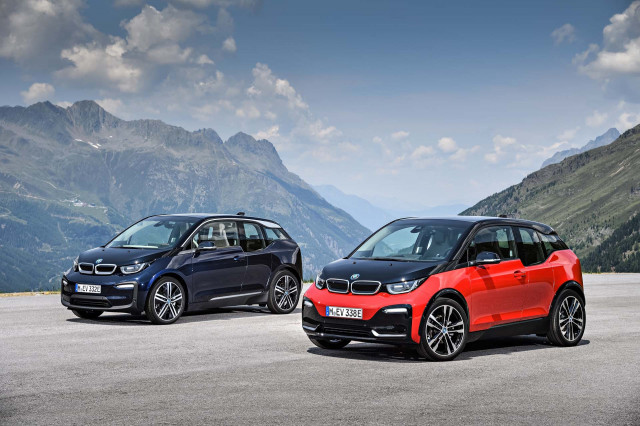
BMW i3 electric car sales stopped, future recall announced for specific safety concern

2018 BMW i3 and i3s
2018 BMW i3 and i3s


An obscure safety issue has led to a halt in sales of the BMW i3 electric car until further notice.
The German maker announced a recall for every single i3 sold in the United States, covering 30,542 cars from the 2014 to 2018 model year.

The safety issue that led to the recall and stop-sale follows recent testing by the National Highway Traffic and Safety Administration.

During recent tests, the NHTSA found that 5th-percentile women—female drivers more than 5 feet tall and weighing between 100 and 110 pounds—showed a “marginally higher risk” of sustaining neck injuries in the event of a frontal crash if not wearing a seatbelt.
Drivers should wear their seatbelt at all times, of course. But if a female BMW i3 driver fitting that profile did not do so, she would be at risk of exceeding the injury limit allowed by the NHTSA, according to a report by BMW Blog last Monday.
2017 BMW i3 REx range-extended electric car [photo: Chris Neff]


The blog obtained a copy of the document specifying and detailing the safety concern. It says a remedy for the issue is still under development.
UPDATE: On December 1, BMW dealers sent the following notice to at least some BMW i3 owners:
Our engineers are about to finish the programming of a software repair solution that will fix the non-compliance issue. The software development is in the final stages and the solution is expected to be available as of mid-December.

BMW released a statement which said its own testing did not reveal the inconsistencies found by the NHTSA, but it acknowledged them and said it will fix the issue.
The issue isn't software or a specific component, but a design characteristic that doesn't properly protect a small, specific portion of the population.
The remedy is expected to involve reprogramming of the airbag control logic.
2017 BMW i3 REx range-extended electric car [photo: Chris Neff]


BMW made it clear that the i3 is completely safe to drive in all conditions when the safety belt is fastened properly.
Unfortunately, the stop-sale means buyers looking at a new i3—which was recently updated for the 2018 model year—will be out of luck due to the safety concern.
The 2018 BMW i3 adds a sportier i3s trim and slight styling updates, though the battery and rated ranges remain identical to the 2017 model year.

BMW gave no definitive timeline for when it will lift the stop-sale. BMW will begin mailing notifications to owners of the affected cars in January 2018.
The 30,542 cars to be recalled for the as-yet-unspecified modification include 29,383 sold to customers and 1,159 currently held by U.S. dealerships.

Tuesday, September 19, 2017

Cruise Claims First Production Ready Self Driving Car Title

Alright, all you Teslaholics. Settle down. We all know that every Tesla built since October 2016 is capable of full Level 5 self driving operation. But that hasn’t stopped Cruise Automation, the San  Francisco based autonomous car startup purchased outright by General Motors last year, from claiming it has the world’s first production ready self driving car. How can they make such an outrageous claim? Read on.
The car Cruise Automoation is crowing about is a modified version of the Chevy Bolt. Last week, its CEO Kyle Vogt told the press, “Today, we’re unveiling the world’s first mass-producible car designed to operate without a driver. This isn’t just a concept design — it has airbags, crumple zones, and comfortable seats. It’s assembled in a high volume assembly plant capable of producing 100,000’s of vehicles per year, and we’d like to keep that plant busy.”

What does “production ready” mean? According to Cruise, it means the third generation Autonomous Chevrolet Bolt has all of the hardware and sensors needed for full autonomy but can be built on a conventional General Motors assembly line using The General’s standard mass production techniques.
Doug Park, GM vice president for autonomous technology, says the autonomous car requires changes to the electrical system, redundant steering and braking systems, plus the installation of additional sensors and different safety systems. For an idea of the amount of new pieces needed to make the cars capable of driving themselves, see the illustration below.

Previous iterations of the self driving Bolt were hand built after the the normal production process was complete. That meant the company spent most of its time tracking down electrical gremlins and making repairs instead of accumulating test miles. “Hand building a few hundred complex cars is tortuous and expensive, but it’s technically possible. People have done it. But things start to fall apart beyond that,” Vogt says.
“Achieving massive scale with a low defect rate and high reliability is ridiculously hard,” he adds, echoing what Elon Musk has said about auto manufacturing. “Cars are big, heavy, and have tens of thousands of parts. So you really need a well-run assembly plant to build something that works, such as the billion dollar plant we’re using in Lake Orion.
The complexity of modern automobiles is something Tesla is working hard to address. The new Model 3 has far more parts than the Model S or Model X and the upcoming Model Y will have fewer still. It’s all part of Tesla’s drive to simplify the manufacturing process.
Vogt goes on to say that just in time production has also sped up development of the car. The current model is the third in only 14 months, due largely to the ability to observe a problem in the field and implement an in-plant fix the same day.
Current regulations still require a human driver behind the wheel, but once the software and regulations catch up, Cruise says it is ready for to begin production of driverless car. It anticipates sales to ride hailing and ride sharing fleets first with sales to individual consumers following shortly thereafter.
Cruise may have made great strides in creating a production ready self driving car, but it still has a long way to go before it makes one that is visually appealing. Tesla deserves lots of credit for integrating its autonomous driving systems seamlessly into its cars, so they don’t look like refugees from the Lost In Space sound stage.
Source: TechCrunch

Monday, August 7, 2017

Maven Says Uber and Lyft Drivers Love Chevy Bolt


General Motor’s Maven car sharing unit finds that Uber and Lyft drivers love the Chevy Bolt and are putting a lot of miles behind the wheel.
Rachel Bhattacharya, who heads GM’s commercial mobility unit, spoke about it yesterday at a CAR Management Briefing Seminar in Traverse City, Mich.
The Maven fleet brought in 150 Bolts during May, and has 250 more on order.
Bolt rentals have done very well through the Maven Gig program, where ride-hailing and delivery service drivers rent a Maven vehicle for a week at a time. Maven Gig launched in May in San Diego and has expanded to San Francisco.
Drivers pay more for the Chevy Bolt under the program than they would under other Maven rentals; but they end up saving money on fuel costs.
Drivers pay $229 for the weekly rental, which covers insurance, maintenance, and charging. It’s about $40 more than other rentals, but drivers end up saving about $70 a week on fuelcosts, the GM executive said.
“Early interest has been phenomenal,” Bhattacharya said. “For most of them, it’s not about environmentalism. It’s about fuel savings.”
It’s taken off in the past three months. The GM mobility executive said that drivers are putting an average of 30 percent more miles in the Bolt than while driving cars with internal combustion engines.
Maven customers have put in more than 1 million miles during their Bolt rentals since the offer was launched in May.
The car sharing service is doing business now in 17 North America since its startup 18 months ago. Besides Maven Gig, the Maven Home service has done well with customers living in apartment and condo complexes and needing short trips in a shared rental car.
Bhattacharya said established brands like Zipcar helped open the door for Maven.
GM has the advantage of getting young consumers to try out car sharing services and its own vehicle products, which could the first car they end up buying.
It’a also setting the stage for testing self-driving Bolts through its partnership with Lyft and through its Maven subsidiary,
“The whole goal of Maven is we’re the learning laboratory for General Motors as we’re preparing for an autonomous future,” she said. “We’re still very much in startup mode, but we’ve had some positive results to date.”

Sunday, August 6, 2017

Chevy Bolt EV user interface: reviewer calls it best of any electric car

The 2017 Chevrolet Bolt EV is an amazing, long-range electric vehicle that won multiple awards for good reason.

Driving the EV for an extended test for the first time, it’s obvious this is the future of driving. (Tesla CEO Elon Musk recently predicted that 50 percent of new cars will be electric in 10 years.)
Beyond the surprising acceleration, the spirited feel around corners (possibly because the car feels so light), and the ability to drive 238 miles on one charge, the features that amazed me were all related to the touchscreen interface

I drove the Bolt EV at the Consumer Electronics Show in Las Vegas a few months ago, and I wasn’t quite as impressed. Back then, Chevy had not fine-tuned the electric motor, and it wasn’t as sporty.
I remember thinking the interface was unique, but I kept wondering if the sluggish speed (compared to a few other electrics) would be an issue.
Driving on the curvy roads north of San Francisco, however, it became obvious the car was ready for production.
2017 Chevrolet Bolt EV


You have to hold on tight when you punch it, which seems counterintuitive in a small hatchback like this.
Then you start using the display and it feels more like an iPad. What’s going on?
The touchscreen feels responsive and doesn’t distract you from the road like a few other touchscreens in cars that have a lag.
Along the top, there’s an obvious home button, one for apps, and one for music. You can customize the layout, colors, and look and feel to one that matches your tastes and driving style.
2017 Chevrolet Bolt EV, road test, California coastline, Sep 2016


For example, the “eco” layout, shown below, includes information about the energy used.
You can further edit the screen by locating the boxes — similar to the tile interface in Windows 10 — in a different pattern or making a “tile” full-screen.
The color scheme Chevy uses made it easy to spot different sections of the UI. I never had to hunt around for the bright blue track control icons.
When I wanted to change how the EV was drawing power, I found that section easily without having to click on smaller icons (as is the case with many other cars).
Chevrolet Bolt EV drives 300 miles [Screenshot from video by owner Glenn Williams]


Someone at Chevy deserves credit because they obviously tested the interface with actual drivers—who have actual fingers.
Instead of having to fine-press on an icon, you can click anywhere in the tile.
That meant, even on rocky terrain as the car was moving around a bit on the road, I was still able to make selections.

Having a clear interface helps with distracted driving problems. You can easily make selections without having to tap-tap-tap on the buttons as you look at the screen for too long.
The UI is one of the best I’ve seen in any recent car, and I’m including a test drive in a Tesla in that comment.