Honda has rolled out its newest salvo in the effort to wean drivers off
gasoline.
In a three-pronged approach, a team simultaneously deploys multiple solutions to solve a particular problem. We see this tactic at work when your humble author tries to assemble furniture or harried parents attempt to get their toddler to eat dinner.
Rather than placing all their eggs in one particular alternative-fuel basket, Honda has decided to pursue a cadre of options: a plug-in
hybrid, a battery-powered all-electric, and a hydrogen fuel cell car. So confident are they in their gambit, the company has developed a car that can be equipped with either of these three powertrains.
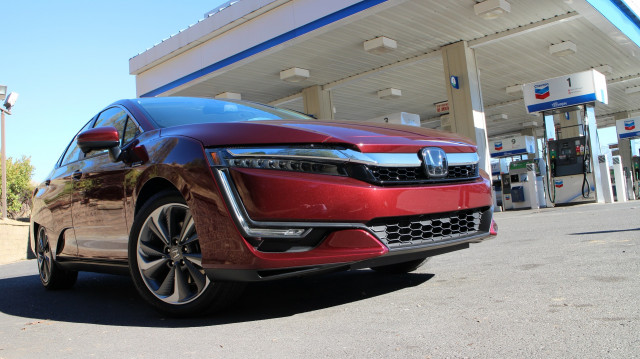
The machine you see here is the Honda Clarity.
Knowing the country’s infrastructure for hydrogen is anemic, and all-electric cars can induce severe bouts of range anxiety,
Honda expects the plug-in
hybrid version of the Clarity to be king of its three-person family, selling the bulk of its 75,000 unit forecast over the next four years.
The Clarity Plug-In Hybrid utilizes Honda’s two-motor hybrid technology, consisting of a 1.5-liter DOHC Atkinson-cycle inline-four gasoline powered engine coupled to a starter/generator
motor. This
engine is paired with a 181-horsepower AC synchronous traction motor and a 17-kilowatt hour (kWh) lithium-ion battery pack. Total system output is in the neighborhood of 212 horsepower.
Around the hills of California’s Napa Valley, we found the Clarity Plug-In
Hybrid relied heavily on its electric
motor, using its gasoline
engine to occasionally provide extra power or to generate electricity. According to Honda, the car can travel 47 miles on the battery alone without consuming a drop of premium unleaded.
The Clarity Plug-In is designed to operate in one of three driving modes, depending on the driving situation. Switching between them requires no intervention or decision-making from the driver, with the car moving seamlessly from one mode to another based on the demands of my right foot.
In EV Drive mode, the Clarity operates like an all-electric vehicle – the
engine is off and is decoupled from the drivetrain to reduce friction. Motive power comes from the 181-horsepower
traction motor, which draws electricity from the lithium-ion battery pack. We covered about 20 miles in this mode, mostly on flat and smooth California roadway.
The second mode, Hybrid Drive, allows the Clarity to function as a series hybrid. Like EV Drive mode, motive power comes from the electric
traction motor. The gasoline engine is now coupled to the drivetrain and it, along with a generator motor, produce electricity which is sent directly to the traction motor or stored in the battery pack, depending on the driving situation and the battery’s state of charge.
Engine Drive mode is typically engaged when cruising at medium to high speeds. Here, the Clarity functions as a parallel
hybrid. A lock-up clutch connects the
engine (always linked to the generator motor) and the traction motor to send power directly from the engine to the front wheels, bypassing the battery altogether when the driver calls for maximum power from the engine room, such as when we pointed the Clarity along Napa’s twisty Sage Valley Road.
“Hustle” and “hybrid” are rarely spoken in the same sentence but Honda engineers went through great pains to ensure the Clarity doesn’t roll over and play dead when presented with a few corners. Its aluminum rear subframe houses a five-link suspension which, in conjunction with a low slung
battery pack mounted under the cabin floor, give the Clarity an acceptable handling profile. It is certainly no MX-5 – nor is it even an Accord – but it is more than adequate for the intended demographic who likely will not be taking the Clarity to an autocross or along the Tail of the Dragon. Rather, its solid feel is meant to impart an atmosphere of a premium-market car.
Part of this verve can be attributed to the
gearheads Honda tapped to join the Clarity team. At dinner, I spoke at length with one of the engineers from Japan. An affable and knowledgeable man, he excitedly told me about the enjoyment he gets from wrenching on his beloved
HondaBeat with his young son. Clearly, these people are car nuts … and the Clarity is better off for it.
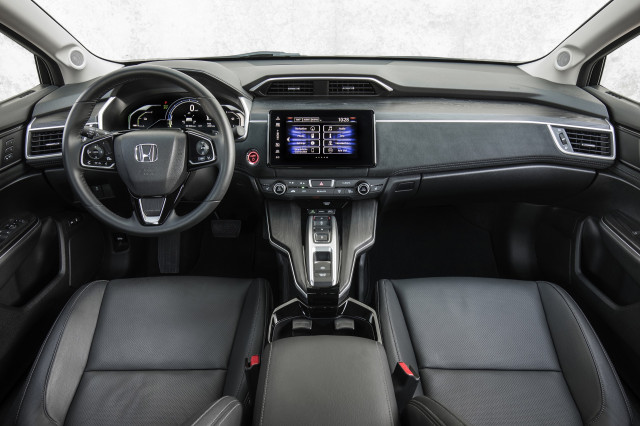
Inside, customers will not find any spaceship-inspired designs or weirdo switchgear (*ahem Prius ahem*). This is on purpose, as the
design team was intent on making the Clarity feel like a normal car. It’s tough enough to get some customers to consider an alternative fuel car, I was told; acclimating to an interior taken straight from the starship Enterprise only makes that task even tougher.
The sole interior feature that will raise eyebrows is a strange “porthole” in the rear parcel shelf, providing an unmitigated view into the trunk. Why? Well, since the Clarity body-in-white is intended to accept three different forms of propulsion (plug-in hybrid, all-electric
battery, & hydrogen), it had to be designed so the fuel sources for each mode of power would fit. Hydrogen takes up a lot of space, explaining the tall trunk lid and slightly abbreviated rear window.
Here’s where
Honda designers ran into a problem. In accommodating a hydrogen fuel cell, the trunklid design was so tall it effectively scuppered rearward visibility, hiding all the tractor trailersand constabulary on your six. To solve this, the team installed a window with a defroster grid on the billboard-high vertical portion of the trunklid (as seen on the Prius) and paired it with a pane of glass on the parcel shelf behind the rear
seats so a driver can see objects directly astern. It is an ingenious solution to a problem that never should have existed in the first place.
Odd
windows notwithstanding, the rest of the interior is standard
Honda fare, with a reconfigurable digital screen dead ahead of the driver displaying a speedometer, flanked by gauges measuring battery and fuel levels. There is plenty of space for front seat passengers and sufficient leg room in the rear passenger compartment for this 6’6” author. Those of non-NBA height will not have a problem.
Sadly, the Clarity infotainment
system is of the
old Honda variety, the one with a capacitive-touch slider for radio volume that everyone hated. Yes, Virginia, there is a physical volume up/down
button on the steering wheel but that only placates the driver and is utterly useless for the front seat passenger. Hopefully, Honda will make a running change and fit the excellent unit found in the 2018 Honda Accord.
Standing in a sunny parking lot, Kiyoshi Shimizu, Development Leader of the
Clarity Series, patiently listened to my questions and explained – through a translator – why they made certain design decisions, such as including an air ionizer in the fuel cell car. Shimizu-san explained they are trying to make a car that’s good for the environment
and good for humans. There’s that multi-pronged approach again.
Honda is predicting previous and current PHEV owners trading out of a Volt or Prius Prime will make up the bulk of Clarity ownership. They also think the car will snag a few
Fusion Energi and Optima PHEV owners in its net as well. What they
don’t want to happen is a potential Accord customer flipping to a Clarity, given that both cars are roughly the same size and whose MSRPs overlap at the upper end of the Accord scale. When I suggested this flip, the Honda exec to whom I was speaking visibly twitched like a freshly caught codfish.
From wherever the customers appear, they will have a choice of two Clarity Plug-In
Hybrids. The standard car is priced at $33,400, while the Touring trim shows a sticker of $36,600. Both models come equipped with the Honda Sensing suite of
safety nannies, along with Apple CarPlay and Android Auto. The high-zoot trim adds navigation, leather seats and steering wheel, power front
seats, and suede material on the dash. Smart customers should save their pennies and get the standard model.
The Clarity will certainly face competition from the Chevrolet Volt, priced at $34,095. The larger and more comparably-sized Fusion Energi SE starts at $31,305 but the
Ford makes less power from its drivetrain and comparable safety equipment requires a $1320 Driver Assist Package and a $1190 Active Braking
System. Ford does, however, have nearly $7000 on the hood of leased 2018 Fusion Energi sedans right now. It pays to shop around.
With a three-car lineup, I think the Clarity family will take its place Honda in the same manner that the
Prius name has tuned into a de facto sub-brand at
Toyota. To use a hockey analogy, the Clarity is the team’s star captain acting as the face of Honda’s environmental efforts while the rest of the line does the grunt work and pays the bills.
Honda’s near-term growth is hybrids, said Jim Burrell, Assistant VP of Connected and Environmental Business Development. In conversation, he mentioned hybrid powertrains in cars and light trucks, with the latter term hinting a hybrid CR-V is on the way.
Long term, though, Honda is still betting big on fuel cell vehicles. It was emphasized that no single tech (hydrogen, electric, or
hybrid) is enough to solve the CO2 problem, an explanation helping to that’s why they’re justifying plowing ahead with hydrogen. A true three-pronged approach, then.
The Clarity Plug-In Hybrid is manufactured in Honda’s Saitama factory in the Sayama prefecture, Japan. It is on sale now in all 50 states.


![2018 Honda Clarity Plug-In Hybrid [photo: owner 'Viking79']](https://images.hgmsites.net/med/2018-honda-clarity-plug-in-hybrid-photo-owner-viking79_100637732_m.jpg "2018 Honda Clarity Plug-In Hybrid [photo: owner 'Viking79']")


 Posts
Posts


