Showing posts with label London. Show all posts

Friday, December 15, 2017

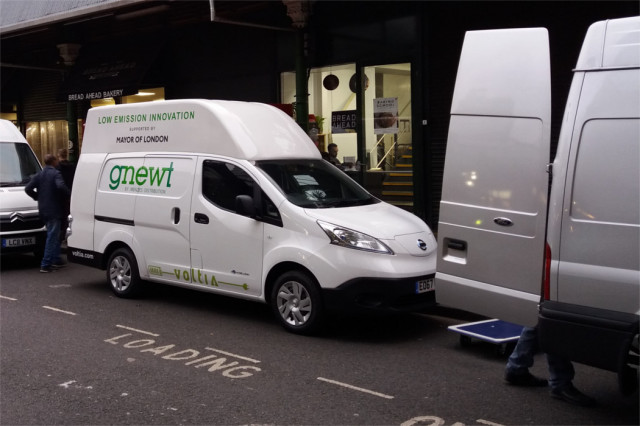
Voltia conversion expands Nissan e-NV200 electric delivery van for London

Nissan-Voltia eNV200 MAXI operated by Gnewt Cargo


As the United Kingdom joins other countries in committing to a future ban on fossil-fuel vehicles, commercial fleet operators that rely on diesel vehicles are left in a bit of a pickle.
Nissan has an answer in its zero-emission eNV200 electric cargo van, but its small dimensions leave a lot to be desired for commercial operators that need something a little, errrm, bigger.

Thankfully, a European company specializing in electric van fleet implementations is doing what Nissan hasn't: adding more van to the van.
Voltia is now offering upsized versions of the eNV200 that expand the base van's cargo capacity from 140 cubic feet (4 cubic meters) to up to approximately 280 cubic feet (8 cubic meters).
It's called the Nissan-Voltia eNV200 MAXI and it offers operators up to 87 miles (140 kilometers) of range on a single charge (on the European test cycle), using the same running gear as the stock eNV200.
The conversion, which is similar to other van "upfitter" solutions, adds a higher roof and extends the length of the eNV200 to increase its cargo volume.


Voltia will sell you a complete van for 31,900 EUR ($37,600), which includes the the cost of the e-NV200 base vehicle and retains the full Nissan factory warranty.
Voltia's partner and client, Gnewt Cargo, plans to lease 33 electric vans, with partial funding provided by the UK Department of Transport and the Office for Low Emission Vehicles.

The total lease cost will be GBP 1.65 million ($2.2 million), of which the government will pay GBP 1.11 million ($1.48 million) to Gnewt. The vehicles will be used for "last-mile logistics."
Voltia is currently taking preorders on an updated version of the van that uses the e-NV200's forthcoming 40-kilowatt-hour battery pack, the same one found in the new 2018 Nissan Leaf.

Saturday, April 29, 2017

EV Fast Charging Companies Get Green Light From London

Fastned is well on its way to becoming one of the largest electric car charging networks in Europe. Last week, it announced it was working with German authorities to construct a fast charging network in that country. Now, Fastned says it has signed a memorandum of understanding with Transport For London to do the same in the Greater London area.
Michiel Langezaal, CEO of Fastned, told the press last week, “We are witnessing the start of the Autowende from fossil to electric. This is accompanied by the start of a transition from petrol stations to fast charging stations where electric cars can charge super fast and continue their journey. Fastned is building a pan-European network of fast charging stations that will provide freedom to drivers of electric cars to travel across Europe. As charging speeds increase, charging will become like refueling your car, and fast charging stations will be the petrol stations of the future.”
Transport for London has established a goal of 300 fast charging stations in the Greater London area by the year 2020 in order to meet the City’s plans to significantly reduce air pollution by expanding the number of electric vehicles on its roads and highways. Having a fast charging network in place is deemed critical to meeting that goal.
Fastned was selected after an extensive competitive bidding process, along with a few other companies. “The other charging companies are Bluepoint London, the Centrica Consortium, Chargemaster and Electricity Supply Board (ESB),” Roy Hales notes. “London’s first 75 charging points should be operational by the end of the year. By 2020, there could be 300. “
Fastned’s Lengezaal says, “We are very happy that TfL is making locations available for charging infrastructure through a public tender procedure. This enables Fastned to build the infrastructure required to give freedom to electric vehicle drivers and allows Fastned to live up to its mission to accelerate the advent of the electric car.”
Transport for London (TfL) will enter into concession agreements with Fastned to permit construction of the fast charging stations starting in a few months. In total, TfL has an £18 million fund for upgrading the city’s power supply and to build rapid charge points.
London is doing much more than this, though — on January 1, 2018, all new taxis coming into the city will have to be capable of zero-emissions driving, as any vehicle with a plug is. Roy Hales adds: “TfL and the Office for Low Emission Vehicles are offering taxi drivers up to £7,500 towards their purchase of  a new zero emission capable black cab.” Those electric taxis, unsurprisingly, will need some places to charge — and to charge fast. Hence the complementary EV charging scheme.

Sunday, July 19, 2015

London Getting 50 More Electric Buses, Bringing Total To 51

electric-buses-double-decker-London
In China, some cities have ordered thousands of electric buses. Unfortunately, most cities around the world haven’t even tested out one yet. But the ones that have been piloting them have generally found out that they work well and can cut air and noise pollution while costing the same as a diesel bus on a lifetime basis.
London has run a pilot project with a BYD electric bus, and things turned out well enough that it just decided to order 50 more. The 50 electric buses will be the only buses running on two Transport for London (TfL) lines — the 507 and 521. Unfortunately, for whatever reason, the buses won’t start running until fall of 2016.
Go Ahead won the contract and will decide in the end which electric buses to use (top contenders are certainly BYD and Proterra).
Of course, this is just the beginning. “By 2020 all 300 single deck buses operating in central London will be zero emission (either electric or hydrogen) and all 3,000 double deck buses will be hybrid,” TfL writes.
“Today’s announcement follows the introduction of the first of two new electric buses, manufactured by Spanish company Irizar, into passenger service earlier this week. At a Global Clean Bus Summit hosted by City Hall in June, Mayor of London Boris Johnson also announced a world-first trial of a purpose built pure electric double deck bus that will begin in October.” So I guess Irizar is a contender, too.
“The Ultra Low Emission Zone that will be introduced in 2020 is the most ambitious measure of its kind taken to tackle air pollution anywhere in the world, and it will transform our bus fleet into a cleaner, greener and more pleasant way of travelling for Londoners,” Deputy Mayor of London for Environment and Energy, Matthew Pencharz, said.
Kudos to London.

Tuesday, May 26, 2015

Ford makes GoDrive car-sharing available to public in London

Ford Motor Company will begin making its London-based GoDrive car-sharing service available to the public. (Earlier post.) The service offers flexible, practical and affordable access to a fleet of cars for one-way journeys with easy parking throughout the city.
The project started as one of more than 25 experiments that form Ford Smart Mobility, Ford’s plan to use technology and innovation to take the company to the next level in connectivity, mobility, autonomous vehicles, the customer experience and big data. The pilot was called City Driving On-Demand. The application being introduced to the public is called GoDrive.
With the global car-sharing industry expected to exceed US$6 billion (£3.8 billion) by 2020, Ford is introducing GoDrive to target on-demand use and gain insight on emerging mobility trends and customers’ car-sharing habits. Ford is exploring the opportunity for car‑sharing services, working with Londoners to better understand their mobility needs and travel and parking patterns.
Intended to complement existing transport systems for integrated journeys, GoDrive is the only car-sharing service offering one-way trips with guaranteed parking. A pay-as-you-go approach, with pay-by-minute pricing covers congestion fees, insurance and fuel. Drivers use a smartphone app to easily reserve and access a car. Half of the fleet consists of Focus Electric vehicles.
The pilot experiment launched with 100 registered members accessing zero‑emission Focus Electric or fuel-efficient, low-emission Fiesta 1.0-liter EcoBoost models from secure parking hubs near major public transport locations, such as Waterloo and Victoria railway stations. Ford now is inviting 2,000 people to register for a free expanded service offering 50 cars across 20 locations. Ford is offering free membership and a £20 free driving credit to new members who sign up to theGoDrive program.
GoDrive also is notable for its continued evaluation and improvement through structured learning. Features regularly are added to the service based on learnings and customer feedback.
It is estimated that in the UK alone the car-sharing sector will grow by 23% from 2013 to 2025. A recent Ford-commissioned survey of 5,500 commuters in major European cities found that a majority of people consider their journey to work more stressful than their actual jobs, and 80% of Londoners said they are late for work once a month or more due to hold-ups.
Our research tells us that car clubs currently are perceived as inflexible when it comes to booking, time slots and return locations. Features such as one-way journeys and pay-as-you-go extend the number of opportunities that drivers would want to car-share and could prove a game-changer. More drivers are finding GoDrive to be a key service that can potentially empower people living in the city with its flexible approach.
—Alicia Agius, project lead, GoDrive, Ford of Europe
Since its launch earlier this year, feedback on the experiment has been largely positive, with the majority of initial users expressing optimism for the future of Ford in the growing car‑sharing space. Users have cited access to technologies found in Ford’s current model line‑up, such as Ford SYNC and parking assistance features, as a selling point of the project.
Members also highlighted the convenience of a one-charge, pay-as-you-go system that includes the London Congestion Charge, currently £11.50 (US$17.73). Drivers can familiarize themselves with the car during a five-minute grace period free of charge. Running costs are displayed via their app.


With the experiment currently in its beta phase, Ford hopes to build on the initial success and gain further insight into user behavior that will help refine the customer experience. Different weekend and day-hire pricing options, and further on- and off-street parking options will be investigated.
Ford also is exploring car-sharing experiments in Germany, India, and the US that will help the company determine how to best serve global customers as they face new mobility options in the future. Other Ford car-sharing experiments include:
  • Ford Carsharing, Germany. The first manufacturer-backed, nationwide car-sharing program incorporating dealerships, has run for two years and recently expanded to 40 dealers in 67 cities with 135 locations. In partnership with large, multi-partner car-sharing company Flinkster, the service allows Ford Carsharing customers to use about 3,600 Flinkster vehicles, and Flinkster’s 270,000 customers to use the Ford fleet. Starting in 2015, customers can access a vehicle with a smartphone app, rather than a customer card.
  • Share-Car, Bangalore, India. Ford is working with Zoomcar to test a sharing concept that would allow small groups, such as co-workers, apartment dwellers and families, to share a vehicle among multiple drivers. The approach helps consumers who can’t afford a car but want the benefits of owning one. The pilot program is expected to expand to two more communities later this year.
  • Car Swap, Dearborn, US. An experiment using Ford-owned fleet vehicles. Participating Ford employees use a mobile app that allows them to search for a vehicle that meets their needs and negotiate terms of the swap. The experiment will provide an in-depth understanding of how Ford can help make car swapping easier.
  • Dynamic Shuttle, New York and London. Exploring a shareable service that will offer point-to-point pick-up and drop-off on-demand. The experiment aims to better understand the social dynamics and routing requirements of shared transportation for city dwellers.
Saturday, January 4, 2014

SkyCycle Highway Would Add Bike Paths Over London’s Railways

skycycle

London has existed for more than two-thousand years as a major metropolis, but it’s only been the past century that the city’s ancient roads were given over to automobiles. While that’s unlikely to change anytime soon, the SkyCycle bicycle highway proposal would see bike-only lanes built over London’s extensive rail network.
Designed and proposed by architect Sir Norman Foster, and borrowing its name from a similar design unveiled last fall by designer Sam Martin, the SkyCycle would be a dedicated, car-free bicycle highway built on top of the metropolis’s many railways. As high as three-stories in places, the ten routes would encompass some 135 miles of bike-only roadways, a response to a drastic increase in cyclist deaths in a city where more and more commuters prefer pedal power over petrol.
In November, six London cyclists were killed in just 13 days, prompting renewed calls for a rush-hour ban on heavy trucks, a time when bicyclists make up to 25% of all of London’s commuters. London saw 14 cyclists deaths in total in 2013, which is unfortunately about average in relation to historical data, even though cycling use is on the rise. The SkyCycle proposal would give cyclists their very own paths to traverse however, freeing up the roads once again for both foot and automobile traffic. During my visit to London a few years ago, I was very nearly hit by cyclists on two separate occasions, my only warning being a brusqe “Oy oy oy!” seconds before an almost-collision.
Of course, adding 135 miles of bike lanes atop London’s rail network is neither a cheap nor quick solution, with the project taking an estimated 20 years and $329 million to complete. When finished though, up to 400,000 commuters could use the SkyCycle on an average day, seriously easing the congestion that plagues London’s streets while also reducing the travel times cyclists face.
While not exactly a unique idea, it’s one that seems to be gathering wider support as commuters grow tired of constant congestion and the high costs that come with travel by car. Bicycle ridership is up across the board, and after seeing the success of Amsterdam’s dedicated bicycle highways, these proposals are finally gaining the serious consideration they deserve.


Source: Dezeen