Showing posts with label 2016 Toyota Mirai. Show all posts

Wednesday, December 27, 2017

ANNOUNCEMENT: EVERY TOYOTA WILL BE ELECTRIFIED AFTER 2025

Toyota RAV4 Electric Car
Volvo has committed to offering an electrified version of every car in its lineup from 2019 onTesla is 100% electric, anyway, showing even more commitment to the coming electric future. And, if there was any doubt left in your mind that it is going to be electric- not CNG, not ethanol, not hydrogen fuel cells, and not even hybrid- that is going to win this war, consider this: Toyota will offer an electric version of every model it sells from 2025.
That’s right. A mere three years after giving up on battery electric vehicles to focus its attention on hybrids and hydrogen, Toyota seems to have done an about-face. USA Today is reporting that “Toyota could become Tesla’s next big headache” after a December 18th announcement from the Japanese automaker that it has plans to offer “an electrified option” for every one of its Toyota and Lexus models.
Sure, the fine print actually reads that “electrified options include all-electric, plug-in hybrid, fuel cell, or hybrid,” but this is from a company that, in 2015, had a head of R&D who said stuff like, “The cruising distance is so short for EVs, and the charging time is so long. At the current level of technology, somebody needs to invent a Nobel Prize-winning type battery.”
That was then, it seems. As for now, it looks like Toyota wants to be a little more “Tesla competitive” in the coming years. At least when it comes to PR, anyway.
What do you guys think? Is the company that spent twenty years leading the hybrid cause to the mainstream finally ready to get behind electric cars, or is this just a shameless grab for attention in a world that has already decided it’s not going to buy into Toyota’s proposed hydrogen future? Let us know what you think in the comments section at the bottom of the page.


Source | Images
: Toyota, via USA Today and Inside EVs.

Thursday, December 21, 2017

Toyota to Electrify All Its Vehicles by 2025, Introduce 10 EVs by Early 2020s


GM has said it will have 20 EVs by 2023, others are also making big claims, and now formerly reluctant Toyota says it will be in the thick of it too.
Yesterday from Japan, Toyota announced its future plans for the all-electric market. The company will accelerate its development of battery-electric vehicles, culminating with “more than 10” BEV models being available worldwide by the early 2020s. The wave will start in China before expanding to other markets with a gradual introduction in Japan, India, the United States, and Europe.
Remarkably, for all its work and success in the hybrid and plug-in hybrid segments, the company currently does not offer a single EV here in America. The short-lived RAV4 EV came and went like a summer’s breeze, the second generation of which was developed in conjunction with Tesla.
The relationship between Toyota and Tesla officially ended in August 2014 with Tesla’s fulfilment of the battery supply agreement. Based on this cooperation, it wouldn’t be a surprise to see the Japanese manufacturer work with an experienced EV company again to help acheive their new goals.
Toyota’s electrified vehicle strategy centers on a significant acceleration in the development and launch plans of hybrid electric vehicles (HEVs), plug-in hybrid electric vehicles (PHEVs), batteryelectric vehicles (BEVs), and fuel cell electric vehicles (FCEVs).
Also of note, the company stated that every model in the Toyota and Lexus line-up around the world will be available either as a dedicated electrified model or have an electrified option by 2025. This is huge news, given the depth and breadth of Toyota’s passenger car and light-truck offerings around the globe.
Toyota has long advocated that all-electric cars would remain on the fringe due to their relatively low range. This announcement changes that tune and signals a shift in the thinking of management. To help solve the puzzle of EV range, Toyota and Panasonic will start a feasibility study on a joint automotive prismatic battery business.
Their shared goal is to achieve the best automotive prismatic battery in the industry, ultimately contributing to the popularization of electrified vehicles … and no doubt justifying the expense of developing these machines.
The announcement went on to say that by the year 2030, Toyota aims to have sales of more than 5.5 million electrified vehicles, including more than 1 million zero-emission vehicles.
Extensive experience in battery and electric motor development – through hybrids, natch – will give the company a head start on this project. Currently, Toyota is careful to slip the word electric into everything in its Prius line, from the compact Prius c billed as a hybrid-electric to the PriusPrime as a plug-in hybrid electric. The startling Mirai is hyped as a fuel-cell electric vehicle.
Thanks to these machines, and their forebears, Toyota sales of electrified vehicles have reached more than 11 million units worldwide to date.

Thursday, November 30, 2017

Toyota to build megawatt electric and hydrogen plant fueled by California bio-waste

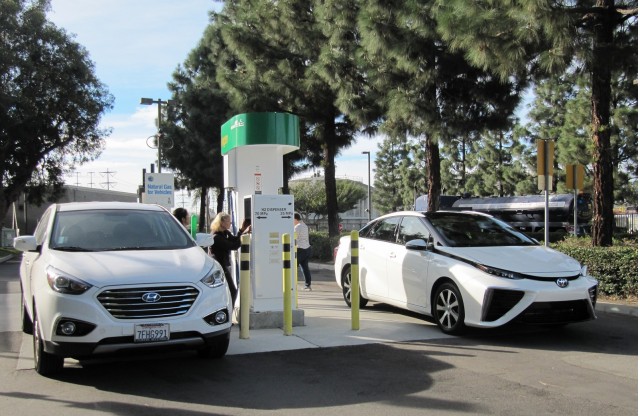
2015 Hyundai Tucson Fuel Cell, 2016 Toyota Mirai at hydrogen fueling station, Fountain Valley, CA


Toyota today is the world's most ardent proponent of using hydrogen fuel cells for zero-emission vehicles rather than large battery packs.
The huge Japanese carmaker, one of the world's four largest, now sells its Toyota Mirai fuel-cell sedan around the world, and has more hydrogen-powered vehicles in development.

As it has discussed over the last year, some of those may be heavy trucks as well as passenger cars.

Any fuel-cell vehicle, of whatever size, requires a hydrogen fueling infrastructure to operate, however, and the carmaker has had to work consistently to help authorities and private companies deliver that infrastructure in California.
Toyota announced on Thursday that it would build a renewable energy and hydrogen generation plant at California's Port of Long Beach that uses bio-waste from California's huge agricultural industry to produce water, electricity, and hydrogen fuel.
It will be, the company says, the first such site in the world to operate at a scale of 1 megawatt.
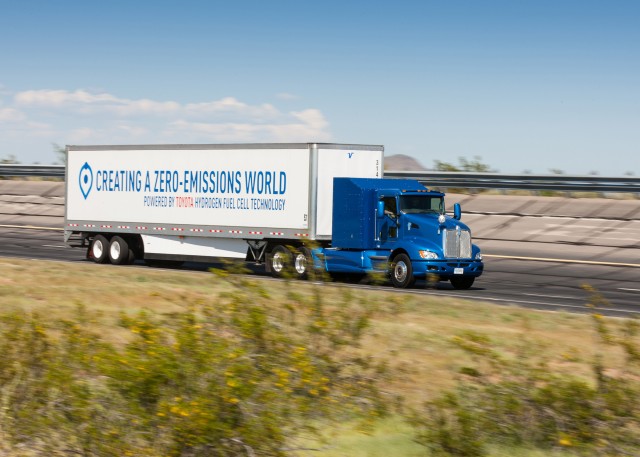
Toyota 'Project Portal' proof-of-concept hydrogen fuel-cell powered semi tractor, for Port of LA


When it is fully operational, the so-called Tri-Gen plant will generate more than 2 megawatts of electricity and 1.2 tons of hydrogen fuel a day.
That amount of electricity will power 2,350 average homes, and that quantity of hydrogen fuel will cover the daily drives of almost 1,500 hydrogen vehicles, which hold roughly 5 kg of fuel compressed to 10,000 psi.
The electricity will supply operations by Toyota Logistics Services at the Port, which will become the first Toyota facility in North America running entirely on renewable energy.

“For more than 20 years, Toyota has been leading the development of fuel cell technology," said Doug Murtha, the company's group vice president for strategic planning, "because we understand the tremendous potential to reduce emissions and improve society."
Among the vehicles to be fueled at the site will be the Toyota "Project Portal" heavy-duty Class 8 hydrogen truck to be tested in port operations.
All Toyota Mirai sedans will also be fueled at the station once they're unloaded from the ships that have brought them to North America from the car's single assembly plant in Japan.
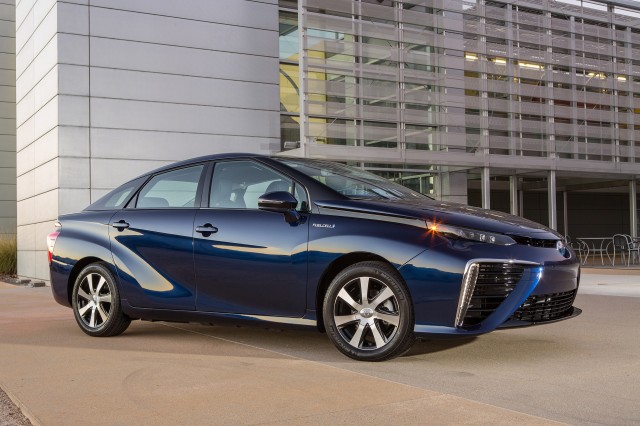
2017 Toyota Mirai
2017 Toyota Mirai


California's ports have long sought to reduce emissions from thousands of idling diesel tractors and specialized yard trucks; a zero-emission hydrogen truck would contribute to that effort.
They have numerous projects underway to test fully electric, plug-in hybrid, and other fully or partially zero-emission vehicles to reduce or eliminate exhaust from the vehicles operating within the ports and hauling freight to and from them.
The new Tri-Gen plant has been developed by FuelCell Energy. Among entities that have supported it development are the U.S. Department of Energy, the California Air Resources Board, South Coast Air Quality Management District, Orange County Sanitation District, and the University of California at Irvine, where researchers developed some of the core technologies used at the site.

To date, Toyota has delivered roughly 2,400 Mirai fuel-cell sedans in the U.S. It is one of two hydrogen-powered vehicles on sale in the U.S., the other being the Honda Clarity Fuel Cell sedan.
California now has 31 fully operative retail hydrogen fueling stations, with more planned to bring the total to 100 by 2020.
Thus far, about 3,000 fuel-cell vehicles in total are operating on U.S. roads, all delivered within carefully defined areas of California where hydrogen fueling stations are near buyers' homes and workplaces.

Wednesday, July 26, 2017

Toyota Plans Long Range, Fast Charging Electric Car By 2022

Toyota is not giving up on the hydrogen fuel cell technology that powers the Mirai, but is busy working in the background on an all electric car with solid state batteries that offer long range and fast recharging. The plan is to introduce the car, which will be built on an all new chassis, to the Japanese market in 2022. Toyota spokesperson Kayo Doi tells Japanese daily news source Chunichi Shimbun the company will not comment on specific product plans but does intend to commercialize solid state batteries by the early 2020s.

Solid State Batteries Are The Future

No one doubts that solid state batteries are the future. Replacing the liquid electrolyte found in today’s lithium ion batteries will eliminate the risk of fire and explosion associated with current battery technology. That danger, while low, remains a concern for many people considering the purchase of an electric car.
To limit such risks, electric cars today must use sophisticated cooling systems to stabilize the temperature inside battery packs. Such systems add cost, weight, and bulk to the cars. Solid state batteries will not need such elaborate cooling systems, which will help bring down the cost of building an electric car. As an added bonus, they are capable of being recharged in much less time than a conventional lithium ion battery.
Researchers such as John Goodenough have been trying to build a robust, inexpensive solid state battery for decades. Toyota saying it will do so is one thing. Actually doing it is quite another. Israeli startup StoreDot says it has a solid state battery with a range of 300 miles that recharges in 5 minutes. Henrik Fisker claims his new EMotion electric car will go more than 400 miles on a single charge and then recharge in just 9 minutes. That car is set to hit the road in 2019.

New Electric Car Division At Toyota

Toyota created a new partnership last year that combines talent from Toyota Industries Corporation, Aisin Seiki Company, Denso Corporation, and Toyota Motor Company to design an electric car. The slimmed down unit began life with only 4 people — one from each corporatation — in order to trim bureaucratic “noise” and produce quick results.
Toyota CEO Akio Toyoda said at the time, “Over these past few years, which we have positioned for strengthening our planting of seeds for the future, we have taken such measures as establishing the Toyota Research Institute, made Daihatsu a fully owned subsidiary, and have begun work to established an internal company responsible for compact vehicles for emerging markets. The new organizational structure for EVs is a part of this effort. As a venture company that will specialize in its field and embrace speed in its approach to work, it is my hope that it will serve as a pulling force for innovation in the work practices of Toyota and the Toyota Group.”

China Wags The Dog

Stirring words. Now to see how they translate into reality. Toyota, like all major car makers, is focused on the booming automobile market in China. It plans to introduce an electrified version of its C-HR sport utility vehicle using conventional lithium ion batteries there in 2019, spurred in part by the insistence of the Chinese government that at least 10% of the new cars sold in the country be EVs by that date. It also brought its highly imaginative Concept-i to the 2017 CES show in Las Vegas last January.
Toyota’s goal of building electric cars by 2022 is laudable, but a lot of water will have gone under the bridge by that time and the rest of the world’s automakers will not be sitting on their hands in the meantime. It would not be smart to count Toyota out, but their horse for the EV sweepstakes is more than a little late leaving the barn.
Source: Reuters

Wednesday, November 30, 2016

Toyota Discovers Way To Increase Battery Capacity By 15%

rav4-ev
There is perhaps no mainstream automaker that has been more dismissive of electric vehicles than Toyota. So imagine my surprise when I read the Japanese automaker’s announcement that it had observed lithium-ion deviation in batteries, allowing for as much as a 15% increase in range and capacity of current battery technology. Is Toyota having second thoughts when it comes to hydrogen fuel-cell technology?
“The lithium-ion battery is a key technology for electrifying cars, and there is a clear need, going forward, for improving this technology and its performance even more,” said Toyota battery technology researcher Hisao Yamashige in the announcement. The so-called lithium ion deviation, which occurs in electrodes and the electrolyte as a result of charging/discharging, is believed to be responsible for both peak battery performance and eventual degradation, though researchers aren’t exactly sure why as the deviation was not possible to observe with standard scientific instruments.
Instead, Toyota turned to the SPring-8 synchrotron radiation facility which, according to Wikipedia, “…is used for materials analysis and biochemical protein characterization by many Japanese manufacturers and universities.” The facility also grants free use of their equipment, so long as the companies publish their results. I’m guessing Toyota saved quite a bit of money by sharing it with the public.
Toyota’s corporate line has been that electric vehicles are only good for short-range driving, and that hydrogen fuel-cells are a better option as a replacement for current car technology. Just last month, however, the automaker was rumored to be preparing a line of long-range electric vehicles for launch in 2020. Armed with this new information, Toyota could have a sizable advantage over other traditional automakers if it can offer 15% more driving range at a comparable price.
The flip side of this coin is that Toyota Mirai sales haven’t exactly been booming, hindered by a slow rollout of hydrogen fueling stations. Has Toyota seen the light? Or is the automaker merely keeping its options open?

Tuesday, August 30, 2016

When will hydrogen fuel be available everywhere in the U.S.? Poll results

2015 Hyundai Tucson Fuel Cell, 2016 Toyota Mirai at hydrogen fueling station, Fountain Valley, CA


While you might think that any zero-emission vehicle would be viewed as a good thing, hydrogen fuel-cell vehicles continue to generate opposition among some electric-car fans.
Perhaps viewing them as competition for long-range battery electric vehicles of the sort now planned by virtually every car maker, they produce huge volumes of comments every time we write about them.

Now we have some data to show how well the Twitter followers of Green Car Reports think they can do in the market.
We simply polled those followers about when they thought that hydrogen fuel for vehicles would be available throughout the U.S.
The rough analogy would be as available as gasoline is today, at more than 100,000 separate fueling station locations throughout the 50 states.
The results were revealing.
More than six out of 10 Twitter followers who responded to the poll said hydrogen will "never" be available throughout the U.S.
The remaining 38 percent of votes were split several ways, with the next most common group being "2030 or later," chosen by 20 percent of respondents.

The choice of "2025" got only 12 percent of the votes, and the nearest-term answer, 2020, garnered a measly 6 percent of supporters.
In other words, the readers who responded to the poll really, really don't believe that hydrogen-fueled vehicles will ever become ubiquitous.
Honda Clarity teaser image, April 2016


The difference in zero-emission vehicle powertrains, of course, is that electricity in some form is generally found within a short distance of almost everywhere that cars are parked.
The same can't be said for hydrogen, which must be dispensed at pressures up to 10,000 pounds per square inch from pumps on specialized sites that currently run as high as $2 million per location to build.

We look forward to comparing the results of this poll to our latest poll, running now, which asks the same question—with the same set of date choices—about DC fast-charging instrastructure for electric cars.

Sunday, August 28, 2016

Toyota will help high schoolers build and race fuel cell RC cars


Toyota is working with California high school students to put a real futuristic spin on the remote-control race car concept. The Japanese automaker is working with Horizon Educational Group on a competition that teaches high-school students how to build mini hydrogen fuel-cell electric vehicles, says Green Car Reports. And then race them.

The project is called the Hydrogen Horizon Automobile Challenge. Toyota started working with students from ten Los Angeles County high schools and ten Orange County high schools. The program is part of Horizon Educational Group's work producing teaching materials related to renewable-energy technologies such as wind and solar power as well as fuel cells. Meanwhile, Toyota's broader aim is to push high-school students into the so-called STEM fields (Science, Technology, Engineering, and Mathematics). You can never have enough young scientists for these automobile companies, can you? The first race among these students is scheduled for next March.

Toyota's expanding its community outreach efforts as it looks to boost exposure for its Mirai, which is the company's first mass-produced hydrogen fuel-cell vehicle and can go as far as 300 miles on a full tank. The automaker started selling the model at eight California dealerships last November, with lease rates starting at $499 a month. Through July, Toyota sold 270 Mirai vehicles in the US.

Reports also surfaced earlier this year that Toyota is planning to introduce a smaller, cheaper version of the Mirai in time for the 2020 Summer Olympics in Tokyo, with the price coming in at about $53,000, compared to the $65,000 price tag on the current Mirai in Japan. Not as small or as cheap as those little remote-controlled racers, of course.

Related Video:

X