Showing posts with label Hyundai Tucson Fuel Cell. Show all posts

Thursday, November 30, 2017

Toyota to build megawatt electric and hydrogen plant fueled by California bio-waste

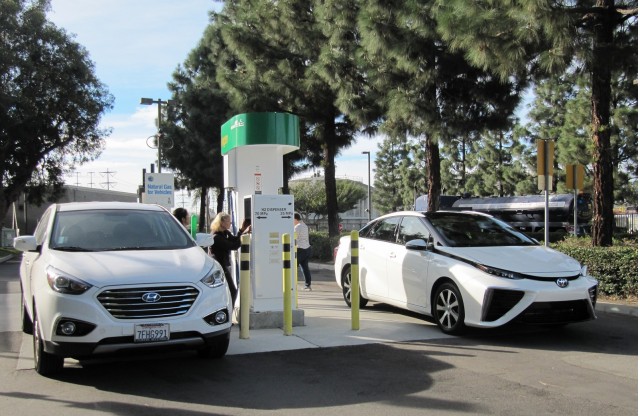
2015 Hyundai Tucson Fuel Cell, 2016 Toyota Mirai at hydrogen fueling station, Fountain Valley, CA


Toyota today is the world's most ardent proponent of using hydrogen fuel cells for zero-emission vehicles rather than large battery packs.
The huge Japanese carmaker, one of the world's four largest, now sells its Toyota Mirai fuel-cell sedan around the world, and has more hydrogen-powered vehicles in development.

As it has discussed over the last year, some of those may be heavy trucks as well as passenger cars.

Any fuel-cell vehicle, of whatever size, requires a hydrogen fueling infrastructure to operate, however, and the carmaker has had to work consistently to help authorities and private companies deliver that infrastructure in California.
Toyota announced on Thursday that it would build a renewable energy and hydrogen generation plant at California's Port of Long Beach that uses bio-waste from California's huge agricultural industry to produce water, electricity, and hydrogen fuel.
It will be, the company says, the first such site in the world to operate at a scale of 1 megawatt.
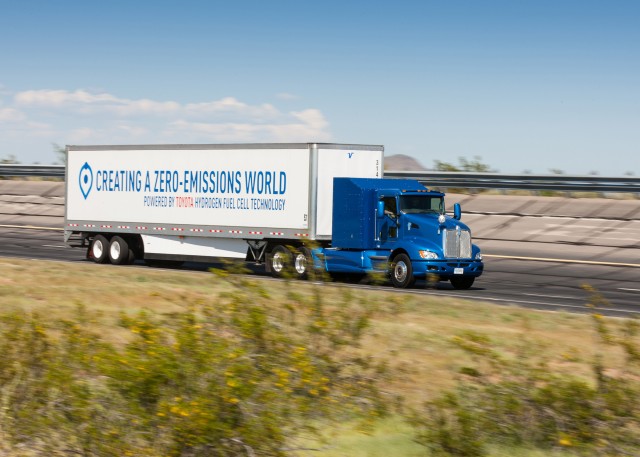
Toyota 'Project Portal' proof-of-concept hydrogen fuel-cell powered semi tractor, for Port of LA


When it is fully operational, the so-called Tri-Gen plant will generate more than 2 megawatts of electricity and 1.2 tons of hydrogen fuel a day.
That amount of electricity will power 2,350 average homes, and that quantity of hydrogen fuel will cover the daily drives of almost 1,500 hydrogen vehicles, which hold roughly 5 kg of fuel compressed to 10,000 psi.
The electricity will supply operations by Toyota Logistics Services at the Port, which will become the first Toyota facility in North America running entirely on renewable energy.

“For more than 20 years, Toyota has been leading the development of fuel cell technology," said Doug Murtha, the company's group vice president for strategic planning, "because we understand the tremendous potential to reduce emissions and improve society."
Among the vehicles to be fueled at the site will be the Toyota "Project Portal" heavy-duty Class 8 hydrogen truck to be tested in port operations.
All Toyota Mirai sedans will also be fueled at the station once they're unloaded from the ships that have brought them to North America from the car's single assembly plant in Japan.
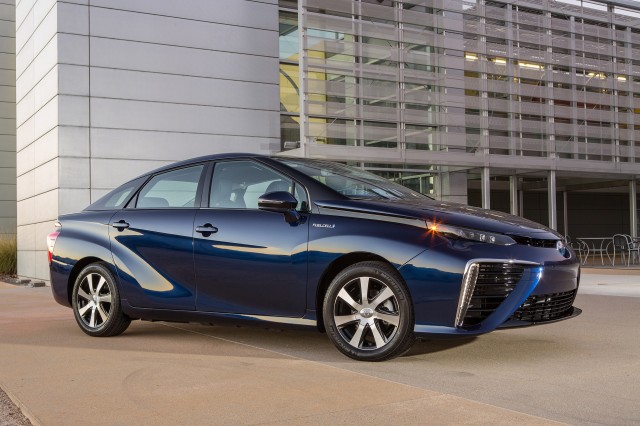
2017 Toyota Mirai
2017 Toyota Mirai


California's ports have long sought to reduce emissions from thousands of idling diesel tractors and specialized yard trucks; a zero-emission hydrogen truck would contribute to that effort.
They have numerous projects underway to test fully electric, plug-in hybrid, and other fully or partially zero-emission vehicles to reduce or eliminate exhaust from the vehicles operating within the ports and hauling freight to and from them.
The new Tri-Gen plant has been developed by FuelCell Energy. Among entities that have supported it development are the U.S. Department of Energy, the California Air Resources Board, South Coast Air Quality Management District, Orange County Sanitation District, and the University of California at Irvine, where researchers developed some of the core technologies used at the site.

To date, Toyota has delivered roughly 2,400 Mirai fuel-cell sedans in the U.S. It is one of two hydrogen-powered vehicles on sale in the U.S., the other being the Honda Clarity Fuel Cell sedan.
California now has 31 fully operative retail hydrogen fueling stations, with more planned to bring the total to 100 by 2020.
Thus far, about 3,000 fuel-cell vehicles in total are operating on U.S. roads, all delivered within carefully defined areas of California where hydrogen fueling stations are near buyers' homes and workplaces.

Monday, March 9, 2015

Hyundai Tucson PHEV Debuts In Geneva

hyundai-tucson-phev
It wasn’t that long ago that the Hyundai Tucson Fuel Cell vehicle debuted in Detroit with some fanfare, and the promise of free fuel. It seems that the Korean automaker is hedging its bets when it comes to hydrogen though, debuting the Hyundai Tucson 48V Hybrid Concept and an even more-efficient plug-in hybrid diesel, both riding on an all-new platform.
The Tucson 48V Hybrid Concept pairs a 2.0 liter turbodiesel engine making 134 horsepower with a 14 horsepower electric motor powered by a 48-volt lithium-ion battery pack. Total combined output of 148 ponies and 305 lb-ft of torque through a six-speed manual transmission, and the Hyundai contributes just 109 g/km CO2 to the atmosphere. Though just in hybrid form, Hyundai wants to bring this technology to its larger SUVs as a means to offset emissions at just a quarter of the price of full hybrid system might cost.
But the automaker didn’t stop there, as the Tucson PHEV concept not only offers more power, but a respectable electric driving range as well. A 1.7 liter turbodiesel making 113 horsepower is mated to a 67 horsepower electric motor for combined output of 180 horsepower and a substantial 350 lb-ft of torque. Electric driving range is estimated at 31 miles per charge of the 10.7 kWh lithium-ion battery, and CO2 emissions are estimated to a mere 48 g/km, less than half the 48V Concept. The electric motor can drive the rear axle, while the diesel engine powers the front wheels, offering a hybrid drivetrain not unlike the Kia Soul e-AWD concept that debuted earlier in the month. There’s also rumors of a dedicated EV coming as early as next year.
The new Hyundai Tucson comes with a host of other improvements, such as new engine, connectivity, and safety features. But the big news to me is that Hyundai is debuting an all-new Tucson, sans the hydrogen drivetrain they made such a big deal about less than a year ago. At the Detroit Auto Show, Hyundai showed off its first Sonata Plug-in Hybrid, but it barely mentioned its efforts with hydrogen. This could be another indication that the automaker may be moving away from hydrogen fuel cells or, at the very least, making sure it doen’t ignore a growing plug-in car market.

Friday, June 20, 2014

DOE Spending $20 Million For $4 A Gallon Hydrogen, But Why?


Hydrogen-fuel-station

The Department of Energy has announced a round of grants totaling $20 million with the goal of bringing hydrogen fuel costs down below $4 a gallon equivalent. That’s frankly a stupid idea, because consumers will end up paying the same (or more!) for hydrogen as they do for gasoline. So like, what is the incentive to “go green” if you can’t even pretend like it’s saving you money?
The first round of hydrogen fuel cell vehicles are just starting to roll out, with the Hyundai Tucson Fuel Cell leading the way. And if you thought EVs were expensive, wait until you get a load of fuel cell vehicles.  The Hyundai Tucson Fuel Cell leases for $599 a month, and the Toyota FCV will be somewhere in the $75,000 range when it goes on sale next year. While the Hyundai will come with free fuel (at least at first), Toyota hasn’t mentioned a similar scheme for its hydrogen vehicles.
While it’ll all depend on specific fuel economy, if hydrogen fuel goes mainstream, consumers will end up with the same monthly fueling costs as before. Meanwhile, drivers of pure electric vehicles can save, literally, hundreds of dollars every month by filling up on cheap electricity. The Nissan Leaf is rated at 73 miles, and costs between $2 and $4 to fully charge. Split the difference at $3, and you’re still cheaper than a gallon of gasoline.
You can also plug in at home with EVs, or even better, get your power from roof-mounted solar panels, essentially refilling your car for free. The difference is even more pronounced on a long range EV like the Tesla Model S, which if charge during off-peak hours, can be fully recharged for between $4 and $10. A comparable car would need between $60 and $80 of gasoline.
I know Obama is suddenly hot for hydrogen, but it’s a dead-end technology that doesn’t benefit the customers except for one way, and that’s faster refilling, and that gap is closing thanks to the Tesla Superchargers. Oh, the government is throwing cash at that experiment too. At best, hydrogen fuel cells maintain a cost status quo for consumers, and where it comes down to dollars and cents, EVs have a major advantage. Too bad the DOE can’t figure that out.


Source: Gas 2.