All three deals go beyond simple battery supplies. Toyota will work with the three battery suppliers on everything fromdeveloping new solid-state batteriesto building out systems to recycle the batteries they produce.
Toyota executives have said in the past that they don't believe lithium-ion batteries are the best solution for electric cars, and that they expect better chemistry to emerge to make electric cars more affordable, reliable, and safer.
With the electric-car market looking set to expand dramatically in the next few years, Toyota and other automakers that have stood on the sidelines are scrambling to ramp up their own supply chains to begin producing EVs.
Toyota announced in June that it is developing itsfirst dedicated electric-car platform, potentially for a mid-size SUV, in conjunction with Subaru.
Executive vice president Shegeki Terashi told reporters in Japan last month that the company expectshalf of its sales by 2025to come from hybrids, electric-cars, or plug-ins, according to aReutersreport. "There may be a gap between the amount of batteries we can produce, and the amount of batteries we may need,” he said at the time.
By now, regular readers of this column are well aware that we (along with most other writers who focus on electric vehicles) consider the threat of the “Tesla killer” to be no threat at all. Yes, Big Auto is producing excellent EVs, some of which are in Tesla’s league, but they’ll never build more than they have to, and they’ll continue steering customers to their gas-guzzling, high-margin models. It’s what they do.
*This article comes to us courtesy of EVANNEX (which also makes aftermarket Tesla accessories). Authored by Charles Morris. The opinions expressed in these articles are not necessarily our own at InsideEVs.
Above: A look at one of Tesla’s lithium-ion battery cells (Instagram: @yancki87)
Even if the legacy automakers were to have a green epiphany and go all in on electrification, there’s another reason that they’ll struggle to catch up to the California carmaker. Tesla’s superior, cheaper battery packs give it a huge competitive advantage (just don’t call it a “moat”).
The US Advanced Battery Consortium (USABC), an industry group led by GM, Ford and Chrysler, has been working since 2013 to accelerate the development of EV battery technology. However, as Andrew Thomas points out in a recent Medium article, “Tesla’s battery is cheaper, higher capacity, more reliable, and more available than anything produced by USABC.”
“Tesla still uses commodity cylindrical cells, whereas other car manufacturers still use prismatic (Chevy Bolt) and pouch (Nissan LEAF) cells,” Thomas writes. In fact, Tesla is no longer using off-the-shelf “laptop batteries” – it has worked with partner Panasonic to develop new cells optimized for its vehicles. However, it has stuck with the strategy of assembling large numbers of small cylindrical cells into a pack.
The Chevy Bolt’s 60 kWh battery pack has 288 cells. The Nissan LEAF’s pack has 192. Tesla’s packs require many more cells – a Model 3 with a 50 kWh battery pack has 2,976 cells, and a Model S or X with a 100 kWh pack requires a whopping 8,256. Obviously the smaller cells are cheaper, but it stands to reason that it must be more difficult, and hence costlier, to assemble them into a pack.
Therein lies a mystery – Tesla is widely believed to have the lowest battery cost in the industry. But how does it manage to assemble all those tiny cells into a pack economically? As far as Thomas has been able to tell, no one outside the company knows.
“I can’t find a picture or video of the robots that assemble the cells into packs,” Thomas writes. “These robots would need to wire bond the batteries to the bus bars. For every battery cell there will be 2 wire bonds (positive and negative). So it’s a lot of work. The robots need to be very fast, otherwise Tesla would need a lot of them to mass produce battery packs and it would drive up their costs.”
One clue might be found in a 2017 Wired article by a former employee, who reports that the Model S and X battery packs are assembled on a “secret” second floor at Tesla’s Fremont factory.
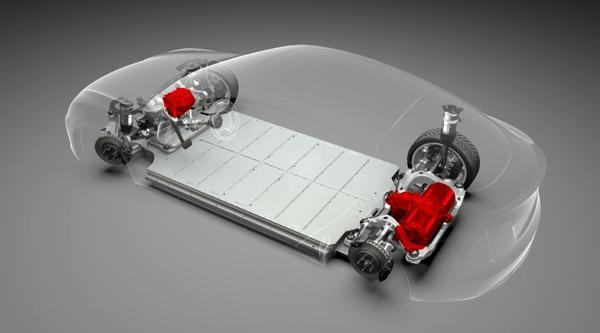
Above: A Tesla battery pack sits in the floorpan of the vehicle (Source: Tesla)
Another clue comes from something Elon Musk said on the Q3 2017 earnings call: “We are pushing robots to the limit in terms of the speed that they can operate at, and asking our suppliers to make robots go way faster, and they are shocked because nobody has ever asked them that question. It’s like if you can see the robot move, it’s too slow. We should be caring about air friction like things moving so fast. You should need a strobe light to see it.”
So where are these speed demons? “There are some pictures from the Gigafactory, where the Model 3 battery pack is manufactured, but none where I see a robot wire bonding the battery cells,” writes Thomas. “I don’t see any machines that are close to moving so fast you would need a strobe light to see.”
Could those robots be doing their dizzying dance somewhere on the secret second floor in Fremont? And possibly in Nevada as well? Recent visitors from the media have found that the section of the Gigafactory where the cells are made is under heavy security – no photos or videos allowed – and also appears to be one of the most highly automated sections of the plant.
However, Tesla is pulling it off, there’s little doubt that its batteries are cheaper, and Thomas believes things will stay that way. “Even if incumbents decided to use cylindrical cells, it will be challenging to engineer a manufacturing process that is economical, and not time consuming. Packaging cylindrical cells is a process Tesla has been refining for over 10 years.”
Tesla’s industry-leading battery cost also has implications beyond the auto industry. Elon Musk has said in the past that the company’s stationary storage business could someday be bigger than its vehicles. Enrique Dans writes in Forbes that “battery manufacturing is set to become one of the most important industries on the planet, and whoever dominates it will occupy a privileged place in many ways, supplying a wide variety of industries from vehicles to household goods, as well of course as electricity generation.”
“Twelve years ago, when he described his company’s ‘secret master plan,’ Elon Musk spoke not only about making cheaper electric cars, but included a third point, which was providing the means to generate zero-emissions electricity, a point that many pundits missed amid the hullaballoo over Tesla cars,” Dans continues. “Today, with the company in the black, it turns out that battery production has been the key to its strategy: the reason why auto industry veterans like Bob Lutz could not understand Tesla’s road map was because Tesla isn’t a car company, it’s a battery company.”
“Tesla isn’t a car manufacturer competing with other automobile manufacturers…Tesla’s vehicles are consumers of the company’s main product: batteries,” Dans concludes. “Rethink your models and your spreadsheets: stop seeing Tesla as a carmaker and start understanding that the company has much more ambitious plans for the future.”
Dan foresees the battery industry growing ever more important, and eventually overtaking an auto industry faced with shrinking demand for private cars. If such a future comes to pass, we all know the name of the company most likely to benefit. As Andrew Thomas puts it: “Big Auto is screwed.”
Rolls-Royce is launching a lithium-ion based energy storage system for ships. Rolls-Royce has been delivering energy storage systems since 2010, however the actual energy storage units were previously supplied by an external party.
Illustration of a ship system setup with batteries. This example shows a hybrid system for a tugboat. Source: Rolls Royce.
Energy storage is a major green investment for a ship owner. Returns are maximized when the system is correctly dimensioned for the specific ship, and includes intelligent power control.
Rolls-Royce now offers SAVe Energy, a cost-competitive, highly efficient and liquid-cooled battery system with a modular design that enables the product to scale according to energy and power requirements.
SAVe Energy complies with international legislations for low- and zero-emission propulsion systems.
The development work has been partly funded by the Norwegian Research Council of Norway’s ENERGIX program. The three ship owning companies Color Line, Norled and the Norwegian Coastal Administration Shipping Company have been partners in the development, ensuring that the energy storage system covers a wide variety of marine applications, including ferries, cruise vessels and multi-purpose vessels.
SAVe Energy is be delivered from the Rolls-Royce Power Electric site in Bergen, Norway, as part of the company’s offering of complete ship systems.
The electrification of ships is building momentum. From 2010 we have delivered battery systems representing about 15 MWh in total. However now the potential deployment of our patent pending SAVe Energy in 2019 alone is 10-18 MWh.
—Andreas Seth, Rolls-Royce, EVP Electrical, Automation and Control – Commercial Marine
SAVe Energy can be applied to several areas including peak shaving, spinning reserve and battery-powered vessels. Combined with an LNG- or diesel-powered engine in a hybrid solution, it will increase efficiency and reduce emissions, and can be coupled with most types of propulsion units.
In a hybrid set up, SAVe Energy handles the peak load, while the main power generators will relate to the average load and not reduce the propulsion units thrusting capabilities.
Battery systems have become a key component of our power and propulsions systems, and SAVe Energy is being introduced on many of the projects we are currently working on. This includes the upgrade programme for Hurtigruten’s cruise ferries, the advanced fishing vessel recently ordered by Prestfjord and the ongoing retrofits of offshore support vessels. As a system provider we can find the best solution considering both installation and operational cost.
—Andreas Seth
SAVe Energy is an ESU system (Energy Storage Unit), and was recently class-approved by DNV GL, confirming that SAVe Energy has been developed in compliance with the newest 2018 ruleset, and are accepted for installation on all vessels classed by DNV GL.
GeneralMotors and Honda have announced a partnership to develop new battery components for electrified vehicles.
The two automakers already have a proven relationship when it comes to electrification, having established the industry’s first manufacturing joint venture for an advanced hydrogen fuel cell system set to arrive around 2020. Now, GM and Honda will work together on new advanced chemistry battery components, including the cell and module, in hopes of accelerating both companies’ plans for all-electric vehicles.
In a statement released by both companies, the joint venture promises to deliver a next-generation battery that features higher energy density, smaller packaging, and faster charging capabilities for future products, mainly for the North American market.
The companies will collaborate based on GM’s next-generation battery system, with the intent for Honda to source the battery modules from GM. The goal is to combine scale and global manufacturing efficiencies from both companies to provide greater value for consumers.
“This new, multi-year agreement with Honda further demonstrates General Motors’ capability to innovate toward a profitable electric portfolio,” said Mark Reuss, General Motors executive vice president of Global Product Development, Purchasing and Supply Chain. “GM’s decades of electrification experience and strategic EV investments, alongside Honda’s commitment to advancing mobility, will result in better solutions for our customers and progress on our zero emissions vision.”
Siemens and Northvolt, a company working to build a European Li-ion Gigafactory with 32 GWh of battery capacity, are partnering for the development of best-in-class technology to produce high-quality lithium-ion batteries. The partnership, which will be supported by Siemens through an investment of €10 million (US$11.7 million); after production start in 2020, Northvolt will become a preferred supplier for lithium-ion batteries for Siemens.
We are happy to support Northvolt in building the battery factory of the future. With our Digital Enterprise portfolio, we contribute to a competitive battery cell production in Europe that fully exploits the benefits of software and automation: greater flexibility, efficiency and quality with shorter time to market.
—Jan Mrosik, CEO of Siemens Digital Factory Division
Northvolt is driving the battery production to build a battery with very low CO2footprint. Our Digital Enterprise portfolio will support Northvolt in building a state-of-the-art battery plant. We are excited to go in as a partner in this project.
—Ulf Troedsson, President and CEO of Siemens Nordics
Siemens sees the Northvolt initiative as a reference project for the battery production of the future, which will rely on the integration and digitization of the entire value chain: from the design of the battery cell through production planning, engineering and production to services.
The technology partnership is set up around two main areas of collaboration:
Technology. Use of the Siemens Digital Enterprise portfolio, encompassing everything from manufacturing planning and design software to automation, including industrial communications networks and cloud solutions, will allow Northvolt to optimize its battery production and sharpen its competitive edge.
Supply of lithium-ion batteries. Siemens intends to purchase batteries from Northvolt once its large-scale production facility is up and running. The companies are also exploring potential areas for joint development programs.
The European industry is moving rapidly towards electrification. With its world-class expertise within electrification, automation and digitalization, Siemens will become an important technology partner, supplier and customer to Northvolt in this coming transition. Once we begin large-scale production, our aim is to supply the greenest lithium-ion batteries in the world.
—Peter Carlsson, Co-Founder and CEO, Northvolt
Northvolt plans to offer the battery factory equivalent of a semiconductor foundry. It will offer one or two basic form factors and perfect the production of these. It will also offer a number of leading industry standard chemistries, which will be improved continuously. For high volume customers, proprietary chemistries will be closely tailored to fit their specific need
When electric cars first appeared on the scene circa 2010, lots of people asked, “How much does it cost to replace the battery?” Now Nissan has given a definitive answer to that question. If you own a 2011 to 2015 Nissan LEAF, replacing the battery will cost you exactly $5,499, plus installation, which the company estimates will take about 3 hours. Owners of 2011 and 2012 cars must also add $225 for a special adapter kit to retrofit the new battery to their cars.
Hey, that’s not too bad, is it? After all, take your Belchfire 5000 to your local dealer and ask them how much it will cost to replace the internal combustion engine if if throws a rod and pukes oil all over itself. You would be lucky to get a new engine for a paltry $5,500.
There are a couple of stipulations you should be aware of. First, you must own the car that is having the battery replaced. Second, if you have a loan outstanding on the car, you will need to get the lender’s approval for the swap. Three, the original battery goes back to Nissan for recycling or use in a grid storage system. You can’t keep it and use it as a coffee table in your living room. Nissan assigns the old battery a value of $1,000.
You can finance the purchase of the new battery through Nissan if you wish. The company says to figure on a monthly payment of around $100. Once the new battery is paid for, you own it. It is not a lease or a rental arrangement. The replacement battery will have the benefit of all the latest improvements, including cooling upgrades. The new battery is what Nissan calls its “lizard battery.” meaning it is not as susceptible to early degradation if used in a hot climate.
The warranty on the new battery is the same as it is in a brand new LEAF — 8 years/100,000 miles against defects and 5 years/60,000 miles against capacity loss. “These replacement batteries are the same battery found in 2015 LEAF vehicles, which are also on sale now at Nissan dealers. As a replacement, this battery is expected to provide similar range and charging characteristics as the battery offered since the launch of the LEAF in 2010,” Nissan says.
When we think of electric car batteries, we think of Samsung SDI, Panasonic, LG Chem, and Tesla. The name Toshiba seldom enters the conversation. Yet Toshiba has been toiling away in relative obscurity at the margins of battery research for several years. Now it says it has developed a new version of its SCiB battery that can be recharged in less time and at higher power than batteries from its competitors.
The anode and cathode are the keys to any battery. Those are the places where electrons rush in during charging and out again to power electric motors or other devices. The more electrons that can be stored and the faster they can move the better. Anodes and cathodes degrade over time, reducing battery performance. Some can be damaged by physical impacts or high temperatures, leading to the escape of poisonous gases or fires.
Designing anodes and cathodes that have high energy density, long life, and low volatility is very much an occult science worthy of alchemists. Toshiba introduced its SCiB rechargeable battery cells in 2008, which differ from most other lithium ion batteries in that they use lithium titanium oxide for the anode.
The company says LTO improves battery performance at low temperatures (we can’t all live in Palo Alto). It also gives excellent power density, long battery life, and is resistant to the damage that can occur in other batteries from external impacts. In tests, the new battery maintains 90% of its capacity after 5,000 charging cycles.
The next generation of Toshiba’s SCiB battery cells uses titanium niobium oxide for its anode material. Toshiba says it has double the storage capacity of the graphite based anodes generally used in conventional lithium ion batteries. The new battery has both high energy density and ultra-rapid recharging characteristics. Its titanium niobium oxide anode is less susceptible to lithium metal deposition during ultra-rapid recharging or recharging in cold conditions — a frequent cause of battery degradation and internal short circuiting.
Toshiba claims the new battery can add up to 200 miles of range to an electric car after just 6 minutes using a high power charger, but doesn’t define what it considers “high power.” Typical DC fast charging equipment in the US operates at 50 kW. Tesla Superchargers have 135 kW of power and ABB has just announced the first installations of chargers that have up to 350 kW of power.
“We are very excited by the potential of the new titanium niobium oxide anode and the next-generation SCiB,” said Dr. Osamu Hori, director of Toshiba’s corporate research & development center. “Rather than an incremental improvement, this is a game changing advance that will make a significant difference to the range and performance of EV. We will continue to improve the battery’s performance and aim to put the next-generation SCiB™ into practical application in fiscal year 2019.”
If you thought a company that plans to start mass producing a new electric car on July 1 would have its factory finished already, think again. According to Teslarati, a person claiming to be a field service engineer for Kuka Robotics has taken several photos of 467 new robots that have been delivered to the factory recently and are awaiting installation. The photos were posted on the Southeast Traders forum by a person with the username Mac11FA, who says he will be onsite for the next 7 weeks to help get the robots mounted and operating properly.
Kuka Robotics is located in Augsburg, Germany, and its robots can cost from as little as $50,000 to as much as $500,000 a piece. Each is capable of performing multiple tasks involving movements along multiple axes using a variety of tools and adapters. They can perform such tasks as spot welding and laser welding, as well as handling of materials. Larger robots are often used to move large components between sub-assembly lines. The total cost of the Kuka robots Tesla ordered for its Model 3 production line is rumored to be around $50 million.
Tesla owners who have toured the factory recently were asked not to take photos inside, but one person, who uses the name Engle on the Tesla Motors Club forum, posted this comment: “You can’t take photographs, but I can tell everyone that there is an enormous area of the factory where the Model 3 assembly line is being built. There are Kuka robots all over the place waiting to be installed. It’s a beautiful thing. One of the guys that works there said there’s so much activity going on, that he and a friend challenge each other each morning to see if they can figure out what’s new that day.”
Elon Musk teased his audience during the Q3 earnings call last September when he said the Model 3 assembly line would resemble an “alien dreadnaught” when it is completed. Musk is convinced he can disrupt the entire manufacturing sector by building better factories that operate up to 10 times faster than the conventional factories in use today. He calls his plan to reinvent manufacturing “making the machine that makes the machine.”
Many industry experts say Tesla is taking a huge risk by going straight to production with an assembly line that has not been fully calibrated and tested. Musk announced last month that there will be no “beta” versions of the Model 3. Those are the early production cars that are manufactured in small quantities for testing purposes before regular production begins. Every other automaker in the world uses “beta” testing programs.
But Tesla is not every other company. It says the first cars off the line will be delivered to employees, people who can drive them home, discover any defects that need addressing, and bring them back the next day for adjustments. Apparently, Tesla workers are more than happy to serve as guinea pigs.
A near production version of a Model 3 was spotted recently near the factory. Compared to other “early release candidates,” it looks completely dialed in and ready for delivery to a paying customer. Musk’s production timeline is daring and bold. Nothing like this has ever been tried before. None of which is causing Musk to lose any sleep. He is supremely confident of his own abilities and those of the people who work for him. Judging by the astronomical price of Tesla shares at the moment, plenty of people agree with him
Volvo has a long and richly deserved reputation for well built, supremely safe automobiles. Chinese manufacturers have a reputation for poorly built automobiles that fold up like a cheap suitcase upon impact. Can those two reputations be reconciled? Volvo has been owned by Geely Motors, one of China’s prominent car companies, for several years. There have been no complaints about the quality of its cars declining recently.
Now Geely says it will begin building all electric cars by Volvo in China and export them to world markets. “Volvo Cars fully supports the Chinese government’s call for cleaner air as outlined in the latest five-year plan. It is fully in-line with our own core values of environmental care, quality and safety,” said Håkan Samuelsson, chief executive of Volvo Cars. “We believe that electrification is the answer to sustainable mobility.”
Volvo’s first electric cars are expected to go into production in 2019 and be built on the company’s Compact Modular Architecture designed to accommodate smaller cars. Volvo has not said if its first electric car will be a sedan or an SUV, but claims it will have a range of 250 miles and be priced in the $40,000 range. It will be manufactured at Volvo’s factory in Luqiao, China.
Volvo says it will build 1 million electric cars by 2025 and has plans for a larger electric vehicle to be introduced after the launch of its first electric model. The chassis for the larger car will be capable of mounting a 100 kWh battery underneath the floor of the chassis. Will Volvo’s reputation for quality help foreign customers embrace Chinese made vehicles?
Probably. 60 years ago, Japanese companies struggled to overcome a reputation for low quality products. 30 years ago, Korean manufacturers suffered the same problem. Today, cars from Japanese and Korean manufacturers are highly regarded by customers in every country around the world. The chances are good our children and grandchildren will be driving Chinese made cars and wonder what all the fuss was about way back in 2019.
Not every battery maker is a household word. There are many small battery manufacturers who are making advanced batteries to power a variety of electric vehicles from golf carts to heavy duty trucks. Kokam, a Korean company with manufacturing facilities in the United States, has just announced is new XPAND lithium ion battery system.
The XPAND system uses lithium nickel manganese cobalt battery cells in two basic sizes — 7.1 kWh or 11.4 kWh. The individual packs can be added together for a total of 1.5 megawatt-hours of battery storage, depending on the needs of the customer. The individual packs are liquid cooled, have a life span of 6,000+ discharge cycles, and a maximum energy density of 150 watt-hours per kilogram.
For comparison purposes, the current batteries in the Tesla Model S and Model X have an energy density of around 135 watt-hours per kilogram, although the batteries for the upcoming Model 3 are expected to have a higher energy density.
Such large lithium ion battery packs may not be ideal for passenger cars but could be perfect for powering buses and large trucks. Recently, a consortium of mayors from cities across the United States have asked for proposals for such things as electric fire trucks and trash hauling vehicles.
Kokam uses ceramic separators between the battery cells and other battery pack thermal containment technologies to prevent the thermal runaway that can sometimes cause battery cells to explode or burst into flame. The fully automated battery factory in the United States has an annual capacity of 700 megawatt-hours of batteries. That’s far less than the Tesla Gigafactory at 35 gigawatt-hours but still a significant amount.
The Kokam batteries have all their external connections on the front panel where they are easily accessible. The modular design means servicing the battery packs in the field is a simple and straightforward process.
The battery management system built into each battery pack is able to accurately report on the state of charge of all cells, which allows drivers and equipment operators to more precisely predict how much power remains. That reduces the likelihood that a vehicle will run out of charge away from the nearest charging equipment.
As vehicles become more modular, batteries, electric motors, and battery management systems from independent suppliers like Kokam will help get more electric vehicles on the road at minimum cost.
Hyundai first introduced a car with a storage battery in 2012 when the Sonata Hybrid was launched. That car came with a lifetime battery warranty. Since then, Hyundai has added another EV model, the Sonata Plug-in Hybrid. It also comes with a lifetime battery warranty. Hyundai’s latest addition to is model lineup is the Ioniq, which comes either as a hybrid, a plug-in hybrid, or a full battery electric vehicle.
Hyundai has just announced that the battery in all three version of the Ioniq will be covered by the same lifetime warranty as the Sonata Hybrid and Plug-in Hybrid. If the battery pack fails, Hyundai will replace it free of charge and “cover recycling costs for the old battery free of charge to the original owner,” according to a promotional e-mail sent to customers. It does not apply to vehicles used in commercial service, which Hyundai defines as “taxi, route delivery, rental, etc.”
Sharp eyed readers will immediately notice the Hyundai warranty does not pertain to battery degradation. Some manufacturers cover it, some don’t. Here’s a chart you may find useful.
Credit: Gary Exner
A flap developed earlier this month when it was revealed that the Chevy Bolt owner’s manual says degradation of up to 40% can occur in the first 8 years of operation. People immediately got their shorts bunched up because that seemed like an excessively high number. But you will notice in the chart above that many manufacturers provide owners with no protection from battery degradation at all. Now you can add the Hyundai Ioniq to that list.
50 years ago, people used to worry about the cost of replacing an internal combustion engine when it failed. A car with 50,000 miles on the odometer was deemed ready for the junk yard. Today, cars routinely go 200,000 miles or more with little more than routine oil changes.
The original Nissan LEAF battery tended to degrade quickly, especially in hot, dry climates like Arizona. Even though Nissan redesigned the battery 4 years ago and there have been few complaints since, battery degradation is now an urban legend that continues to haunt the EV marketplace. It’s not unexpected that people might be nervous about the cost of replacing a battery, but experience shows that batteries are far more robust and long lasting than anyone thought a few years ago.
If you are a belt and suspenders kind of person, you might be wary of a battery operated vehicle still. But the real world data suggests that battery life is mostly a non-issue today. If you want an EV, the best advice you can find comes via Bobby McFerrin: “Don’t worry. Be happy.”
The 2017 Chevrolet Bolt is an entertaining yet practical car that happens to be all electric.
That’s at least one overarching impression following a 100-mile drive around San Francisco last week in the 238-mile range compact crossover that nets for under $30,000 after a federal tax credit.
While inevitable critics will poke at things they find objectionable, this article’s opening line echoes what’s been said of Tesla’s cars – i.e., they’re great cars that happen to be electric – and earning such praise was an official General Motors goal.
Indeed, chief battery engineer Bill Wallace said the objective of the engineering and design teams which fast-tracked it to market ahead of Tesla’s Model 3 was to make an excellent “B Class” (subcompact) car in its own right.
What that should add up to is this is an electric car with far more appeal than 80-110 mile range EVs it now towers over in the range-for-dollar metric.
Thanks to its relatively supersized 60 kWh battery, the Bolt has enough range that many drivers will not need to plug in to recharge every single day, and this buys peace of mind even in regions where charging is not as plentiful as in California, and other EV hotspots.
Mass-Appeal Tech Halo
Presentation of the Bolt as a symbol of a new GM on the edge of the technological frontier was mixed with mutually contradictory messages expressed and implied that this is a potential mainstream solution that may not sell in mainstream volumes.
On the positive side, engineers and marketers passed along the sentiment from the top that CEO Mary Barra lights up with enthusiasm in internal meetings when discussing what the Bolt means for the company and its positioning for the future.
As GM also announced this week an $85 million assembly plant with Honda for hydrogen fuel cells, it is posturing with its most advanced battery electric car to date – due in all 50 states by Q3 2017 – as competitive and a harbinger of more to come.
For many consumers who’ve bought plug-in electrified cars that now comprise 0.9 percent of the U.S. passenger car market, the Bolt is obviously a huge step forward. Hope is that the car will sell well above the just-over 30,000 unit record held by Nissan’s Leaf in 2014, even if GM’s marketing – underway with a slew of video spots – is only as effective as it was for the Volt.
Of the staged rollout, lead marketer Steve Majoros says this is necessary to ensure a quality dealer experience and to meet customer expectations. The company won’t estimate how many units it would like to sell, but as it takes its time to do things right, its people say their hope also is the Bolt will be well received, even capturing sales from buyers who weren’t necessarily thinking of going electric.
Great Spec Sheet
The Nissan Leaf has been the sales king in the sub-$40,000 price class, and while as Majoros noted real-world transaction prices for it are several thousand dollars less than what the Bolt is to sell for, many will see it as worth the stretch.
Of course a next-generation, longer-range 2018 Leaf is right around the corner, but for now the Bolt EV is much faster, more efficient, and with more than double the range.
Powering it is a proprietary motor with 200 horsepower (150 kW) and 266 pounds-feet of torque good for 0-60 mph times for the 3,580-pound car of 6.5 seconds – a relative hotrod next to the 10-second Leaf – or Toyota Prius hybrid or Prime plug-in hybrid.
Chevrolet will also offer over the air software updates as does Tesla now. How often or substantial these will be remains to be seen.
Like other EVs, it is a one-speeder – effectively working like an automatic transmission. Top speed is 92 mph at which point the motor validated at over 12,000 rpm is spinning at about 9,100 rpm.
Range at the top speed is not known – for those of you in Europe who’ll be getting an Opel Ampera-e, a rebadged Bolt exported from the Orion Township plant where they’re exclusively built. A misconception reported out there is range is 170 miles at 92 mph, but Chevrolet communications rep Fred Ligouri says that’s the range for sustained speed of 70 mph, not 92.
The flat in-floor battery adds rigidity to the structure. Ordinary propylene glycol coolant is routed through a cooling plate that regulates temperature for the 10 modules of 288 cells in 96 cell groups to a “chiller” and back. Wallace said the battery is field serviceable, though if ever bad cells are detected, it would mean a module replacement. Proprietary control software can accommodate old and new replacement battery modules, and even mildly different li-ion chemistries. The Volt saw four li-ion chemistries, for example, and things are always evolving.
Providing juice is a rigid, water- and vapor-tight 60-kWh battery. It’s thermally managed – heated and cooled – unlike the Leaf’s battery with which Nissan saved money by foregoing water cooling.
Level 1 (120-volt) charging adds four miles range per hour, or about 60 hours for a 238-mile refill. Level 2 (240-volt) via the 7.2-kW onboard charger adds about 25 miles per hour, or a complete charge in just over nine hours with the official $699 Aerovironment unit sold by Chevrolet, or EVSE of your choice.
About 11 components including the battery cells come from South Korea’s LG Chem and LG Electronics. Unlike Tesla, and potentially other manufacturers, GM’s $750 standalone DC fast charge option is limited to a nominal 50 kW.
This adds 90 miles range in 30 minutes to the pack, and critics have asked why GM would not offer quicker charging like Tesla does – or a public fast charging network like Tesla does – for those wishing to travel.
Apple co-founder Steve “Woz” Wozniak who recently got out of a Model S to get into a new Bolt however answered this objection in a comment under another Bolt review.
“Not mentioned is that this car works fine for road trips.” He said. “We took a test trip last week to Anaheim and back. I was surprised to discover how many DCQC’s (Quick Chargers) there were, 2,200 in the U.S., more sites than for Tesla Superchargers.”
It’s expected more DC fast chargers are coming too, the VW diesel emissions cheating settlement being one source that will enable GM cars to plug right in.
Chassis and Styling
Built with seven types of steel strategically placed plus aluminum for the door, front quarter panel, and hood skins, the Bolt rides on a proprietary chassis clean-sheet designed for this EV – and others that are to follow.
CEO Barra has said the Bolt EV is the company’s platform, not just for its autonomous drive efforts now underway, but for future electric cars as well.
Fitting with the “mainstream” appeal, Chevrolet says the car is stylistically meant to fit in to the family line, and not stick out like a screaming green-car statement as has Toyota’s Prius or Nissan’s Leaf.
Armchair pundits alternately find its utilitarian style to be contemporary and satisfying enough, or not as hip as Tesla’s planned Model 3 which may be in first customer’s hands by October, according to green car analyst, Alan Baum.
Left: rear portion of inside of Bolt’s chassis. Right shows front and firewall. Of the seven types of steel, five are high or ultra-high strength (including “press hardened”), one is mid-strength, one is mild strength.
The Bolt’s coefficient of drag is 0.308 – not 0.32 as reports bashed it as being last year – and otherwise better than the smaller Spark EV’s 0.326 and respectable for what is classified as a “small wagon.”
Unique details give it its own identity, and Wallace said it’s much more than a modified Sonic with fancy battery and motor, though a cost-savings mandate dictated some shared GM parts where feasible.
If anyone still has doubts, the Bolt comes with accoutrements expected of a car pushing just below and above $40,000.
At the business end, an 8-inch main instrument cluster is accompanied by a 10.2-inch infotainment screen with Apple CarPlay, Android Auto, plus OnStar 4G LTE with a Wi-Fi hotspot. Navigation is by OnStar turn by turn or your connected smartphone.
The Bolt by any measure is also a marvel of space utilization. Though it’s a subcompact on the outside, its 95 cubic feet passenger volume plus 16.9 cubic feet cargo volume is within the EPA’s 110-119 “midsized” scope. If it were classified as a sedan as the Leaf is, it would be midsized.
This is enabled by details like carved out seatbacks, but mainly thanks to the flat floor which let the designers optimize the five-seater to be roomier than the Volt. In fact, its 95 cubic feet total volume is a nominally above Tesla’s large-class 94-cubic feet volume Model S and Model X, though some of this is due to the Bolt’s high ceiling.
The 16.9 cubic-feet cargo volume with rear 60/40 bench seat back up is decent, and a stow-able false floor in back comes out to stash stuff, though there is no spare to replace a self-sealing 215/50-17 Michelin Energy Saver tire, if needed. With seat folded down, while the floor is not perfectly flat, room is enough to lie a large bicycle with front wheel removed or other largish objects thanks to the tall ceiling.
Larger size people may wish to test sit in the narrower than usual seats. Design lead Stuart Norris said engineers consciously made the inside bolster (away from the door) to be asymmetrically narrower in order to make room for a wider center console and armrest. This was deemed a good tradeoff as other cars of similar width dimensions have narrow and thin or no center armrests.
Front and rear seat occupants – of average dimensions to a few inches above six feet – ought to find the interior accommodating enough and the rear bench is wide enough for as many as three child seats to be installed. An available heated steering wheel, and heated front and back seats also add to the upscale feel, though lumbar support for the driver would have been appreciated.
Equipped with 10 air bags, the Bolt has safety and user friendliness baked in. The upscale Premier, as shown to the media, has a rear camera mirror replacing the standard rear camera, and a 360-degree Surround Vision system gives a bird’s eye view by stitching multiple camera images together. This system is handy for perfectly fitting within the lines at a parking lot, but the front and rear cameras have noticeably lower resolution than the side cameras that are located in the bottom of the side view mirrors. This leads to an oddly blocky overall look on the surround view image where these lower and higher resolution cameras are stitched together.
A squirter for windshield washer fluid – one fill location for convenience – is positioned to clean road dirt from the rear camera-mirror’s eye.
Other features optional on the LT, and standard on the Premier are Side Blind Zone Alert, Rear Park Assist and Cross-Traffic Alert. Also in place as part of a $1,000 option on the Premier car driven was GM’s Forward Collision Alert, Lane-Keep Assist with Lane Departure Warning and a Low-Speed Forward Automatic Braking plus Front Pedestrian Braking.
Bolting Down The Road
Putting the shift by wire system in D lets the very quiet motor propel the vehicle forward with effortless ease.
Chevrolet made better-than-average quickness a priority in its limited-market Spark EV with its up to 400-pounds-feet of torque in the 2014 model, and the Bolt follows through with the fun factor.
Stomping on the accelerator from a standstill will scuff the tires a bit though StabilTrak stability and traction control – which can be turned off – stops the rubber burn. Torque is enough that entering a highway from an on ramp at about 35 mph the front tires lit up for a brief spell.
With a top-speed of 92 mph, all the go-power is concentrated for legal and mildly extra-legal potential in the U.S. That makes sense when dealing with a single-speed transmission which sees energy losses go much higher when it winds to higher rpm.
Wallace said a multi-speed transmission might very well deliver efficiency gains, but per almost universal EV practice, that is off the table, as is for now all-wheel-drive, though the chassis is capable of handling a rear motor drive. Another rep on hand said “we shall see” whether GM ever rolls that out, but the primary goal for now was to stay lower on the cost scale.
Ride quality is within limits of normalcy, though on rough roads a somewhat firmly sprung MacPherson front, torsion beam rear suspension lets potholes and bumps be felt more than in a longer wheelbase car tuned to the plusher side of things.
Would you like a bigger battery? It’s not believed the Bolt’s battery form factor is able to squeeze much, if any more cells in, and no word of modular batteries a la Tesla has been mentioned.
On some uneven pavement, a mild fore-aft seesaw effect was noticeable, but overall, the vehicle is well controlled, and the ballast of a 960-pound battery in the floor offers exceptionally low center of gravity and poise.
So, is this a “hot hatch? No. Not if max-velocity cornering or lap times are part of the formula, though the 6.5-second 0-60 and 2.9-second 0-30 times are quick and within realm of some cars positioned as performance models.
Corner carving otherwise is enjoyable, if not scintillating, and if one wanted to amp up this a bit, grippier tires than the low rolling resistance rubber could be had on the aftermarket, at the expense of some range.
Speaking of which, while we did not have opportunity to run the car out of power, its range is known to be within spec for the 238 mile EPA estimate. The EPA certification is conservatively based on the D setting, and while Chevrolet will not estimate a non-official number, this means maximizing regenerative braking makes more range possible.
And for that, Chevrolet has your best interests in mind. That is, it innovated beyond competitive EVs like the BMW i3 which utilize a lot of regenerative braking with the Bolt’s L shifter setting. This allows “one-pedal driving” as Chevrolet calls it, and will bring the Bolt to a complete stop. Actually, the system uses some motor torque to hold the car at a complete stop, and otherwise lives up to its name and is quite novel.
With this capability, the driver need rarely touch the brake pedal and it opens up a whole new experience that seems welcome and makes sense.
A left-side mounted paddle – like a paddle shifter in a sports car – also lets the driver feed more regenerative braking in, adding to the ability to focus on the go pedal. Of course a brake pedal is in place, usable – necessary on quicker stops – and feel is OK.
Using regen from any of the possible ways – ordinary coasting in D, deceleration in L, and via the paddle make the drive experience unique. With up to 70 kW of regen energy being returned to the battery, range is definitely extendable and adds to an effect akin to trickling gas back into a tank, as it were.
Of course internal combustion vehicles do not add gasoline to their tanks on the fly, so this is an elegant solution EVs offer that conventional cars do not.
And, it can be an entertaining solution too, as it becomes a game to add miles to the range-o-meter which uses algorithms to estimate how far you have to go based on load draw and it learns and adjusts to the driver’s habits also.
Mass Market Ready
The Bolt EV folds in lessons learned from the Volt, Spark EV, and other electrified vehicles and promises a well-sorted car.
GM notes out of over 100,000 Volts sold, no battery has needed to be replaced under the degradation warranty. Its cells are “pharmaceutical grade” with only two problems per million, and the Bolt is positioned as a pure EV to take things from there.
Volt and Bolt parked at the Henry House, a modern sustainably built green home in Portola Valley near Palo Alto owned by one of the first three buyers of the Bolt. (See also top photo.)
But while the engineers are genuinely proud of the product, the Bolt is the first of a field that will include the Model 3, and next Leaf. Hyundai and Kia are also planning 200-mile EVs in a year or so, Ford will have one later this decade, as will VW, and well, there will be more to come.
The Bolt is first in the 200-plus miles for under $40,000 club, but won’t long be the only. This is now more true with a rollout schedule that won’t see some U.S. states getting customer deliveries until mid-year and even to September, and by then the Tesla Model 3 hoopla may be in full swing for its fans, and 400,000-plus intenders.
Analyst Alan Baum’s first-year Bolt sales estimate factoring variables including its new tech versus new vehicles on the horizon plus other realities such as Chevrolet’s plug-in marketing track record, is 21,000 units in 2017. That’s about 3,700 less than the second-gen Volt did last year, but once the Bolt is fully for sale in 50 states, how might it do in 2018, you ask? Baum estimates 25,000 Bolt sales.
As a further counterpoint however, GM is quietly confident and has under promised and over delivered on a few things, not least being the range. Its quality control is also likely to be quite high, whereas Tesla has seen a number of QC issues including replaced drive motors in the Model S, and myriad glitches in the Model X.
Tesla’s chief challenge is to improve manufacturing processes – something Elon Musk has promised will happen – but meanwhile the Bolt, while maybe more perceptibly plain, offers a lot. Now.
Its maker, with something to prove, is furthermore prepared to back up the emblem of its technological credentials with white glove customer service just like Volt and Cadillac buyers already enjoy.
Our summation? As we said to head marketer Majoros – who offered a mild nod of acknowledgment – if the Bolt were a BMW product, it might break any glass ceiling that’s existed until now on EV sales.
Chevrolet’s policy is however not to boast as it’s still coming out from under the shadow of its past, and it’s been stung by too-ambitious projections before. That was for the Volt introduced for 2011 which by all accounts has been underappreciated by the general public, yet loved by many, if not all, who’ve driven and known the car.
So, the new EV with a bowtie badge may thus be in a similar boat. The expectation of high quality and a satisfactory value proposition is what Chevrolet is saying between the lines, and until proven otherwise, we see no reason not to believe it.
In fact, until it is fully known what other carmakers bring to market this year and next, the Bolt may be the best EV value for the dollar that anyone can buy.




 Posts
Posts


