Showing posts with label Tesla Model S P100D. Show all posts

Sunday, January 6, 2019

Tesla’s Secret Weapon: Intense Focus On Batteries

Tesla
INSIDE TESLA’S SECRET, INTENSE FOCUS ON BATTERIES
By now, regular readers of this column are well aware that we (along with most other writers who focus on electric vehicles) consider the threat of the “Tesla killer” to be no threat at all. Yes, Big Auto is producing excellent EVs, some of which are in Tesla’s league, but they’ll never build more than they have to, and they’ll continue steering customers to their gas-guzzling, high-margin models. It’s what they do.
*This article comes to us courtesy of EVANNEX (which also makes aftermarket Tesla accessories). Authored by Charles Morris. The opinions expressed in these articles are not necessarily our own at InsideEVs.
Above: A look at one of Tesla’s lithium-ion battery cells (Instagram: @yancki87)
Even if the legacy automakers were to have a green epiphany and go all in on electrification, there’s another reason that they’ll struggle to catch up to the California carmaker. Tesla’s superior, cheaper battery packs give it a huge competitive advantage (just don’t call it a “moat”).
The US Advanced Battery Consortium (USABC), an industry group led by GM, Ford and Chrysler, has been working since 2013 to accelerate the development of EV battery technology. However, as Andrew Thomas points out in a recent Medium article, “Tesla’s battery is cheaper, higher capacity, more reliable, and more available than anything produced by USABC.”
“Tesla still uses commodity cylindrical cells, whereas other car manufacturers still use prismatic (Chevy Bolt) and pouch (Nissan LEAF) cells,” Thomas writes. In fact, Tesla is no longer using off-the-shelf “laptop batteries” – it has worked with partner Panasonic to develop new cells optimized for its vehicles. However, it has stuck with the strategy of assembling large numbers of small cylindrical cells into a pack.
The Chevy Bolt’s 60 kWh battery pack has 288 cells. The Nissan LEAF’s pack has 192. Tesla’s packs require many more cells – a Model 3 with a 50 kWh battery pack has 2,976 cells, and a Model S or X with a 100 kWh pack requires a whopping 8,256. Obviously the smaller cells are cheaper, but it stands to reason that it must be more difficult, and hence costlier, to assemble them into a pack.
Therein lies a mystery – Tesla is widely believed to have the lowest battery cost in the industry. But how does it manage to assemble all those tiny cells into a pack economically? As far as Thomas has been able to tell, no one outside the company knows.
“I can’t find a picture or video of the robots that assemble the cells into packs,” Thomas writes. “These robots would need to wire bond the batteries to the bus bars. For every battery cell there will be 2 wire bonds (positive and negative). So it’s a lot of work. The robots need to be very fast, otherwise Tesla would need a lot of them to mass produce battery packs and it would drive up their costs.”
One clue might be found in a 2017 Wired article by a former employee, who reports that the Model S and X battery packs are assembled on a “secret” second floor at Tesla’s Fremont factory.
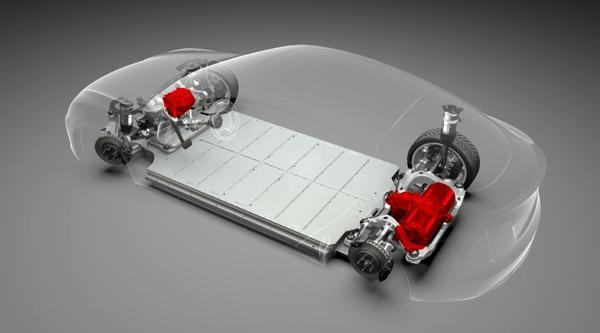
Above: A Tesla battery pack sits in the floorpan of the vehicle (Source: Tesla)
Another clue comes from something Elon Musk said on the Q3 2017 earnings call: “We are pushing robots to the limit in terms of the speed that they can operate at, and asking our suppliers to make robots go way faster, and they are shocked because nobody has ever asked them that question. It’s like if you can see the robot move, it’s too slow. We should be caring about air friction like things moving so fast. You should need a strobe light to see it.”
So where are these speed demons? “There are some pictures from the Gigafactory, where the Model 3 battery pack is manufactured, but none where I see a robot wire bonding the battery cells,” writes Thomas. “I don’t see any machines that are close to moving so fast you would need a strobe light to see.”
Could those robots be doing their dizzying dance somewhere on the secret second floor in Fremont? And possibly in Nevada as well? Recent visitors from the media have found that the section of the Gigafactory where the cells are made is under heavy security – no photos or videos allowed – and also appears to be one of the most highly automated sections of the plant.
However, Tesla is pulling it off, there’s little doubt that its batteries are cheaper, and Thomas believes things will stay that way. “Even if incumbents decided to use cylindrical cells, it will be challenging to engineer a manufacturing process that is economical, and not time consuming. Packaging cylindrical cells is a process Tesla has been refining for over 10 years.”
Tesla’s industry-leading battery cost also has implications beyond the auto industry. Elon Musk has said in the past that the company’s stationary storage business could someday be bigger than its vehicles. Enrique Dans writes in Forbes that “battery manufacturing is set to become one of the most important industries on the planet, and whoever dominates it will occupy a privileged place in many ways, supplying a wide variety of industries from vehicles to household goods, as well of course as electricity generation.”
“Twelve years ago, when he described his company’s ‘secret master plan,’ Elon Musk spoke not only about making cheaper electric cars, but included a third point, which was providing the means to generate zero-emissions electricity, a point that many pundits missed amid the hullaballoo over Tesla cars,” Dans continues. “Today, with the company in the black, it turns out that battery production has been the key to its strategy: the reason why auto industry veterans like Bob Lutz could not understand Tesla’s road map was because Tesla isn’t a car company, it’s a battery company.”
“Tesla isn’t a car manufacturer competing with other automobile manufacturers…Tesla’s vehicles are consumers of the company’s main product: batteries,” Dans concludes. “Rethink your models and your spreadsheets: stop seeing Tesla as a carmaker and start understanding that the company has much more ambitious plans for the future.”
Above: A look inside Tesla’s Gigafactory (Youtube: Las Vegas Review-Journal)
Dan foresees the battery industry growing ever more important, and eventually overtaking an auto industry faced with shrinking demand for private cars. If such a future comes to pass, we all know the name of the company most likely to benefit. As Andrew Thomas puts it: “Big Auto is screwed.”

Sunday, February 12, 2017

Lucid Air On Display At Private Parties In LA This Weekend

What’s the party everyone wants go to? The one that not everyone is invited to! We all want what we can’t have. Lucid Motors is using that principle to build excitement for two private parties in the Los Angeles area this weekend. The first will be on Saturday at a well known museum in the city where guests will be able to test drive a Lucid Air sedan themselves and chat up muckety mucks from the factory, including members of the design team. The second will take place on Sunday up the coast at a private estate in trendy Newport Beach.
Lucid Air sedan
Compared to Faraday Future, another putative Tesla electric car rival, Lucid — formerly known as Atieva — has been keeping a low profile since it was founded in 2007. It has no factory, although one is supposedly going to be built outside of Phoenix, Arizona in the near future. One of its cars was spotted recently driving in San Francisco and the company said last week it is now accepting refundable deposits for the car. The deposits come in two flavors. The plain vanilla option costs $2,500. The Tutti Frutti choice is $25,500 dollars to reserve a “Launch Edition.” Lucid says only 255 of those cars will be built. There goes that “not everyone can have one” vibe again.
The car itself has a certain Wow! factor about it. It features three electric motors — one for the front wheels and two in the rear — with advanced computer controls that allow “torque vectoring.” (See video below.) That’s a fancy way of saying that torque can be fed instantaneously to whichever wheels need it most, something even the mighty Teslas cannot claim to do. All told, the three motors have 1,000 horsepower on tap and a 130 kWh battery has enough capacity to propel the car down the road 400 miles before it needs recharging.
Lucid claims its luxury sedan can scoot to 60 mph in 2. 4 seconds. That may be what prompted Tesla to develop its new Easter egg for the Model S P100D with Ludicrous Mode. That car does the 60 mile per hour dash in 2.34 seconds. Motor Trend just tested one that did it in 2.275 seconds using a NHRA style one foot rollout format. There used to be a time when 0 – 60 times were given in whole numbers. Not today. When you are laying out 150 large or more for a car, hundredths of a second give the owner bragging rights. If bragging is important to you, be prepared to open up your wallet — wide.
The Lucid Air is small on the outside, big on the inside. Chief technology officer Peter Rawlinson, who played a large role in getting the Tesla Model S into production, says that new battery packaging techniques allow the car to have the same interior room as its larger rivals. He promises that riding in the car will be like being in “an executive jet,” Having never ridden in one of those, I will have to take his word for it. Pricing for the car has not been announced but it won’t be the electric car for mainstream drivers we have all been hoping for.
Will the Lucid Air ever see production? That’s the question everyone would like an answer to.
Source: Teslarati

Thursday, February 9, 2017

Tesla Model S P100D Sets Record 0–60 MPH Time Of 2.275507139 Seconds

A 2017 Tesla Model S P100D accelerated from 0 to 60 miles per hour (mph) in just 2.275507139 seconds while being put through the paces recently by the auto junkies over at Motor Trend.
This is apparently the first time that a production car has ever done 0 to 60 mph in under 2.3 seconds while being tested by the magazine’s experts, making for a new “record” of sorts.
Pretty impressive for a 4,891 pound chunk of metal when you think about it.
In addition to doing 0 to 60 mph faster than any other production car ever tested by Motor Trend, the 2017 Tesla Model S P100D also, predictably, notched the fastest 0 to 30 mph, 0 to 40 mph, and 0 to 50 mph times.
“Predictably” because the great advantage that the Model S has over its competitors is its very impressive torque — one of the most notable performance advantages of electric vehicles.
Despite owning the acceleration range up to 0 to 60 mph, the 2017 Model S P100D does get outcompeted slightly at higher speeds by some of the much more expensive supercars out there. Motor Trend provides more:
“The Tesla does not hold the advantage forever, though, because higher speeds give the advantage to horsepower over instant torque. The Ferrari LaFerrari hits 70 mph a tenth of a second quicker; the Porsche 918 and McLaren P1 pull ahead at 80 mph, and these hypercars all continue to pull away at higher speeds. But around town, everybody has long since lifted off the accelerator pedal.
“Indeed all-wheel-drive cars capable of face-warping launches such as this latest, most ludicrous Tesla Model S P100D and November’s wheelie-ing Porsche 911 Turbo S have us examining a lesser-known physics term: jerk. It’s the rate of change of acceleration. Think of it as the difference between being accidentally pushed by a clumsy person and being aggressively shoved by a jerk.
“Launching a Model S P100D (weighing 5,062 with gear and driver) in full-on Ludicrous Easter-egg mode snaps your body in a manner that is utterly impossible to replicate in any other street-legal production car on normal tires and dry asphalt at a mid-$100,000 price point. We regard 0–30-mph acceleration times as the benchmark for how hard a car launches, and this new Tesla gets there 0.05 second ahead of the next quickest (aforementioned) 0.92-second 911 Turbo S. The two run pretty even through 40 mph, after which the Tesla pulls ahead, maintaining a 0.2-second lead from 60 mph through 90 mph. The two cross the quarter-mile mark together at 10.5 seconds, at which point the Tesla is running 125.0 mph, and the Porsche is traveling 6.8 mph faster.”
Rather than quote the whole article, I’ll simply say that if you’re a speed junkie, and you have the time, then the full article is worth a read. Motor Trend goes into great depth comparing the acceleration of the 2017 Tesla Model S P100D with the other supercars out there, making for a very interesting comparison.

Sunday, August 28, 2016

Why The Tesla 100 kWh Battery Is A Super Big Deal

One of Elon Musk’s favorite words is “super.” Things are not important to him, they are super important. So he would probably say the new 100 kWh battery available now (for a hefty price) in the Model S and Model X is a super big deal, one that has little to do with the cars’ outrageous performance potential — 0-60 in 2.5 seconds for the Model S, 2.9 seconds for the Model X.
Tesla Model S P100D
Every battery for an electric car begins with cells, mostly lithium ion cells today. They are assembled into clusters and the clusters are then assembled into a complete battery pack. But there’s more to it than meets the eye. Inside the battery pack, coolant must be allowed to circulate. As electricity is withdrawn from a battery, it heats up. If it gets too hot, it can ignite, resulting in a rather spectacular fire.
The key to the new Tesla 100 kWh battery is that it represents the state of the art in battery packaging. In a conference call announcing the new battery, Musk indicated that the new battery comes close to providing the theoretical maximum power possible for its size and shape using the current battery chemistry. I”t’s been quite a challenging development,” he said.
There wasn’t room enough left over in the chassis of the Model S and Model X to make the battery pack larger, so Tesla engineers totally redesigned the cooling system to be more compact yet more efficient. Then they rearranged how the cell clusters were arrange inside the battery pack.
Battery cooling is a big deal for electric cars. There are rumors that Apple is working with a small company in South Korea on battery cells that are hollow in the middle. That empty space is said to allow more air flow for better cooling. But of course, all that is merely theoretical, since Apple isn’t really building an electric car. Or is it?
The real reason the new Tesla 100 kWh battery is a super big deal is because, once again, it marks Tesla as being the smartest company in the game. Tesla is 3 to 5 years ahead of anybody else on the planet when it comes to making world class electric cars.
Elon may be an SOB to work for. His expectations are super high and his demands on his employees are super severe. But his right foot is firmly planted on the accelerator and he has no intention of backing off. Apparently, he doesn’t know how. That is why his cars will always be super far ahead of the competition.