Showing posts with label Mercedes Benz. Show all posts

Wednesday, August 1, 2018

Mercedes-Benz EQS caught in spy shots

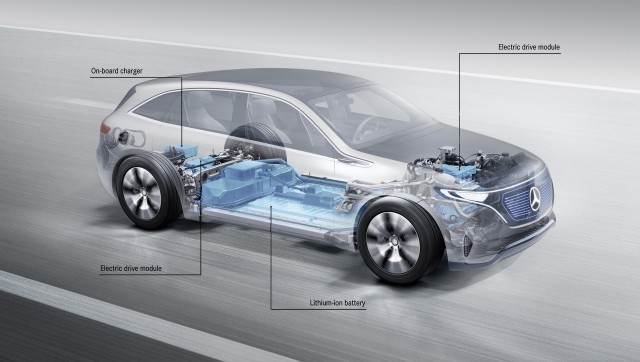
Mercedes-Benz Generation EQ concept, 2016 Paris auto show


For decades, Mercedes-Benz sold only two passenger cars. Now, the automaker is promising 10 different electric cars.
Although the Mercedes has not revealed plans for all of them, spy photographers have recently captured a large electric sedan from Mercedes-Benz testing at Mercedes's headquarters in Sindelfingen, Germany. 

The spy pics were published by Motor Authority.
In line with Mercedes-Benz's naming convention and statements from company executives, observers expect the new sedan to be called the EQS, sitting parallel in Mercedes-Benz's lineup with its flagship S-Class.
Previous statements from Mercedes executives have hinted that the EQS will go on sale in 2020, likely as a 2021 model.
It is expected to ride on Mercedes's dedicated, modular electric-car architecture, dubbed MEA. At the same time, Mercedes is separately developing a new gas-fueled S-Class sedan that will ride on a separate rear-wheel-drive gas platform (MRA), and debut around the same time.

The EQ chassis sits a little higher than the basic S-Class to allow space for the large battery packs under the floor, but it has a much more steeply swept windshield and sleeker profile.
A high tail indicates it could be a hatchback, perhaps like the Tesla Model S, its target competition. It could, however, be just part of the prototype's camouflage.
Among the 10 electric models Mercedes has said it will deliver, the EQS represents the third passenger car, after the EQC small SUV and the EQA small coupe.
It has also revealed prototypes and specs of two commercial electric vans, and is expected to offer a small electric sedan the size of the C-class.

Monday, November 21, 2016

Morgan Stanley Report Predicts Electric Car Revolution Will Accelerate Soon

Morgan Stanley has released a new report estimating that electric car sales will increase become 10 to 15 percent of the global new car market by 2025. That is three time the rate the investment banking house has projected in the past. Why the sudden shift in its thinking? While the US is conveniently planning to reduce or eliminate fuel economy regulations, every other civilized country has rules in place that will require auto manufacturers to dramatically lower the emissions from their vehicle in just a few years time.
Vokswagen ID electric car
A note on defining terms. Some Gas2 readers object strenuously to calling any car with an internal combustion engine an electric car. However, those who are less technically oriented often lump all cars that take advantage of an electric motor to drive an vehicle either full or part time together under the term “electric car.” Morgan Stanley falls into the group that is somewhat fuzzy with definitions.
Morgan Stanley analyst Harald Hendrikse, lead author of the report, says there are still significant barriers to mass adoption of electric cars. “Battery costs remain very high. Battery range remains too small and batteries are still too heavy. Battery charging infrastructure has not been sorted out in many countries. Are EVs actually environmentally friendly given through-life cost and environmental impact?
“Consumer demand seems to have been very limited for most EVs launched to date – presumably excluding Tesla. Despite this, we now have a situation where some of the largest (manufacturers) in the world are investing heavily in this technology, and setting aggressive targets for their take-up,” Hendrikse writes.
Those are all excellent points. Nonetheless, Hendrikse concludes, “Although many questions over EVs remain, we believe it is the sharply rising cost of regulatory compliance on existing internal combustion engines (ICE) that is pushing (manufacturers) to change their strategy towards EVs, as much as improvements in battery technology.” He adds, “As more (manufacturers) commit to launching more EVs, accessing more consumers, we think EV penetration forecasts could rise to potentially 10 to 15% by 2025, more than three times current forecasts.”
So far this year, manufacturers around the world have announced major new efforts to add electric cars to their product lineups. Volkswagen in particular has promised to pivot to electric cars to try and recover from its diesel cheating scandal. Its new electric cars will be sold under the I.D. brand. Not to be left out, Mercedes Benz says it is readying a new branding structure for its future electric cars. It has selected EQ as the brand it will market those cars under.
Hyundai and Honda have new electric cars coming soon. BMW and Porsche are rushing to join the party. Even Toyota, which held out the longest, has now changed its position and plans to build electric cars. “We do not think we can continue to ignore the change in strategy. It changes almost 100 years of automotive development, with significant implications for the current global automotive installed base, its employees, and also the global automotive supply chain,” Hendrikse writes in his report.
While the Morgan Stanley report may have electric car fans cheering, it has sobering news for car companies. “Our group auto EBIT (earnings before interest and tax) margins turn negative in the mid-2020s as a result of ICE price deflation and costs of EV development. Continued deterioration in the ICE business due to lower volumes from EV cannibalization and lower prices offsets the improving EV profitability after 2025, despite our cost restructuring assumptions,” Hendrikse said.
In other words, car makers are going to be a lot less profitable in the near term than they are accustomed to. That prediction may be enough to convince The Donald to fund research into coal powered pickup trucks, but in the rest of the world, where actual adults are in charge, the next decade is shaping up to be a very testing time for car companies. Not all of them will survive.
Source: Forbes

Tuesday, January 19, 2016

Mercedes To Boost Electric Range Of Plug-In Hybrids As It Adds Models

2018 Mercedes-Benz GLE350e Plug-In Hybrid


Last year and this year see a veritable onslaught of low-volume German plug-in hybrids, both sedans and SUVs. BMW and Mercedes-Benz have each said they'll offer plug-in hybrid versions of all their high-volume vehicles by 2020. Those include the Mercedes-Benz S-Class large sedan, GLE-Class SUV (nee ML-Class), and C-Class sedan; for BMW, the first is the X5 xDrive 40e SUV that competes directly against the GLE.

They will be followed by a plug-in hybrid version of the new 2017 E-Class just introduced last week at the Detroit Auto Show. But virtually all of those models have electric ranges of no more than 14 to 20 miles, as does the Audi A3 e-Tron compact hatchback that went on sale last month. Hope is at hand, however, or will be within a couple of years: Mercedes, for one, is planning to boost battery size to give its plug-in hybrids longer range, likely starting in 2018 or so.
2017 Mercedes-Benz E-Class (E350e plug-in hybrid)


That news comes from an interview with Thomas Weber, product chief for Mercedes, published yesterday on the Australian automotive site Motoring. Weber says that Mercedes will have launched 10 separate plug-in hybrid models by the end of 2017, but that's not the end of the story.
“The next-generation vehicle will overcome the 30-km to 50-km hurdle," he told Motoring, "and then the next generation after that will be 80 to 100 km when they run as pure electric cars.”

A range of 30 to 50 kilometers (19 to 31 miles) would be a noticeable boost on today's ranges, but likely not enough to ensure running a majority of miles on electric power. That will come in the second generation after the current models, when 80 to 100 km (50 to 62 miles) would get all models into the range of the current 2016 Chevrolet Volt. As GM often mentions, nine out of every 10 trips in the new Volt can be done exclusively on battery power recharged from the grid.
2016 Mercedes-Benz S550e Plug-In Hybrid


It's worth noting that BMW has already previewed its system to get to that second level, known as Power eDrive. The system uses a single electric motor for lower-speed travel around town, along with a battery pack large enough to permit Volt-like levels of electric usage. And given the tendency of German carmakers to follow each other's leads, you can likely expect the same from Audi.

BMW already has its first generation of all-electric cars in the market, while Audi and Mercedes will both launch 200-mile or better electric cars around 2018 or 2019. But the big question--unanswered by Weber--is when that second generation of Mercedes plug-in hybrids will arrive. If you assume two- or three-year improvements in lithium-ion cell energy density, that likely won't be until the 2018 or 2019 model years.

Thursday, November 27, 2014

Mercedes CLA Shooting Brake Aims For 60 MPG

Mercedes-Benz CLA 250 4MATIC Shooting Brake (X117) 2014
Mercedes-Benz has recently been accused of cooking the books when it comes to rating the fuel economy of their new cars in Europe, which rarely meet real world expectations. But until regulators crack down on MPG ringers, Daimler will continue to be able to market cars like the new Mercedes-Benz CLA Shooting Brake as offering as much as 60 MPG.
The CLA Shooting Brake may not be everybody’s cup of tea, but station wagons are clearly making a comeback, and Mercedes designers have made a beauty in this case. I seriously dig this Merc, and as a child of the 80s, I’m glad to see a staple of my formative years returning to the road with such style.
That incredible fuel economy figure comes courtesy of a 2.1 liter turbodiesel making 136 horsepower and a 221 lb-ft of torque, though a more potent version will offer buyers up to 177 horsepower and 258 lb-ft of torque. Both engines will offer fuel consumption figures of about 4.0 liters per 100km, which works out to about 60 MPG.
Mind you, this is on the more generous (and easier to cheat) European testing standards; should this engine/car combo ever come stateside, I’d expect a rating more in the 40 MPG range. The 1.6 liter gasoline engine gets a rating of 5.5 liters per 100km, which works out to 42 MPG on the highway, and as much as 211 horsepower if speed is more your thing. All CLA models will come with the award-winning ECO start/stop system, which does help improve fuel economy somewhat.
Mercedes also claims that in its Blue EFFICIENCY form, the CLA Shooting Brake has a drag coefficient of just 0.26, making it one of the slipperiest cars on the road. The sedan version of the CLA managed to set a benchmark of just 0.22 though, so you sacrifice some aerodynamics in the name of style. Alas, we won’t be getting the CLA Shooting Brake here in America, which means adding it to our list of wish-we-had-it vehicles. All we’re getting is the B-Class Electric Drive, which isn’t half as exciting as its main rival, the BMW i3.

Tuesday, November 25, 2014

Tesla Talks Batteries And Charging Stations With BMW


tesla-model-s-vs-bmw-i8
After Elon Musk announced that he was opening the book on Tesla’s multitude of EV patents, it didn’t take long for BMW to initiate a discussion with the electric automaker. Apparently those discussions have been fruitful, as Elon Musk told Germany’s Der Spiegel that he had met with BMW representatives to discuss batteries, charging stations, and carbon fiber.
“We are talking about whether we can collaborate in battery technology or charging stations,” Musk said in the interview with the weekly magazine. He also said that BMW’s efforts with carbon fiber are both “cost efficient” and “interesting” to the Tesla CEO, and it’s easy to see why. By using carbon fiber, the BMW i3 manages to be the lightest electric car on the road, tipping the scales at a svelte 2,600ish pounds.
BMW aims to bring carbon fiber prices down some 90% to make it more viable as a replacement for steel. Compare that to the nearly 5,000 pound Tesla Model S P85D, and you start to understand why Musk might be interested in BMW’s expertise on the matter. Word has it that the Tesla Model III will be made mostly from steel instead of aluminum like the Model S; could a partnership with BMW could put carbon fiber on the table.
That’s less likley than Tesla teaming up with BMW on batteries and charging stations though. The California automaker already sells batteries and drivetrains to rival Mercedes-Benz, and of particular interest to BMW are the Supercharging stations. BMW also has a few ideas regarding EV charging though, and both the i3 and i8 have been well received. and considering Elon has always targeted the BMW 3 Series as a benchmark for the Model III, it seems to me these two companies may have more in common than most automakers.
But that’s not to say all their goals align. Musk is keeping Tesla all-electric, while BMW is exploring hydrogen fuel cells with Toyota. Toyota and Tesla recently parted ways, and the Japanese automaker has since come out saying that nobody wants to buy EVs.
Tell that to Tesla.
It’ll be interesting to see what, if anything, comes from talks between Tesla and BMW. Will future BMWs plug into the Supercharger network? Will next-gen Teslas be made from carbon fiber?
Source: Reuters

Sunday, July 13, 2014

2015 Westfalia Camper, by Mercedes-Benz


2015 Mercedes Camper Van


Meet the new for 2015 Westfalia Marco Polo. Built on the new Mercedes-Benz Vito passenger vans, the Marco Polo is a compact live-in van designed to blend practicality with a Mercedes-level of comfort and elegance.
As the Sprinter’s “little brother”, the MB Vito platform is more than up to the challenge of hauling around a few cabinets and mattresses – and the ones in the Westfalia Marco Polo are definitely up to the challenge of wearing the legendary three-pointed star.
When vertical, the rear “love seat” in the back of the 2015 Westfalia Marco Polo is a plush, luxurious affair that slides into single- and double-bed sleeping configurations with the push of a button. The love seat has individually adjustable backrests for both lucky passengers, and electro-pneumatically inflatable side bolsters that provide lateral and lumbar support in sitting mode and automatically “flatten” out the surface in bed mode. The “pop up” roof holds an additional two-sleeper foam mattress for, ostensibly, the driver and front-seat passenger.
On the driver’s side of the cabin, the new Westfalia Marco Polo has a kitchen unit with dual-burner stovetop, sink and 10.6 gallon (40 liter) top-loading refrigerator, all with impact-resistant glass capping off the high-end cabinet work. When it’s time to eat, a folding table attached to the kitchenette slides out from its folded position, and the two front seats swivel ’round.
The Westfalia Marco Polo is available with a number of four-cylinder turbo diesel engine levels and interior trims, but the hot setup is the 190 HP/325 lb-ft that Mercedes claims is good for 39 MPG (Euro cycle). Pair that engine up with the yacht-style teak flooring and light leather interior (shown, below), and you’ve got yourself a winner.

mercedes-benzv-classmarcopolo
mercedes-benzv-classmarcopolo-0
mercedes-benzv-classmarcopolo-1


Source | Images: Daimler, via Gizmag.

Sunday, May 11, 2014

US buyers show little interest in big hybrids


The idea of producing large, luxury-vehicle hybrids is turning into a "what were they thinking?" exercise in futility, USA Today reports. General Motors is discontinuing hybrid versions of the Cadillac Escalade,Chevrolet Tahoe and GMC Yukon SUVs, while Mercedes-Benz and Toyota's Lexus division are doing the same with their S-Class hybrid and LS hybrid sedans, respectively. The culprit? Big price increases for fuel economy improvements that border on the unimpressive.

Granted, the Escalade hybrid gets 31 percent better fuel economy than the standard version, but that still maps out to a combined fuel-efficiency rating of just 21 miles per gallon. That can be seen as a worthwhile increase, if it didn't cost over $8,000 extra. The 2014 Escalade Hybrid, for example, starts at $74,425 while the non-hybrid can be had for $66,295. Meanwhile, the Lexus full-size hybrid costs $6,000 more than the regular version but only gets 1-2 mpg better combined fuel economy. The result of all these high costs? Low sales. Through April, GM sold 82 of its hybrid SUVs and pickups, down from 541 a year earlier. And the LS hybrid sales were in single-digit territory for April. That isn't stopping Lexus from promoting its hybrids as the right solution (with the wrong facts), though.

There are still automakers giving big hybrid vehicles a shot, though. Nissan's Infiniti division is selling a hybrid version of its QX60 and says an impressive 10 percent of QX60 buyers choose the hybrid, which costs just $3,000 more. Looks like money talks.
News Source: USA Today

Tuesday, April 29, 2014

Mercedes-Benz B-Class Electric Drive priced at $41,450 for US; 85-mile range


D3_5407
The MY14 B-Class Electric Drive. Click to enlarge.
The Mercedes-Benz MY14 B-Class Electric Drive—the first electric offering for the brand in the United States—is priced at $41,450, excluding $925 destination and delivery. Customers may be eligible for federal tax credits (which run up to $7,500) or state/local tax credits. The MY14 B-Class Electric Vehicle will be available beginning in mid-July to dealers in California; Connecticut; Maine; Maryland; Massachusetts; New Jersey; New York; Oregon; Rhode Island; and Vermont. 50-state availability will be announced in 2015.
All B-Class Electric Drive vehicles will be covered by Battery Coverage Plus which includes 8-year, 100,000 mile battery coverage, coverage for defects, coverage for capacity, no cost annual maintenance, and Roadside Assistance.
The new Mercedes-Benz B-Class Electric Drive is based on the conventionally powered B-Class, for which the current generation has become a top seller since being launched in many countries in 2011. Since the launch of the first B-Class version in 2005, Mercedes-Benz sold more than 1 million units.
13C901_2
Click to enlarge.
Mercedes-Benz has collaborated with Telsa Motors to develop the electric B-Class. The new Mercedes-Benz EV features a Tesla drive system equipped with an electric motor generating 177 hp (132 kW) and a 28 kWh lithium-ion battery. Maximum torque is 251 lb-ft (340 N·m)—approximately equivalent to the torque from a modern three-liter gasoline engine. The electrically driven B-Class accelerates from zero to 60 mph in 7.9 seconds.
In the interests of optimizing range, the top speed is electronically limited to 100 mph (161 km/h). Range is an estimated 85 miles (137 km).
D3_4615

The B Class Electric Drive features a full regenerative mode (D-), normal drive (D), and coasting (D+) feature. The “D Auto” feature features radar-based recuperation, which adjusts speeds depending on traffic in front of the vehicle.
The lithium-ion battery is housed in the “Energy Space” in the underfloor of the vehicle. Charging time for 60 miles worth of electricity is 2 hours with a Level 2 Charger (40 Amp); a complete charge will take 3.5 hours.
In terms of information and communication systems, the electric B-Class offers customary Mercedes-Benz levels of comfort and functionality. The standard equipment package includes a head unit with 5.8 in (14.7 cm) color display, twin tuner and MP3-compatible CD player as well as USB port. The Becker MAP PILOT is the standard navigation system while the COMAND multimedia system with internet access, navigation and LINGUATRONIC voice control is also optionally available.
The instrumentation of the B-Class Electric Drive is rounded off by functions that are specific to electric vehicles. A Vehicle Homepage allows remote interaction and remote configuration of the vehicle. The driver can use his or her PC or smartphone to access the vehicle via the internet. It is possible, for example, to determine the current state of charge of the lithium-ion battery or show the vehicle’s current range on a map.
In addition, the planned route can be displayed, showing where the vehicle can be recharged along the way, should this prove necessary. The range of connected services is rounded off by a feature that allows individually timed pre-heating or cooling of the vehicle.
Mercedes-Benz has equipped this electric car with the radar-based collision warning system COLLISION PREVENTION ASSIST with adaptive Brake Assist as standard. This assistance system gives the driver a visual and audible warning of detected obstacles, prepares them for braking action and assists them with the braking process as the situation requires. In this way, it significantly reduces the danger of a rear-end collision. Additional cutting-edge driver assistance systems are also available, including Blind Spot Assist, Lane Keeping Assist and Active Parking Assist.
Friday, March 14, 2014

Electric Mercedes S-Class WIll Follow The Plug-In Hybrid

s-class-coupe

Mercedes-Benz is going green, and according to one of their top tech guys, the German automaker will launch an all-electric S-Class…eventually. The problem, of course, is battery capacities, but if Tesla can do it, surely Mercedes can figure it out too?
An all-electric Mercedes S-Class won’t be unveiled for awhile yet though, as the S-Class plug-in hybrid is only just starting to roll out. It’s powerful and efficient vehicle, no doubt, but Tesla has shown that there is most certainly a market for premium electric vehicles. More importantly though, chief of S Class engineering Uwe Ernstberger thinks that autonomous vehicles will lead the way in the next few years.
Mercedes plans to be at the forefront of self-driving cars, though Uwe admits there are still plenty of challenges in launching that technology as well. The Mercedes S-Class already employs a suite of autonomous driving technologies, and if you combine that with an all-electric drivetrain, a real Tesla Model S rival starts to shape up. It’d have to be a marked step up from the Mercedes B-Class or SLS Electric Drive models though, neither of which have the range to rival Elon Musk’s electric car, even though the two are said to be growing closer.
For now  the plug-in hybrid S-Class will have to be good enough for Mercedes fans wanting to lessen their environmental footprint.


Source: Top Gear