Showing posts with label Karma. Show all posts

Sunday, September 11, 2016

New (Sort Of) Karma Revero Seeks To Take A Bite Out Of Tesla Model S Market

The Fisker Karma is back, sort of. After Fisker went bust in 2013, its assets were purchased by Wanxiang, a Chinese company. From 22 employees then, the company has grown to over 600 today. It plans to have nearly 1,000 by the end of the year. The Fisker name is nowhere to be found any more, but the Karma name has been retained. The new version is known officially as the Revero.
Karma Revero plug in hybrid
Details revealed during the launch this week include a starting price of $130,000, with few options available. The powertrain is virtually unchanged from the original Fisker Karma. It remains a plug-in hybrid with a 260 horsepower turbocharged four cylinder gasoline engine sourced from General Motors. 40 kW  DC fast charging is now available. The battery still uses cells supplied by A123 but has been upgraded from 20.4 kWh to 21.4 kWh. A recharge on standard household current takes 12 hours or 3 hours with the DC fast charging option.
All electric range is said to be 50 miles, which means Revero owners should be able to get to work and back without ever needing an assist from the engine.  The onboard charger has been upgraded from 3.3 kW to 6.6 kW. 0-60 in Sport Mode now happens in 5.4 seconds — 1 second faster than the original car was capable of.
Owners of the Fisker Karma complained bitterly about the lousy touchscreen. Wanxiang has focused the bulk of its attention on making the touchscreen in the new car faster and more responsive. Apple CarPlay is standard. Android Auto will be available soon. Over the air software updates are standard. All cars will come with a built-in 4G wireless hot spot.
Karma will use the same machines at its new California assembly plant that Valmet used to build the Fisker Karma in Finland. Many of the production manuals were in Finnish, so they needed translating before production began. One new feature of the Revero is a solar panel roof that can generate enough electricity in a day to move the car about 1.5 miles.
The Revero is obviously aimed at Tesla Model S owners who still suffer from range anxiety. The car is priced near the top of the Model S range. It is 2 seconds slower than the fastest Model S. It has an exhaust pipe. And while it is not unattractive, it is no ravisbhing beauty, either. Chances are the Revero’s main selling point will be that it is not a Tesla. While there may be a dozen or more Teslas at the local country club, the Revero owner will have the advantage of exclusivity.
Will that be enough to make the Revero a success? Online orders begin at the end of this month. Or you can contact your nearest Karma dealer.


Source: AutoBlog  Photo credit: Karma

Saturday, November 14, 2015

Karma Forges An Alliance With BMW

Karma sedan
Karma Automotive is the successor to Fisker Automotive, the company that tried to manufacture a luxury electric car before anyone had ever heard of Tesla. Like many technology leaders, it was overwhelmed by the marketplace and went bankrupt, leaving an unpaid $139 million dollar government loan in its wake.
The assets of the company were purchased in 2013 by Wanxiang Grpup, headed by Chinese billionaire entrepreneur Lu Guanqiu. The reconstituted company now has 300 employees and plans to introduce an updated version of the Karma plug-in hybrid sedan next year. On November 12, it announced that it has signed a deal to use high voltage battery charging systems and other electric drive train technology from BMW. The cooperative agreement with BMW may lead to further links between the two companies. Karma has said it wants to bring a fully electric car to market soon. That’s an area that BMW knows a lot about.
“Carmakers buy parts from other carmakers, especially in expensive areas like powertrain technology,”  Jim Taylor, chief marketing officer for Karma tells Automotive News.  “As we launch the vehicle under the new name Karma, using BMW components will be a big help to the brand.” That’s very much of an understatement. A lot of people paid a lot of money for the original, only to be left high and dry when the company went belly up. It’s one thing to buiild a car. It’s quite another thing to convince prospective buyers the manufacture will still be around to service it later.
“The Wanxiang Group is giving Karma Automotive the opportunity to bring a stunning car back to the market, and the partnership with BMW and their outstanding track record is a great fit for the future,” said Karma’s CEO Tom Corcoran. “We will continue to develop beautiful cars with the latest cutting edge hybrid and EV technology.”
The original Karma sedan used a 4 cylinder engine sourced from General Motors to extend the car’s range. There is no word on where Karma will get the range extender engine for this latest version of its plug-in hybrid car. Once production begins, the cars is expected to sell for $115,000.

Saturday, November 22, 2014

LA motor show 2014 report and gallery

LA motor show 2014 report and gallery
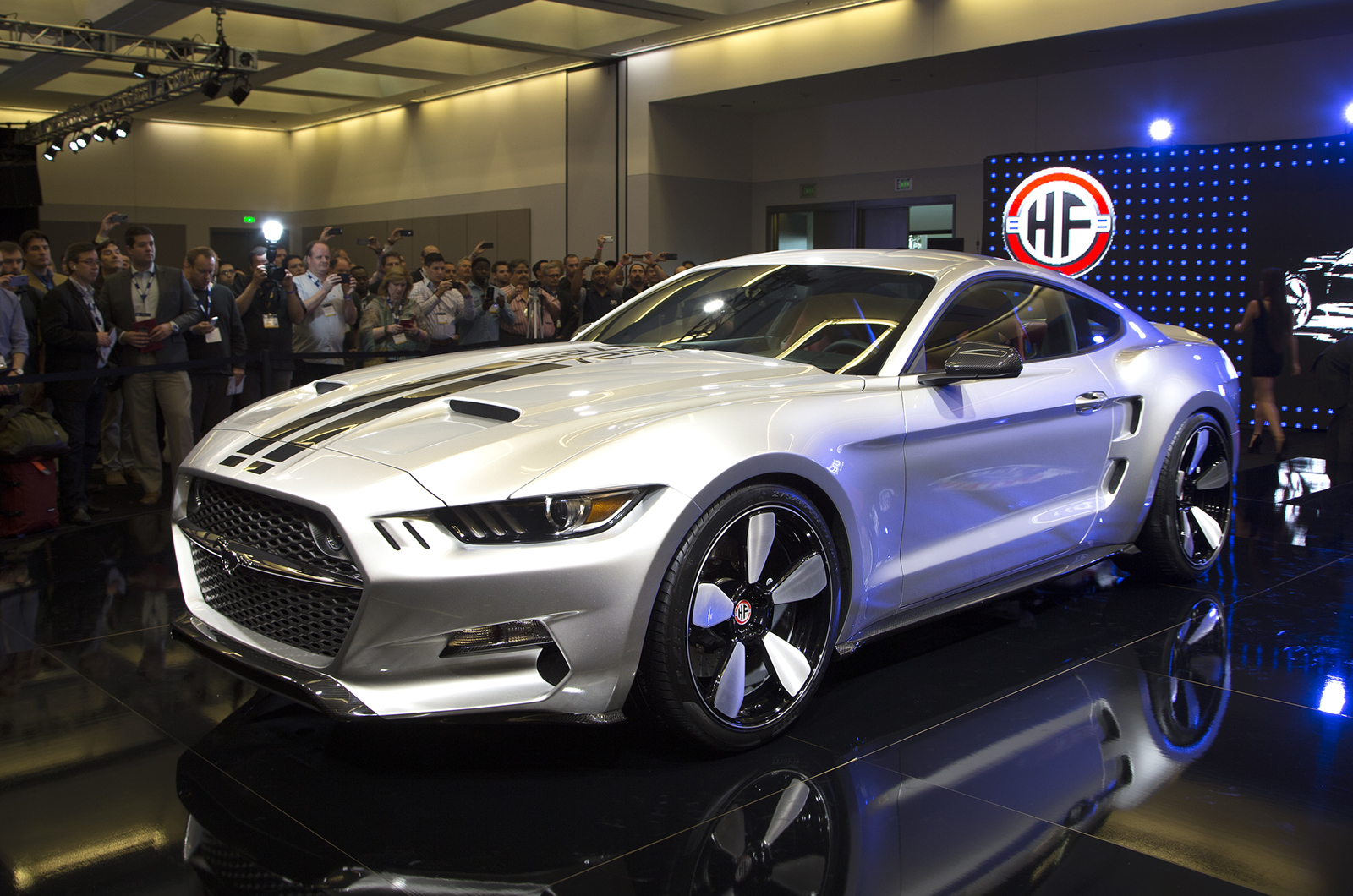
The Fisker Rocket is based on the sixth-generation Ford Mustang
It's small. That's what nearly everyone is saying about this year'sLos Angeles motor show. If it's just the highlights you want, you can visit them in a couple of hours. 
However, if the West Coast's most important motor expo is small, it is also perfectly formed. Whereas others in the expo game dedicate vast areas of show-stand real estate to widget manufacturers whose wares most show-goers couldn't even identify, much less appreciate, LA concentrates on motors that count, with plenty of variety in size and price.
This year's theme is indisputably the rise of hydrogen fuel cell cars. Honda, Toyota, VW and Audi were all there with vehicles that were drivable on LA streets and close to production-ready, and the lingering message from everyone was: we've designed and perfected the cars; now give us the infrastructure. 
VW Group, whose Hymotion Golf, Passat and Audi A7 h-tron Quattrowere joined by Toyota's Mirai and Honda's FCV in the fuel cell field, were let loose on LA in hacks' hands not to prove they were special, but that they were normal. 
These were common or garden electric cars, except that their power was generated on-board from hydrogen, their only tailpipe emission was water vapour and their only noise was a faintly-whirring compressor. 
How long before we can buy such a car? Some say they're coming to the UK next year. How long until hydrogen is in easy supply? Quite a lot longer. One reason these cars were made available in LA is because the Californian capital has a lot of fuelling stations by world standard - a princely total of 15.
Audi also went on the front foot, design-wise, with its beautiful Prologue concept, claimed to introduce a whole new design style. There's a wider, lower grille, new lights, a new attitude to "muscles" on the sides of the body, an architectural approach to the body lines that design the shape, and a new interior approach. 
It was well received, which is just as well. Forthcoming A6A7 and A8models are already influenced by this concept - compellingly explained by new design chief Marc Lichte, who was installed after group technical guru Dr Ulrich Hackenburg arrived a year ago to "sort out" Audi's forward models.
Mazda gave us hope of a new leader in the B-segment SUV class with its handsome but confusingly labelled CX-3 (what's a CX-2, then?) and Honda also weighed in with a pretty HR-V for the same sector, hopefully not to be dismissed like its faded predecessor as the Hip Replacement Vehicle.
Jaguar Land Rover always plays well in the US these days - which is probably why senior managers like Ralf Speth and Wolfgang Ziebart were prominently on hand instead of at the competing Guangzhou in China. 
They improved their cause with all-wheel drive and manual gearbox versions of the Jaguar F-type sports car, a hugely well-liked car in California, and with the new Land Rover Discovery Sport, also bound to play well with its particularly brilliant styling and five-plus-two seating.
Former Aston design boss Henrik Fisker, who has stepped away from the failed California-based business bearing his name and producing the Karma plug-in hybrid saloon, was on hand with a super-Mustang called Rocket, a 725bhp co-operative project between himself and the world's biggest Ford dealer, inevitably Californian.
The car, hugely muscular, is clad in hand-made carbon fibre panels and tipped to cost around £80,000 in the US. 
Playing for big money was the new Bentley Grand Convertible, which reprises the old Azure's aura by being happily powered by the venerable 6.75-litre pushrod V8, updated again.
It was interesting also to see Mercedes-Benz reprising the Maybach name we all thought had been compromised in the remarkably tasteless and unsuccessful luxury saloon the group produced to do battle with the Rolls Phantom, back when that car was new. It spectacularly lost the battle.
Mercedes-Maybach is to become a luxury line, just as Mercedes-AMG is the sporty line, and judging by the general approval afforded to the V12-engined S600, now clearly an S-class variant, it is going to work.
The American marques mostly disappointed us. There wasn't much to see on their stands (Buick looked like a deserted parking lot) and their offerings were mostly updates - four pipes, hood vents and a splitter for the new Caddy ATS-V coupĂ©, for instance, and it's not even a 2015 model. 
That all seems to prove that the LA Show's fabled tussle for US supremacy with Detroit's show in January is far from won. In fact, if Motown can field a decent number of interesting American creations in two months' time, it might even have been lost.

Source: Autocar

Thursday, July 3, 2014

Wanxiang Will Relaunch Fisker In America, Then China

fisker-karma-china

With failed hybrid carmaker Fisker in one corner, and battery maker A123 Systems in the other, China’s Wanxiang is poised to take on Tesla. For Wanxiang’s CEO Lu Guanqiu though, this is about more than business, it’s about a lifelong dream that may play out over generations.
But as Forbes reports, Wanxiang is going to fight Tesla using the same tactics as Elon Musk. Mr. Lu will be starting his electric car ambitions in America before coming home to China, which is expected to be the largest market for EVs by 2020. With Tesla’s roll out of the Model S in China running into roadblocks that include a lack of charging infrastructure and customers irate over delivery delays. It’s far from the smooth rollout that Tesla had in Europe, and it will take years to cover the country in Superchargers the way America is now connected.
That leaves the door open for Wanxiang to restart Fisker production at a factory in Delaware, bringing the brand back to life here in the U.S. Once production is restarted, development of the Fisker Atlantic can be finished and the cheaper plug-in hybrid can be brought to market.
The next step? Take Fisker (or whatever it ends up being called) to China, where sales of electric and plug-in cars are expected to explode. Tesla has done the same thing, though Wanxiang’s CEO  seems determined to make-it-or-break-it, saying he will spend “every cent” into making electric cars. Could the Fisker Karma and Atlantic end up as electric cars instead of hybrids?
With the plan to relaunch the brand within the next year, we don’t have long to wait.


Source: Gas 2.