Showing posts with label 2014 Los Angeles Auto Show. Show all posts

Saturday, November 22, 2014

Expect Fewer Two Car Households In The Future

two-car-garage
The percentage of two car households in America is expected to fall from 57% today to 43% by 2039, according to consulting firm KPMG. Its projections for the future were released Tuesday as part of the Connected Car Expo at the Los Angeles Auto Show. Gary Silberg, KPMG’s automotive sector lead partner says, ” If that happens, the overall number of cars in America will actually decline. The industry economics would look fundamentally different than they do today.”
Part of the reason for the predicted shift in car ownership habits is because more Americans are electing to leave suburbia and return to urban life. Living in the city means access to public transportation and the ability to walk or bike to work. It also means finding places to park two cars is more of a challenge. KPMG says it costs about 61 cents per mile to own a car today. Getting rid of one car can slash how much American families pay every year for car insurance, maintenance, taxes, and fuel to the tune of $10,000 per year or more.
Another factor identified by the study is the rise of internet-powered car sharing platforms like Uber and Lyft. “The economics of mobility on demand are powerful,” Silberg says. Basically, why bother owning a car if you can have all the benefits with none of the drawbacks?
The percentage of two car families is already below 50-percent in several major US markets. New York City households are the least likely to own two cars, but even in car-friendly cities like Los Angeles and Houston, the percentages have dropped. In Los Angeles, 47.8 percent of households claim two or more vehicles and in Houston, it’s 47.1 percent, according to 2013 US Census Bureau data.
KPMG is advising auto companies that the rise of computer-based ride sharing will have a significant impact on the auto business. But the company is also telling its clients that they can hold onto customers by enhancing their connected driving experience. In other words, the ability to interface with work, family and friends while in the car will be a central consideration for car buyers in the future.

LA motor show 2014 report and gallery

LA motor show 2014 report and gallery
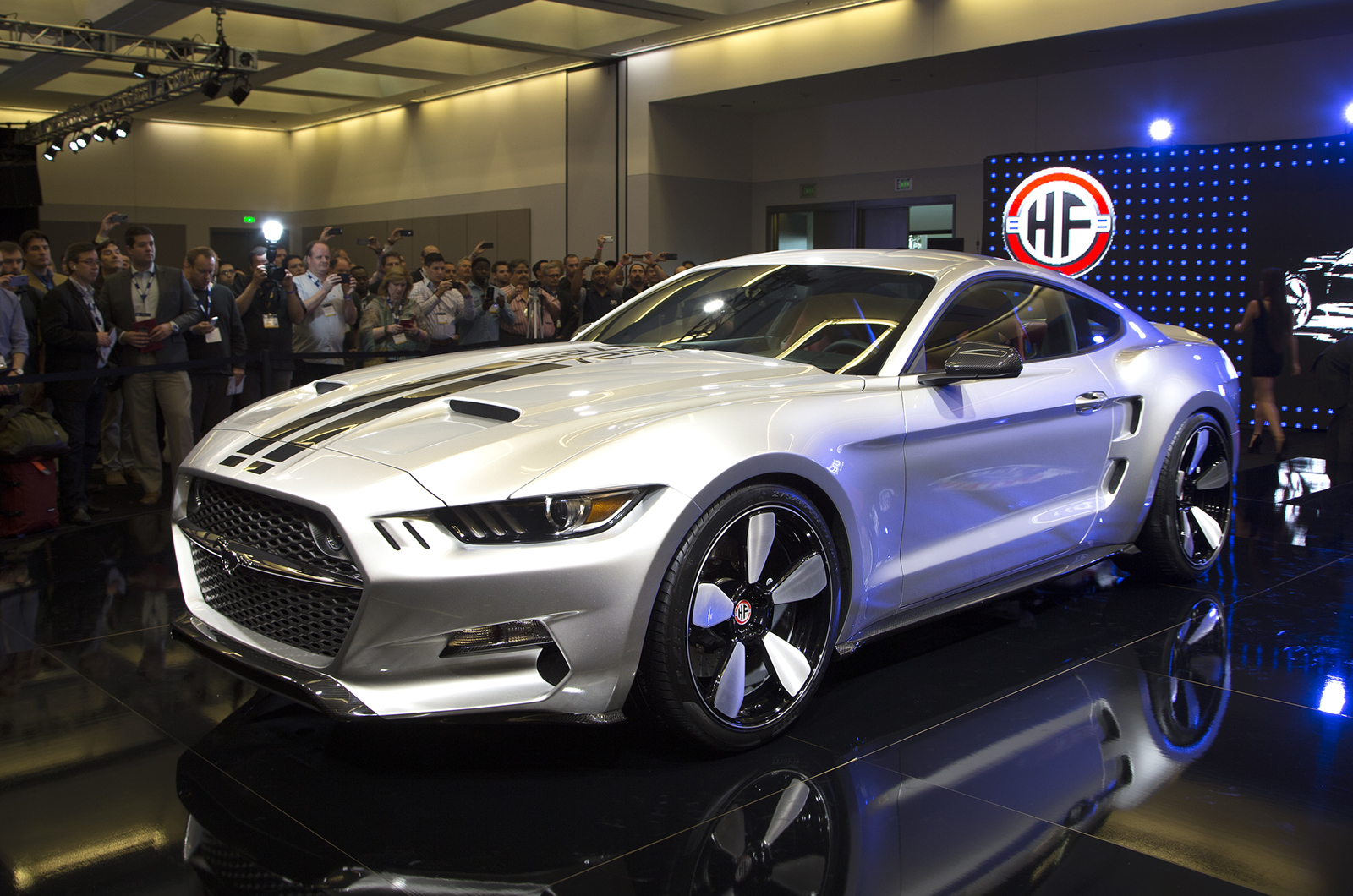
The Fisker Rocket is based on the sixth-generation Ford Mustang
It's small. That's what nearly everyone is saying about this year'sLos Angeles motor show. If it's just the highlights you want, you can visit them in a couple of hours. 
However, if the West Coast's most important motor expo is small, it is also perfectly formed. Whereas others in the expo game dedicate vast areas of show-stand real estate to widget manufacturers whose wares most show-goers couldn't even identify, much less appreciate, LA concentrates on motors that count, with plenty of variety in size and price.
This year's theme is indisputably the rise of hydrogen fuel cell cars. Honda, Toyota, VW and Audi were all there with vehicles that were drivable on LA streets and close to production-ready, and the lingering message from everyone was: we've designed and perfected the cars; now give us the infrastructure. 
VW Group, whose Hymotion Golf, Passat and Audi A7 h-tron Quattrowere joined by Toyota's Mirai and Honda's FCV in the fuel cell field, were let loose on LA in hacks' hands not to prove they were special, but that they were normal. 
These were common or garden electric cars, except that their power was generated on-board from hydrogen, their only tailpipe emission was water vapour and their only noise was a faintly-whirring compressor. 
How long before we can buy such a car? Some say they're coming to the UK next year. How long until hydrogen is in easy supply? Quite a lot longer. One reason these cars were made available in LA is because the Californian capital has a lot of fuelling stations by world standard - a princely total of 15.
Audi also went on the front foot, design-wise, with its beautiful Prologue concept, claimed to introduce a whole new design style. There's a wider, lower grille, new lights, a new attitude to "muscles" on the sides of the body, an architectural approach to the body lines that design the shape, and a new interior approach. 
It was well received, which is just as well. Forthcoming A6A7 and A8models are already influenced by this concept - compellingly explained by new design chief Marc Lichte, who was installed after group technical guru Dr Ulrich Hackenburg arrived a year ago to "sort out" Audi's forward models.
Mazda gave us hope of a new leader in the B-segment SUV class with its handsome but confusingly labelled CX-3 (what's a CX-2, then?) and Honda also weighed in with a pretty HR-V for the same sector, hopefully not to be dismissed like its faded predecessor as the Hip Replacement Vehicle.
Jaguar Land Rover always plays well in the US these days - which is probably why senior managers like Ralf Speth and Wolfgang Ziebart were prominently on hand instead of at the competing Guangzhou in China. 
They improved their cause with all-wheel drive and manual gearbox versions of the Jaguar F-type sports car, a hugely well-liked car in California, and with the new Land Rover Discovery Sport, also bound to play well with its particularly brilliant styling and five-plus-two seating.
Former Aston design boss Henrik Fisker, who has stepped away from the failed California-based business bearing his name and producing the Karma plug-in hybrid saloon, was on hand with a super-Mustang called Rocket, a 725bhp co-operative project between himself and the world's biggest Ford dealer, inevitably Californian.
The car, hugely muscular, is clad in hand-made carbon fibre panels and tipped to cost around £80,000 in the US. 
Playing for big money was the new Bentley Grand Convertible, which reprises the old Azure's aura by being happily powered by the venerable 6.75-litre pushrod V8, updated again.
It was interesting also to see Mercedes-Benz reprising the Maybach name we all thought had been compromised in the remarkably tasteless and unsuccessful luxury saloon the group produced to do battle with the Rolls Phantom, back when that car was new. It spectacularly lost the battle.
Mercedes-Maybach is to become a luxury line, just as Mercedes-AMG is the sporty line, and judging by the general approval afforded to the V12-engined S600, now clearly an S-class variant, it is going to work.
The American marques mostly disappointed us. There wasn't much to see on their stands (Buick looked like a deserted parking lot) and their offerings were mostly updates - four pipes, hood vents and a splitter for the new Caddy ATS-V coupĂ©, for instance, and it's not even a 2015 model. 
That all seems to prove that the LA Show's fabled tussle for US supremacy with Detroit's show in January is far from won. In fact, if Motown can field a decent number of interesting American creations in two months' time, it might even have been lost.

Source: Autocar

Friday, November 21, 2014

Audi Confirms Electric R8 e-Tron, Also 280-Mile Family Electric Car In 2017

Audi R8 e-tron track drive, Berlin Tempelhof Airport


The Audi R8 e-tron electric sports car has been cancelled and revived numerous times, but now it appears that not only will the e-tron enter production, it will also be the stepping stone to a more mainstream electric car.
At this week's 2014 Los Angeles Auto Show, Audi officials indicated that the carmaker is planning an all-electric family car with around 280 miles of range for 2017.

The R8 e-tron will come first, though, perhaps as early as the 2015 Detroit Auto Show in January, according to a report from Seeking Alpha.
The two-seat coupe--along with a rumored plug-in hybrid version--will be based on the platform of the next-generation R8, also set to debut next year.
2016 Audi A3 e-tron - First Drive
Audi technical chief Ulrich Hackenberg has previously said the R8 e-tron will have 250 miles of range--up from the 130 miles of the first prototype cars.
However, speaking to Auto Express at the L.A. show, Hackenberg also said that Audi will leverage experience gained during development of the R8 e-tron for a more practical family car.
With an anticipated 280 miles of range, the car will likely target the Tesla Model S when when it arrives in calendar year 2017, perhaps as a 2018 model.

Audi believes it can achieve that range target thanks to anticipated improvements in battery energy density and electric-motor efficiency.
Audi's parent Volkswagen Group claims to be developing motors that are five times more efficient than the one used in the current VW e-Golf.
No other details have been confirmed, including whether the electric car will be based on one of Audi's existing models, or be a completely new addition to the lineup.
2016 Audi A3 e-tron - First Drive
Either way, it seems Audi is now targeting Tesla directly, and it's not alone.
The luxury brand is also thought to be developing an all-electric version of its upcoming Q8 "four-door coupe utility vehicle," which would seem to have the Tesla Model X in its sights.
Meanwhile rivals BMW and Mercedes-Benz reportedly have plans for larger, more luxurious electric cars, while Porsche may build an all-electric version of its planned "Pajun" (Panamera Junior) sedan.
Will these new models change the electric-car landscape in a few years' time? Or will Tesla simply fire back with an even more competitive product?

Stay tuned.


Source: Green Car Reports