Showing posts with label Honda FCV. Show all posts

Monday, June 12, 2017

Honda to lease 2017 Clarity Electric for $269 a month, 36 months


Honda announced an introductory lease price of $269 a month for 36 months (plus tax) for the 2017 Honda Clarity Electric sedan, which is coming to select dealerships in California and Oregon August 2017.
The lease terms include an attractive allowance of 20,000 miles per year and 24/7 roadside assistance. The lease, which has a federal tax credit built in, requires $1,730 down, plus the first month’s lease payment at signing (not including tax, registration or official fees). In addition, California customers qualify for the state’s Clean Vehicle Rebate of $2,500.
The Clarity Electric is powered by a 161-horsepower (120-kilowatt) electric motor producing 221 lb-ft (300 N·m) of torque and drawing power from a 25.5-kWh battery pack. The vehicle can be fully charged in just over three hours at 240 volts, and when using DC fast charging with the SAE Combined Charging System, it can achieve an 80% charge in just 30 minutes. The model has an EPA range rating of 89 miles on a full charge, and an EPA fuel economy rating of 126/103/114 MPGe (city/highway/combined).
The Clarity Electric, Clarity Fuel Cell, launched in December 2016, and the Clarity Plug-in Hybrid, arriving later in 2017, make Clarity the first ever vehicle series offering customers an array of electrified vehicle choices in a sophisticated, spacious and comprehensively equipped five-passenger sedan. The Clarity series will contribute to the company's target that two-thirds of its global automobile sales will come from electrified vehicles by 2030.
Each Clarity variant has a low, wide aerodynamic body with unique design elements, including its own special hero color, and differentiated front styling, headlights, tail lamps, non-compromised trunk space, Honda Sensing standard and 18-inch alloy wheel designs.
The Clarity series, Honda’s platform for advanced technology powertrains, also features advanced technologies, including Display Audio with Android Auto and Apple CarPlay, and the full suite of Honda Sensing safety and driver-assistive technologies.

Wednesday, September 30, 2015

Honda FCV Sedan Teased Ahead Of 2015 Tokyo Motor Show

Honda FCV
Honda FCV


After showing two concept vehicles over the course of two years, Honda will unveil its hydrogen fuel-cell production car at the 2015 Tokyo Motor Show a month from now. The first teaser image of the Honda FCV shows a car somewhat influenced by the 2013 FCEV concept, and the FCV concept followup that debuted in Tokyo last year. The production model has a more conventional shape than either of the concepts, and a front fascia that seems to borrow elements from the 2016 Civic and Accord.

Certain elements from the FCV concept--including the fender vents and the scoops in the rear doors--are still present as well, but toned down. Still, it appears Honda is taking a similar approach to rival Toyota and its 2016 Mirai, using expressive styling to advertise the hydrogen fuel-cell powertrain.

Note that the name FCV is only a placeholder. The car's actual name will be revealed during Tokyo Motor Show press days.
Honda FCV Concept
Honda FCV Concept
Honda says the car's fuel-cell powertrain so compact that it fits entirely under the hood.
The sedan will have seating for five, and an estimated range of 700 kilometers (434 miles), Honda says.
However, that's as measured on the more-optimistic Japanese testing cycle. Expect it to drop a bit on the U.S. EPA cycle.

Still, it's possible that the Honda fuel-cell sedan will be the second zero-emission vehicle officially rated at more than 300 miles of range in the U.S. The 2016 Toyota Mirai fuel-cell sedan is rated at 312 miles of range by the EPA. Like the Mirai, Honda says the Japanese-specification version of its hydrogen car will also be able to serve as a backup power source for houses during power outages.
Honda FCEV concept
Honda FCEV concept
Honda did not offer any other details, although it does promise an "exhilarating" driving experience, thanks to "high-output motors." The company previously said that the FCV will go on sale in Japan in March 2016, and arrive in the U.S. sometime after that.

Sales may be limited to California, an approach taken by Toyota and Hyundai--with its Tucson FuelCell--because the Golden State is currently the only one with substantial hydrogen fueling infrastructure.

Press days for the 2015 Tokyo Motor Show begin October 28. Watch this space for more details on the Honda FCV.

Wednesday, April 8, 2015

After Decades Of Promises, Are Hydrogen Cars Really Any Closer?

toyota-fcev

Ever since the first Arab Oil Crisis sent gas prices skyrocketing in the early 1970s, automakers have paid platitudes to government officials and environmentalists demanding a cleaner alternative to petrol. Hydrogen fuel cell vehicles have long been touted as a replacement for petrol cars, and the chart below shows just how far back those promises go.
This chart comes from the Catalytic Engineering blog of Bruce Lin, an admitted fan of hydrogen fuel cell technology, but one who remembers the countless promises from automaker executives that hydrogen fuel cell vehicles are right around the corner. It isn’t just automakers though; the Los Alamos National Laboratory released a report in 1980 that said that fuel cell vehicles would be “viable” for production around 1990 and, well, that didn’t happen. Before then though, GM had already released a hydrogen-powered concept van in 1966, though it shelved the technology when it proved too expensive for actual production.
Most automakers seemed to put hydrogen fuel cell vehicles on the back burner until the mid 1990s, when California pressed car companies to build zero-emissions vehicles or face stiff fines. This led to the first generation of electric vehicles like GM’s EV-1 and the first-gen Toyota RAV4 EV, but automakers seemed more interested in selling a future powered by hydrogen. Way back in 1998, GM was predicting that up to 10% of its Opel-brand vehicles could be running hydrogen fuel cells in 2010.
hydrogen-fuel-cell-promisesDaimler was even bolder, predicting it would sell fuel cell vehicles within the first decade of the 21st century, and not just a smattering of vehicles. Back when Daimler was DaimlerChrysler, one executive predicted as many as 40,000 Mercedes-branded fuel cell vehicles on roads by 2004. That didn’t exactly work out as planned, and neither has Honda’s planned FCV, which has since been pushed back to a 2016 or 2017 rollout. Ironically, Honda is one of the few automakers to come close to meeting its own predictions, which suggested a production fuel cell vehicle wouldn’t make it to their dealers util 2018.
It’s not fair to just pick on Daimler and GM though. Ford, Honda, Toyota, and Hyundai have all made equally bold predictions, few of which have come anywhere close to true. As of today, there are just two production hydrogen fuel cell vehicles for sale; the Toyota Mirai, and the Hyundai Tucson Fuel Cell, the latter of which has sold just 100 units in the past year. While demand for the Mirai has proven more robust than predicted, Toyota’s decidedly slow rollout of its fuel cell car is a greater edge to electric vehicles.
Failed predictions from automakers are nothing new, especially when it comes to hydrogen fuel cells. So just keep that in mind next time a suit from a major automaker tries to convince you that hydrogen, the “fuel of the future”, is just a few more years away from mass acceptance. That alibi don’t fly no more.

Saturday, November 29, 2014

Car Makers Giving Away Free Hydrogen

2016-toyota-mirai-6-1
As part of the hoopla surrounding the official introduction of Toyota’s Mirai fuel cell car this week, the company announced that customers would receive free hydrogen for up to three years. Previously, Hyundai also said it would provide free hydrogen for buyers of its Tucson fuel cell vehicles. Are the manufacturers just being generous or is there something else going on here?
Actually, according to AutoBlog, the real reason is it’s not possible right now to accurately measure how much hydrogen is being dispensed at today’s refueling stations. Says Toyota’s national manager of environmental, safety and quality communications, John Hanson, “There are no set standards, so there is no way to charge people for anything.”
Alberto Ayala, the deputy executive officer for the California Air Resources Board, told the group attending the Mirai introduction, ” If you think about it, it’s a real simple yet real practical challenge. If you’re going to pay for X amount of hydrogen, you’re actually getting that amount of hydrogen.” Ayala said it’s not a difficult technical problem to measure the hydrogen as it goes into the car, but “we just have not done it. We are at a point where we are solving multiple remaining questions [with hydrogen infrastructure], and that just happens to be one of them.”
Last summer, the National Institute of Standards said it wants to set the standard tolerance for delivery accuracy at 1%. That’s half of the current 2% standard and would allow motorists to be sure of getting the amount of hydrogen they pay for every time they fill up. Last summer, NIST announced it had developed a hydrogen pump with an accuracy of 99.55%, but that equipment is not in widespread use yet.
Also earlier this year, the Society of Automotive Engineers (SAE) promulgated new standards for hydrogen refueling, including the shape of the nozzle and the pressures at which the gas will be delivered.  The new SAE J2601 establishes two standard pressures – 35 and 70 megapascals (MPa) – it says will permit refueling times of 3 to 5 minutes.
Hydrogen is the most active element on the periodic table. Containing it and making it bend to man’s will takes some doing. A few years from now, hydrogen refueling standards will be finalized and fuel cell cars will go mainstream. Or not. Until then, we all get free hydrogen.

Saturday, November 22, 2014

LA motor show 2014 report and gallery

LA motor show 2014 report and gallery
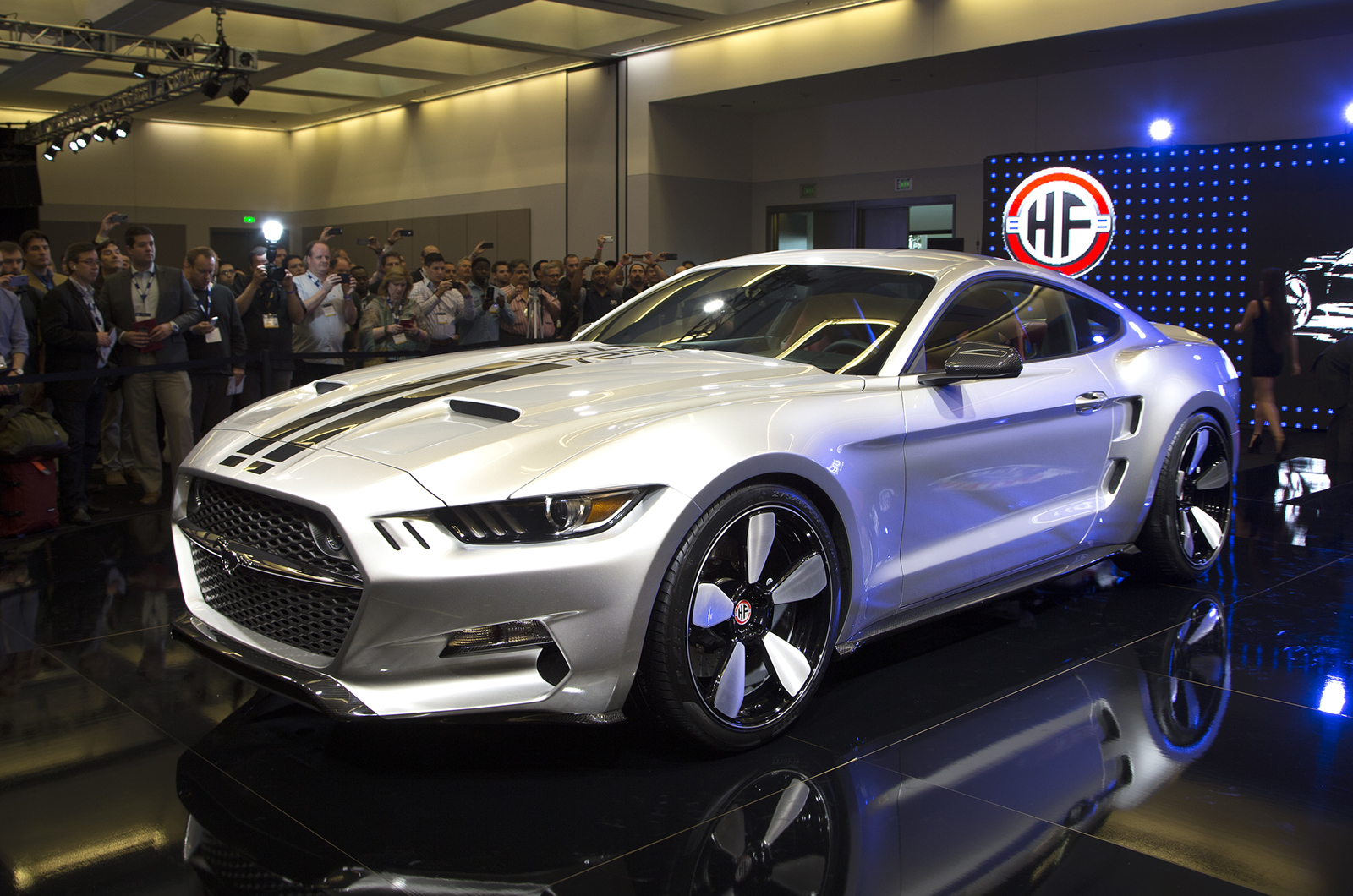
The Fisker Rocket is based on the sixth-generation Ford Mustang
It's small. That's what nearly everyone is saying about this year'sLos Angeles motor show. If it's just the highlights you want, you can visit them in a couple of hours. 
However, if the West Coast's most important motor expo is small, it is also perfectly formed. Whereas others in the expo game dedicate vast areas of show-stand real estate to widget manufacturers whose wares most show-goers couldn't even identify, much less appreciate, LA concentrates on motors that count, with plenty of variety in size and price.
This year's theme is indisputably the rise of hydrogen fuel cell cars. Honda, Toyota, VW and Audi were all there with vehicles that were drivable on LA streets and close to production-ready, and the lingering message from everyone was: we've designed and perfected the cars; now give us the infrastructure. 
VW Group, whose Hymotion Golf, Passat and Audi A7 h-tron Quattrowere joined by Toyota's Mirai and Honda's FCV in the fuel cell field, were let loose on LA in hacks' hands not to prove they were special, but that they were normal. 
These were common or garden electric cars, except that their power was generated on-board from hydrogen, their only tailpipe emission was water vapour and their only noise was a faintly-whirring compressor. 
How long before we can buy such a car? Some say they're coming to the UK next year. How long until hydrogen is in easy supply? Quite a lot longer. One reason these cars were made available in LA is because the Californian capital has a lot of fuelling stations by world standard - a princely total of 15.
Audi also went on the front foot, design-wise, with its beautiful Prologue concept, claimed to introduce a whole new design style. There's a wider, lower grille, new lights, a new attitude to "muscles" on the sides of the body, an architectural approach to the body lines that design the shape, and a new interior approach. 
It was well received, which is just as well. Forthcoming A6A7 and A8models are already influenced by this concept - compellingly explained by new design chief Marc Lichte, who was installed after group technical guru Dr Ulrich Hackenburg arrived a year ago to "sort out" Audi's forward models.
Mazda gave us hope of a new leader in the B-segment SUV class with its handsome but confusingly labelled CX-3 (what's a CX-2, then?) and Honda also weighed in with a pretty HR-V for the same sector, hopefully not to be dismissed like its faded predecessor as the Hip Replacement Vehicle.
Jaguar Land Rover always plays well in the US these days - which is probably why senior managers like Ralf Speth and Wolfgang Ziebart were prominently on hand instead of at the competing Guangzhou in China. 
They improved their cause with all-wheel drive and manual gearbox versions of the Jaguar F-type sports car, a hugely well-liked car in California, and with the new Land Rover Discovery Sport, also bound to play well with its particularly brilliant styling and five-plus-two seating.
Former Aston design boss Henrik Fisker, who has stepped away from the failed California-based business bearing his name and producing the Karma plug-in hybrid saloon, was on hand with a super-Mustang called Rocket, a 725bhp co-operative project between himself and the world's biggest Ford dealer, inevitably Californian.
The car, hugely muscular, is clad in hand-made carbon fibre panels and tipped to cost around £80,000 in the US. 
Playing for big money was the new Bentley Grand Convertible, which reprises the old Azure's aura by being happily powered by the venerable 6.75-litre pushrod V8, updated again.
It was interesting also to see Mercedes-Benz reprising the Maybach name we all thought had been compromised in the remarkably tasteless and unsuccessful luxury saloon the group produced to do battle with the Rolls Phantom, back when that car was new. It spectacularly lost the battle.
Mercedes-Maybach is to become a luxury line, just as Mercedes-AMG is the sporty line, and judging by the general approval afforded to the V12-engined S600, now clearly an S-class variant, it is going to work.
The American marques mostly disappointed us. There wasn't much to see on their stands (Buick looked like a deserted parking lot) and their offerings were mostly updates - four pipes, hood vents and a splitter for the new Caddy ATS-V coupé, for instance, and it's not even a 2015 model. 
That all seems to prove that the LA Show's fabled tussle for US supremacy with Detroit's show in January is far from won. In fact, if Motown can field a decent number of interesting American creations in two months' time, it might even have been lost.

Source: Autocar