Showing posts with label EPA. Show all posts

Sunday, July 1, 2018

Ford Hits CO2 Emissions Targets — 8 Years Early!


Earlier this week, Ford announced that it had achieved its stated goal to reduce the CO2 emissions of its manufacturing facilities to more sustainable levels. The kicker, though, is that it didn’t just meet its 2017 goal. The Blue Oval has met its 2025 goal. (!)
I will freely admit that I’ve been a bit hard on Ford lately forever, but stuff like committing its EV development to China while its US lineup languishes is annoying. The company’s decision to wait for an NEP mandate to commit to electric, biofuel, or fuel cells is also pretty f***ing maddening. Still, this is a big win, and I’m happy to give the Ford guys a well-earned victory lap for it.
You can check out the official Ford press release, below. Then let us know what you think of the company’s efforts to reduce its carbon footprint in the comments section at the bottom of the page. While you’re there, feel free to bitch and moan about how terrible the Electric Focus is, too. Enjoy!

    FORD HITS CO2 MANUFACTURING EMISSIONS REDUCTION TARGET EIGHT YEARS EARLY

    • Ford Motor Company announces in its 19th annual Sustainability Report that it has achieved the company’s manufacturing emissions reduction goal eight years ahead of schedule
    • The goal was set in 2010, aiming to reduce the company’s global carbon dioxide emissions from manufacturing operations by 30 percent per vehicle produced by 2025
    • Ford’s energy conservation work played a major role in achieving the goal eight years early, including paint and other process improvements, LED lighting, plant consolidations and new energy efficient facilities – and more
    DEARBORN — Today Ford Motor Company announces as part of its 19th annual Sustainability Report it has met its goal to reduce manufacturing emissions – eight years ahead of schedule.
    In 2010, Ford’s Environmental Quality Office announced a goal – to reduce the company’s carbon dioxide emissions from manufacturing operations by 30 percent per vehicle produced by 2025. Ford hit the target twice as fast as expected. The results are dramatic, with a global manufacturing CO2 emissions reduction of more than 3.4 million metric tons from 2010 to 2017 – equivalent to greenhouse gas emissions from more than 728,000 passenger vehicles driven for one year.
    “We are proud of the work we have done to achieve this goal,” said Bruce Hettle, group vice president, manufacturing and labor affairs. “We’ve made several improvements to our manufacturing operations – from the lighting we use to plant consolidations – all of which played a role in dramatically reducing our CO2 footprint.”
    Ford reduced its emissions footprint through energy conservation and efficiency changes at Ford’s manufacturing facilities, such as installing more than 100,000 LED light fixtures and updating paint operations.
    “Painting operations use a large amount of energy,” said Andy Hobbs, director, environmental quality office. “Introducing technology that allows wet-on-wet paint application and eliminates a drying oven, in more plants has significantly decreased energy use while maintaining quality.”
    Minimum Quantity Lubrication is another energy-reducing technology. In MQL, a machining tool is lubricated with a very small amount of oil sprayed directly on the tip of the tool in a finely atomized mist, instead of with a large quantity of coolant/water mixture.
    Ford now is working on setting a new goal – this one, focused on renewable energy. “We will continue to set ambitious goals and work to create innovative practices to achieve them,” said Hettle. “Our next strategy will focus on increasing Ford’s use of renewable energy while maintaining our energy efficiencies.”
    Ford also remains focused on reducing vehicle emissions by doing its share to deliver on CO2 reductions consistent with the Paris Climate Accord. The company is charting its course for the future by investing $11 billion to put 40 hybrid and fully electric vehicle models on the road by 2022.


Source | Images: Ford.

Sunday, June 3, 2018

Report: Trump EPA plans to cancel California emissions waiver

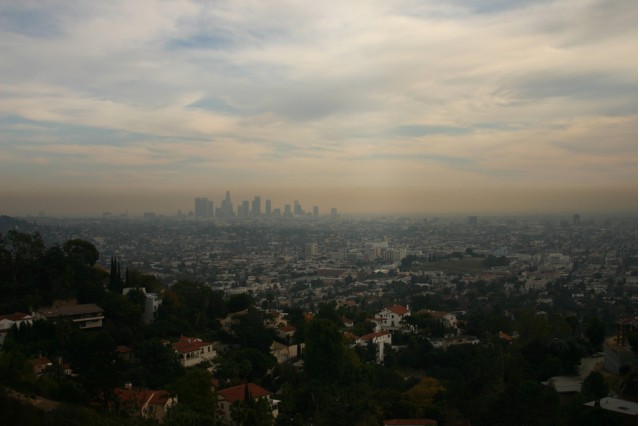
Smog over Los Angeles, courtesy Flickr user steven-buss


The EPA is planning to cancel the special waiver that California has relied on since 1970 to set its own emissions standards, according to a Bloomberg report.
As part of its plan to reverse a program to steadily tighten fuel economy standards that it coordinates with California and the National Highway Traffic Safety Administration, the EPA has drafted a proposal to freeze those standards in 2021 and prevent California from setting its own standards, the Bloomberg report says.

California has had the right to set its own standards since President Richard Nixon signed the Clean Air Act Extension in 1970, because California had already implemented its own emissions limits to clean up the smog that got trapped in the Los Angeles basin. The Act required the EPA to grant California special waivers to set its own tighter standards, as long as they meet certain requirements, because it already had a program in place to mitigate pollution in LA. The steady sunshine there creates more smog, and cool ocean air blowing over the coastal mountains traps the smog in populated inland valleys.
Now, for the first time, the EPA is planning to cancel that waiver, according to the draft proposal. The Bloomberg report cited sources familiar with discussions, but not authorized to talk about the proposal publicly.
The EPA is involved in fuel economy standards because of a 2007 Supreme Court ruling that required the EPA to regulate carbon-dioxide emissions, which can only be done by improving fuel economy. Since 2009, the EPA has worked with NHTSA and the California Air Resources Board to coordinate fuel economy standards. The NHTSA, part of the Department of Transportation, officially sets fuel economy standards, while the EPA regulates emissions including carbon dioxide.
California and 16 other states (plus Washington, D.C.) announced last month that they would sue the EPA over its plan to reverse scheduled increases in fuel economy standards for the 2020 through 2025 model years. The 16 states (plus D.C.) that sued include 12 that follow California's tighter standards. Other states are forbidden from setting their own emissions standards under the Clean Air Act, but they can choose to follow California's standards instead of the EPA's.

Congress required fuel economy standards to be raised for the first time since 1992, to at least 35 mpg, under the Energy Independence and Security Act, signed by President George W. Bush in 2007. After the 2008 election, the Obama Administration was left to implement the increases in the face of the 2007 Supreme Court ruling on CO2 emissions. It set a rising curve of standards through 2025, with a "mid-cycle review" scheduled for 2017—after a new President would take office—to address whether standards following that were realistically achievable.
During the 2016 election, in the final years of the Obama Administration, the EPA documented its case for maintaining the standards in a 1,200-page review. After Donald Trump was elected in November 2016, the EPA finalized its decision to keep the increasing standards in place through 2025 in the final month of Obama's presidency.
As soon as Trump took office, the automakers met with the new Administration to ask that the mid-cycle review be reopened with an eye toward loosening the standards. After Scott Pruitt was appointed EPA Administrator he reopened the review, providing a 38-page legal justification.
This week, the Science Advisory Board, an EPA watchdog, took issue with Pruitt's justification, saying it didn't pass scientific muster, and the board plans to review the decision.
After the 17 states decided to sue and a public uproar ensued, the automakers went back to the Trump Administration and reiterated that the most important thing to them was to have a single set of fuel economy standards that they could count on.
Following that meeting, the EPA reportedly added the proposal to revoke, or circumvent and nullify the California waiver, effectively requiring that all states follow the same emissions and fuel economy standards.

If the EPA attempts to revoke or nullify California's waiver and the states' lawsuit continues, however, fuel-economy standards are likely to be tied up in court with an uncertain outcome for years.
"It's very unclear what they're doing," says Simon Mui, a senior scientist at the Natural Resources Defense Council. "From a legal standpoint, this has never been done before."

Thursday, September 28, 2017

California Ponders Banning Internal Combustion Engines From Its Roads

California may join the growing list of places where vehicles power by internal combustion engines will soon be no longer welcome. China is the principle driver of the idea. With the largest new car market in the world, it carries tremendous clout . But France, the UK, and India are also beating the drum for a ban on cars powered by internal combustion engines.
CARB logo
Mary Nichols is head of the California Air Resources Board. She says she is getting “love notes” from governor Jerry Brown asking why California is not following China’s lead by starting to plan for the demise of conventional cars with internal combustion engines. “I’ve gotten messages from the governor asking, ‘Why haven’t we done something already?’” Nichols told Bloomberg in an interview on September 22. “The governor has certainly indicated an interest in why China can do this and not California.”
Brown is one of the most ardent climate change activists, pledging that his state will adhere to the commitments made by the United States to the other nations of the world at the COP 21 conference in Paris in 2015. He has reached out to other governors to join him in resisting the ignorance flowing from the federal government under the leadership of #FakePresident Trump.
California is the largest car market in the US (Texas is a close second), which gives it enormous influence over the kinds of vehicles that get sold in all 50 states. At present, ten other states follow the emissions regulations prescribed by CARB. While car makers rail against how stringent they are, those rules are actually quite mild compared to emissions standards in other countries, especially China.
The key to profitability in the car business is spreading the cost of developing new products over as many units as possible. That means companies cannot afford to build cars solely for the California market. They have to sell them in all 50 states in order to amortize the investment needed to meet California’s standards. The same holds true globally. What China requires will impact the vehicles car companies sell in other countries.
The industry complains long and loud about how burdensome emissions regulations are but what really sticks in their craw is having to meet a bewildering welter of confusing, conflicting, and often contradictory regulations imposed by the nations of the world. They have a point. Much time, effort, and money goes into trying to satisfy rule makers in multiple countries rather than just building cars. And none of them want governments to kill the goose that laid the golden egg. The internal combustion engine is the bedrock upon which the automobile industry is founded.
California is able to impose higher standards for cars sold within its borders thanks to a waiver from the Environmental Protection Agency that dates back decades. But the EPA is now in the hands of rabid, foaming at the mouth climate change deniers. It is unlikely they would go along with any proposal to ban internal combustion engines entirely.
Mary Nichols thinks there is a way to get it done anyway without involving the feds. The state could use other means, such as its power to license the cars that are permitted to use its roads. And every state is free to set its own tax policies. California could simply tax conventional cars out of existence. “We certainly wouldn’t expect to get a waiver for [banning conventional cars] from EPA,” Nichols says. “I think we would be looking at using some of our other authorities to get to that result.”
India and China are looking at 2030 as the date when an internal combustion ban could take effect. France and the UK are looking a little further down the road. 2040 is more what they have in mind. And California? “There are people who believe, including who work for me, that you could stop all sales of new internal-combustion cars by 2030. Some people say 2035, some people say 2040,” she said. “It’s awfully hard to predict any of that with precision, but it doesn’t appear to be out of the question.”
Source: Bloomberg

Sunday, January 29, 2017

Ford CEO told Trump 1 million jobs at stake because of fuel economy regs


Bloomberg is reporting that Mark Fields, Ford's CEO, pushed President Donald Trump for market-driven national fuel economy standards, and that up to a million jobs could be at stake if those national regulations didn't take consumer expectations into account.

Fields was reporting on his conversation with Trump in remarks made at the National Automobile Dealers Association in New Orleans, Bloomberg reports. The report also states that he and fellow CEOs Mary Barra of GM and Sergio Marchionne of FCA aren't seeking to eliminate fuel economy standards altogether, but rather to make them more flexible.

Bloomberg reports that Fields didn't cite the studies he was referring to in support of his job loss figures, so we can't independently verify Fields' math at this time. But his push to stop selling cars consumers don't want – that is to say, more hybrids and EVs than consumer demand supports right now – is clear. We've already reported on that.

To level an educated guess at what will happen next, Trump seems likely to reduce the stringent 2025 fuel economy targets, perhaps freezing them at current levels. The automakers are already invested in producing vehicles that meet current standards, and they also have to think about foreign markets like Europe that aren't likely to relax standards below current levels. If you consider economies of scale, automakers are likely to ask for federal standards that match global standards for their largest markets as closely as possible.

We'll see if Trump buys Fields' math, but Ford isn't hedging its bets. Backing out of the Mexican assembly plantcost the company $200 million – not a huge sum compared to the total value of Ford, a massive company which had its second best year ever, but still an important gesture to Trump about Ford's priorities.

Wednesday, January 25, 2017

Trump Meets US Car Company Execs: Who Said What And Why

Donald Trump held a meeting with all three US car company chief executives yesterday — Mary Barra, CEO of General Motors, Mark  Fields, CEO of Ford, and Sergio Marchionne, CEO of Fiat Chrysler. Prior to the meeting Trump tweeted, “I want new plants to be built here for cars sold here!” The three US car company leaders were only too happy to raise their voices in unison to praise Trump and his grand vision.
US car company execs meet with Trump
Body language speaks louder than words. Barra, Marchionne, Fields after meeting with Donald Trump. Photo credit: Reuters
“He looks forward to hearing their ideas, on how we can work together to bring more jobs back to this industry in particular,” White House press secretary Sean Spicer said. That would be the same Sean Spicer who two days ago stood up in the White House press room and blatantly lied about the size of the crowd during the inauguration.

Trump is an environmentalist

Trump told the group,  “I am to a large extent an environmentalist. I believe in it, but it’s out of control.” Trump is a man who knows a thing or two about being out of control. Today, he has announced plans to ram through both the Dakota Access pipeline and the moribund Keystone XL pipeline, proving that his brand of environmentalism is all about burning more fossil fuels and fattening the profits of oil company executives.
After the meeting with domestic car company execs, Barra told the press it was “very constructive and wide-ranging,” saying it focused on “policies that support a strong and competitive economy and auto industry,” and “that support the environment and safety and jobs creation.”
Fields was effusive in his praise. Having been slapped around by Trump because of Ford’s manufacturing plants in Mexico, Fields showed he was a quick study who knew how to sing from the Trump hymnal when required. “We’re excited about working together with the president and his administration on tax policies, on regulation, and on trade to really create a renaissance in American manufacturing,” Fields said after the meeting.
Nothing in his remarks had anything specifically to say about making automobiles. Rather, they were in response to Trump’s decision to withdraw from the Trans Pacific Partnership. “We’ve repeatedly said that the mother of all trade barriers is currency manipulation, and TPP failed in meaningfully dealing with that, and we appreciate the president’s courage to walk away from a bad trade deal,” he said. The elephant in the room is China, which has been accused of currency manipulation ever since it embraced its own version of capitalism several decades ago.
Marchionne, who is openly seeking a buyer for Chrysler, chimed in with this: “I appreciate the President’s focus on making the US a great place to do business. We look forward to working with President Trump and members of Congress to strengthen American manufacturing.”

Cutting government regulations

Trump thumped his chest about one of his favorite topics — government regulations. “We think we can cut regulations by 75 percent. Maybe more,” Trump said. “When you want to expand your plant, or when Mark wants to come in and build a big massive plant, or when Dell wants to come in and do something monstrous and special — you’re going to have your approvals really fast.”
Predictably, he made no mention of which regulations he was referring to, but one can make some informed guesses. OSHA regulations that protect workers from losing body parts in pursuit of corporate profits would be a good place to start. Minimum wage and overtime pay provisions? Who needs them? Environmental limitations on  the use of toxic materials that protect workers from industrial hazards? They cost business a lot of money. Clean air and clean water requirements also cost corporations bigly.
The most important ones, of course, are any and all rules that force car makers to manufacture vehicles nobody wants to buy. That would include CAFE and tailpipe emissions standards. Get rid of them and American manufacturers would find it a lot easier to sell high profit cars and trucks that average 15 mpg or so instead of wasting precious resources on hybrid and plug-in hybrid technology. No need to plow scarce corporate cash into EV charging infrastructure. Let the good times roll.
Perhaps Barra and company can bring back the Hummer brand. Those were vehicles every red blooded American craved. Who wouldn’t want to commute in a big, rugged truck the size of an Abrams tank? Those were the days, folks, back before Democrats and tree huggers started shouting about climate change and global warming.

The curse of protectionism

Forget about melting ice sheets. Trump and his acolytes are relying on “alternate facts.” But there is more to this than just keeping the earth safe for human habitation. As Stef Schrader points out in Jalopnik, “If America wants to be ‘great,’ it needs to produce the greatest cars on earth, not cars that are just okay enough to get by within its own borders.” Gee, you mean American car companies should be concerned about selling cars in other countries? What a novel idea.
She points out that protectionism in the form of high tariffs keep good cars out and allows domestic manufacturers to build junk. Need an example? Look at the British car industry. Favored by high tariffs after World War II, it built a succession of increasingly inferior cars until it literally ceased to exist. Today, the only good parts of the British car industry are owned by foreign companies, most of them German. Go figure. What Hitler couldn’t do with his V-1 rockets, the British people did to themselves.
Schrader also has harsh words for a prior era of American protectionism. Following the 1979 oil embargo, American car companies pleaded for relief from the onslaught of well made, fuel efficient cars from Japan. What they got was a program known as “Voluntary  Export Restrictions” in which Japanese manufacturers supposedly agreed to limit the number of cars coming into the US.
As a result, claims Schrader, “Instead of simply making better cars to beat the likes of Honda and Toyota at their heown game, we ended up with domestically-made crapcans like the Chevrolet Citation II and the Chrysler K-cars.” She omitted the equally dreadful Ford Pinto.
The architect of the Voluntary Export Restrictions was one Robert Lighthizer. And who has The Donald tapped to be his lead trade representative? Robert Lighthizer. It’s back to the future all over again.
One other thing to keep in mind is that limiting competition inevitably raises prices. What will all those Trump cheerleaders have to say when the price of cars increases to pay the higher wages commanded by American workers? There’s a reason why Walmart is the largest retailer in the world and it doesn’t have anything to do with domestically produced goods.
There are two thoughts applicable here. One is, those who don’t know history are doomed to repeat it. The other is, be careful what you wish for. You just might get it.

Saturday, January 14, 2017

EPA Accuses Chrysler Of Diesel Emissions Cheating

It’s deja vu all over again. Yesterday, the EPA accused Chrysler of deliberately installing software that allows certain diesel engines sold in its vehicles in the United States to exceed pollution limits set by the agency. Chrysler stock plunged 15% on the news before trading was halted. It latter recovered somewhat but still finished the trading day down 10%.
Dodge Ram diesel pickup

Nitrous Oxides Are A Health Risk

Like the diesel emissions scandal that swept over Volkswagen in 2015, at issue is the level of nitrous oxide emissions from the vehicles affected. Nitrous oxides are considered far more of a health risk than carbon dioxide, especially for the young, the elderly, and those with preexisting respiratory conditions.
Cynthia Giles, an assistant administrator at the E.P.A., tells the press that nitrous oxides “threatens public health by polluting the air we breathe,” said  She said the software in question allowed the engines in question to spew more of them out their tailpipes than permitted by regulations. She said there is “no doubt” that the software “is contributing to illegal pollution.”
The EPA alleges that 104,000 Chrysler vehicles are involved, including Jeep Grand Cherokees from model year 2014, 2015, and 2016. Dodge Ram 1500 pickup trucks with 3 liter diesel engines sold are also involved. EPA regulations call for a maximum penalty of $44,500 for each non-conforming vehicle.

Why Now?

The fact that the EPA initiated this action just days before President Obama leaves office is no coincidence. No one expects Trump’s EPA to care one way or the other about human health. Instead, its focus will be on gutting as many environment regulations as possible to promote manufacturing. Whether people die as a result is of no concern to The Donald.
“It’s very important that they’re doing this now,” says Frank O’Donnell, president of Clean Air Watch, a Washington advocacy group. “They’ve got polluter lobbyists massing at the gate of both Congress and the White House. This case underscores the importance of keeping a federal environmental cop on the beat at E.P.A.”
Sergio Marchionne, the mercurial CEO of Fiat Chrysler, was quick to blast the EPA action.  “There’s not a guy” at Chrysler “who would try something as stupid” he told reporters during a conference call. “We don’t belong to a class of criminals,” he added. “We have done, in our view, nothing that is illegal.”
That last part may be a reference to the fact that Volkswagen has just entered guilty pleas to charges of conspiracy to commit wire fraud and to violate the Clean Air Act, and to customs violations and obstruction of justice. In addition, six Volkswagen executives have been indicted on various criminal charges.

Has Fiat Acted In Bad Faith?

Notwithstanding Marchionne’s remarks, Fiat is in plenty of hot water with European authorities over similar diesel cheating allegations. Fiat was the only company who failed to send a representative to a recent meeting between EU regulators and car makers. Ignoring the meeting seriously annoyed EU officials. Tests have confirmed that Fiat used the simplest means yet to discovered to defeat diesel emissions testing. In Europe, the testing protocol is 20 minutes long. Fiat allegedly simply programmed all its emissions controls to shut off after 22 minutes.
Diesel emissions cheating is rampant in the industry, driven by manufacturers’ desire to be able to advertise high fuel economy. Chrysler’s decision to offer the 3 liter diesel engine in its Ram 1500 pickup trucks allowed it to trumpet that its trucks got better fuel economy than those from Ford and Chevrolet. It is no coincidence that Ford has just announced it will offer a diesel engine in its own light duty pickup truck, the F 15o, starting in 2018.
John German, senior fellow at the International Council on Clean Transportation, whose initial work on Volkswagen’s emissions levels exposed cheating by that company, sys the E.P.A case against Chrysler was not as clear cut but he expects the company to have difficulty defending itself against the government’s accusations.
“Fiat Chrysler will not only have to defend their software, but prove that it does the bare minimum to protect the car’s engines,” Mr. German says. The complexity of modern diesel technology and the trade-offs between emissions controls and engine performance have motivated companies Fiat Chrysler to cut corners, he says. “It’s very enticing to take shortcuts,” he said. “But it’s absolutely possible for a diesel car to fully comply with U.S. emissions standards and have good drivability and performance. It just costs money.”

Diesels Are Different

In general, regulators permit manufacturers to decrease or eliminate pollution controls on diesel engines at certain times to protect them from damage from overheating and other factors. Many diesel engines have difficulty handling internal moisture from condensation at start-up, especially in cold weather. The rules allow the pollution controls to be bypassed at such times, but several manufacturers have pushed the rules beyond their logical intent.
Tests by independent laboratories have found some companies have set their software to turn off when ambient temperatures are as high as 70 degrees F, meaning they operate in some climates virtually pollution control free during much of their useful life, depending on what climate they operate in.
A report released by the The International Council on Clean Transportation just last week says that diesel emissions from cars are as much as ten times higher than those from heavy duty trucks and buses, primarily because testing protocols for commercial vehicles are much more stringent and done in the real world rather than in laboratories. The ICCT was instrumental in exposing the extent of the Volkswagen diesel emissions cheating.

What About The Future?

Diesel engines have been favored by manufacturers and governments for decades. Not only are they more fuel efficient than gasoline engines, when designed for commercial use they can last far longer. Diesel engines in buses often go at least a million miles before any major servicing is needed. Diesels are also famous for their abundant low end torque.
Electric motors also have strong pulling power as they have maximum torque at 0 rpm. The way out of the diesel pollution crisis that grips the world is not more or better software, it is a transition to non-polluting, clean  electric vehicles with no tailpipe emissions whatsoever. The dawn of electric trucks and buses is rapidly approaching.
Source: New York Times

Friday, November 25, 2016

2017 Honda CR-V Rated 34 MPG Highway, 30 MPG Combined

Small crossover vehicles like the Honda CR-V comprise one of the hottest market segments in the US and why not? They are superb family haulers that can cruise comfortably on the interstate while navigating easily on city streets and in shopping mall parking lots. They have the high seating many Americans prefer and most are available with all wheel drive for those who live in locations where slippery winter roads are a concern.
2016 Honda CR-V
If these vehicles have a downside, it is that they typically are somewhat thirstier than the most efficient sedans available today. Even at a time of record low gasoline prices, fuel economy is still an important consideration for most drivers. Nobody enjoys driving a gas pig that is capable of passing everything except a gas station.
The 2017 Honda CR-V equipped with the 1.5 liter turbocharged engine now has the distinction of having the highest EPA fuel efficiency rating of any vehicle in its class. The new model rides on the same global chassis that is the basis of the latest Honda Civic. In front wheel drive trim, its miles per gallon efficiency is rated by the EPA at 34 highway, 28 city, and 30 overall. That puts it ahead of all its peers.
  • 2017 Toyota RAV4 — 23/30/26 mpg
  • 2017 Kia Sportage — 23/30/26 mpg
  • 2017 Nissan Rogue — 26/33/29 mpg
  • 2017 Ford Escape — 23/30/26 mpg
  • 2017 Chevrolet Equinox — 21/31/25 mpg
  • 2017 Subaru Forester — 26/32/28 mpg
The Toyota RAV4 Hybrid has slightly better numbers in city mode but also costs more. It is rated 34/30/32 mpg by the EPA. The four wheel drive version of the new CR-V loses about 1 mile per gallon in all parameters. It is rated 27/33/29 mpg. One mile per gallon may seem an acceptable trade off for the security that all wheel drive offers.
In LX trim with last year’s 2.4-liter four-cylinder, the CR-V is rated 26/32/28 mpg with front-wheel drive and 25/31/27 mpg with all-wheel drive. The 2017 car is 1.5 inches longer, is an inch taller and rides on a 1.6 inch longer wheelbase. Production has begun at Honda’s factory in East Liberty, Ohio. It will also be made in Honda’s other facilities located in Alliston, Ontario and Greensburg, Indiana. Deliveries are expected to begin early next year.
Source: Motor Trend  Photo credit: Honda (2016 CR-V shown)

Monday, November 21, 2016

Hyundai Ioniq Most Efficient Electric Car Says EPA

The EPA last week announced that the new Hyundai Ioniq battery electric car has been given an MPGe rating of 136. That is higher than the rating awarded to the BMW i3 (124 MPGe), the Chevrolet Volt (119MPGe) and Spark EV (119MPGe), the Volkswagen e-Golf (116MPGe), and Tesla Model S 60D (104MPGe). What is MPGe? For those who were absent in class that day, here’s a refresher from Wikipedia:
Hyundai Ioniq electric car
“Miles per gallon gasoline equivalent is a measure of the average distance traveled per unit of energy consumed. MPGe is used by the United States Environmental Protection Agency to compare energy consumption of alternative fuel vehicles, plug-in electric vehicles, and other advanced technology vehicles with the fuel economy of conventional internal combustion vehicles expressed as miles per US gallon.
“The MPGe metric was introduced in November 2010 by EPA in the Monroney sticker of the Nissan Leaf electric car and the Chevrolet Volt plug-in hybrid. The ratings are based on EPA’s formula, in which 33.7 kilowatt-hours (121 megajoules) of electricity is equivalent to one gallon of gasoline, and the energy consumption of each vehicle during EPA’s five standard drive cycle tests simulating varying driving conditions. All new cars and light-duty trucks sold in the U.S. are required to have this label showing the EPA’s estimate of fuel economy of the vehicle.”
Got that? The EPA assumes (and we all know about the word “assume,” don’t we?) that 33.7 kWh of electricity is equivalent to one gallon of gasoline. By that measure, if the Ioniq were a traditional car with an internal combustion engine, it could go 136 miles on one gallon of gas.
Here’s more from Korean website Dong-A. “Unlike ‘miles on a single charge’ that extends as the number of batteries with large capacity increases, the MPGe is an economic indicator that considers the cost of charge. The EPA estimated the yearly fuel cost of the Ioniq Electric at 500 dollars, the lowest among other competing vehicles.”
Putting all the technical jargon aside, what it comes down to is that the Ioniq electric car, which is coming to the US in the middle of 2017, is a very efficient machine. Unfortunately, it has a rather limited range of 124 miles. Popular perception is that an EV should have at least 200 miles of range before mainstream shoppers will even consider it.
That is a misconception, of course. Owners of gasoline powered cars don’t start every day with a full tank but owners of electric cars start every day with a fully charged battery — assuming they remember to plug in at night. The saving grace for the Hyundai offering is that it may cost significantly less than than cars with 200 miles or more of range.
Batteries are costly, so a smaller battery should result in a smaller price. Lots of people still vote with their wallets, so the Hyundai may be able to carve out a nice chunk of the EV market if it costs thousands less than competitors like the Nissan LEAF and Chevy Bolt. Hyundai has not yet released pricing information for the car.

Monday, July 11, 2016

Auto Makers Pushing For A Rethink Of Fuel Economy Standards

Auto makers are lobbying the federal government to rethink its mandate to raise average fuel economy to 54.5 mpg by 2025. The new rules are set to go into effect in 2018. The companies have several concerns about the tighter standards, but it all comes down to selling cars. They worry that consumers will not like the changes meeting the new rules will require and that will hurt sales. The car industry is hugely important to the US economy. A decline in sales could have a ripple effect that would take some of the steam out of an economy that is just showing signs of life after the debacle of 2008.
June fuel economy stats
The debate about what to do with fuel economy standards dates back to the 70’s. Before that, gas was 60 cents a gallon, global warming was something only Al Gore worried about, and people were content to lumber around in big cars powered by V-8 engines. 4 cylinder cars were for wimps and losers. Then OPEC was formed and America went into cardiac arrest, economically speaking. CAFE, or Corporate Average Fuel Economy ratings, were orignally designed to help America break free of imported oil.
We went along with the plan because it was our patriotic duty. 4 cylinder cars were suddenly cool. Models like the original Volkswagen Rabbit GTI proved that being fuel efficient didn’t have to mean driving dull cars. Since then, the size of the vehicles Americans prefer has gone up and down in lockstep with fuel prices. Soon gas was cheap again. General Motors brought out its Hummer lineup, featuring thirsty ground pounders that looked like military assault vehicles. Ford countered with the F250 based Excursion. People couldn’t get enough of them.
Then 9/11 happened, followed closely by the collapse of the global economy engineered by the robber barons of Wall Street. Gas shot up to over $4.00 a gallon and Americans decided they really wanted small cars after all…for awhile. In late 2014, oil prices plummeted and gas was selling for under 2 bucks a gallon. The demand for larger, thirstier vehicles returned with a vengeance.
First CARB then the EPA stopped using fuel economy standards as a way to reduce dependence on foreign oil. Instead, they changed it into a tool for addressing the carbon  emissions being emitted by the transportation sector. In fact, fuel economy is a poor way of addressing emissions. The European Union takes a much more direct and honest approach with regulations that target emissions rather than mpg. The two are related, or course, but using fuel economy as a measuring stick only complicates the process.
The CAFE system has become grossly distorted over the years. For one thing, CAFE numbers are different for different categories of vehicles. The smaller the car, the higher the standard. The larger the vehicle, the lower its fuel economy can be and still comply with EPA targets. The upshot of that piece of bureaucratic brilliance is that Fiat Chrysler has decided to stop making smaller sedans with good fuel economy so it can concentrate on making large trucks and SUV with an outsize appetite for gasoline. The regulations end up encouraging manufacturers to make vehicles that pollute more rather than less. How stupid is that?
For another thing, CAFE numbers are calculated using the old formula. It was discarded years ago as the way to calculate the numbers you see on the window stickers of new cars because it had absolutely no relationship to real world mileage. If CAFE regulations used the more realistic method, the target would be about 20% less — 43.6 mpg instead of 54.5. Building cars that get 43.6 mpg seems fairly doable in a day when many passenger cars already get 35 mpg or better. After all, we are talking about 8 years from now. Surely car companies could find a way to wring 43.6 mpg out of their cars by then?
John Bozzella, CEO of the Association of Global Automakers, told the EPA and CARB recently he wants the upcoming analysis to review assumptions about fuel prices, consumer preferences, and technologies to see whether the targets are still feasible. He says ideas like start-stop systems and hybridization will be required to meet the higher standard. Customers will notice and that may hurt sales. “When we think about the really challenging standards out to 2025 … we’re talking about investments and strategies that are no longer invisible to customers,” Bozzella said.
Bozella also would like EPA, NHTSA, and CARB to harmonize their regulations, so automakers would have one clear goal, not three. That part makes eminently good sense, so much so that we can be sure the regulators will ignore it entirely. Common sense is rarely a component of the regulatory process.
The point this debate misses is that we need to reduce or eliminate carbon emissions from passenger vehicles. The car companies are really looking at the world through the wrong end of the telescope. It’s not about selling more and bigger cars that spew more pollution. It is about changing the driving habits of Americans. The lunatic fringe on the right screams about honest businessmen trying to make a living but being balked by heavy handed regulations. That’s not what this is about at all.
What is is about is avoiding a climatic catastrophe that will imperil the lives of billions of people.We have to stop dumping the effluent of civilization into our skies, our oceans, and our land. We have to stop injecting billions of gallons of contaminated water into the earth to release a few more molecules of natural gas. We have to stop burning coal. We have to stop selling cars with internal combustion engines. There is no other way.
Trying to accomplish all those things using CAFE as the main policy tool is just ridiculous. The only way for it happen is to make the cost of fossil fuels higher than the alternative. Then people will demand non-polluting cars without the need for regulations. Its time to stop fooling around with policies that don’t work and start devising mechanisms that do. Create the right economic incentives, then get out of the way and let the great unseen hand of the marketplace work its magic.
Source: Scientific American via Climatewire