Showing posts with label 2017 BMW i3. Show all posts

Saturday, December 2, 2017

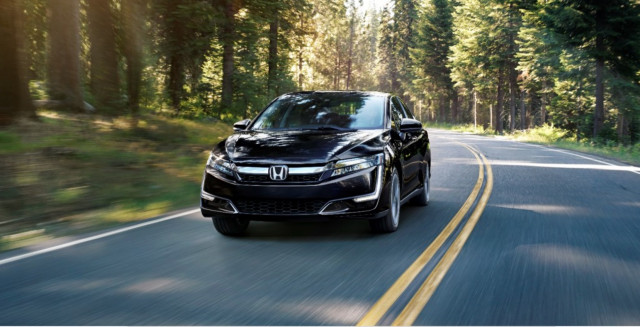
2018 Honda Clarity Plug-In Hybrid starts at $34,290 with 47-mile range

2018 Honda Clarity Plug-In Hybrid


The 2018 Honda Clarity Plug-In Hybrid will start at a recommended price of $34,290 including delivery, making it the least expensive plug-in hybrid sedan on the market this year.
Honda says it will go on sale December 1, and it will be offered at all Honda dealers in the U.S.

That means that for the first time, U.S. buyers can choose between two plug-in hybrids with more than 45 miles of range at prices starting under $35,000.

The 2018 Clarity Plug-In five-seat mid-size sedan is rated at 47 miles of electric range, and 42 mpg combined when operating as a conventional hybrid after the battery is depleted.
The 2018 Chevrolet Volt compact hatchback is rated at 53 miles of range and 42 mpg combined; it starts this year at $34,095, also including the mandatory delivery fee.
While the Volt has a fifth "seating position" on a padded hump between two rear seats, it's functionally a four-person vehicle.
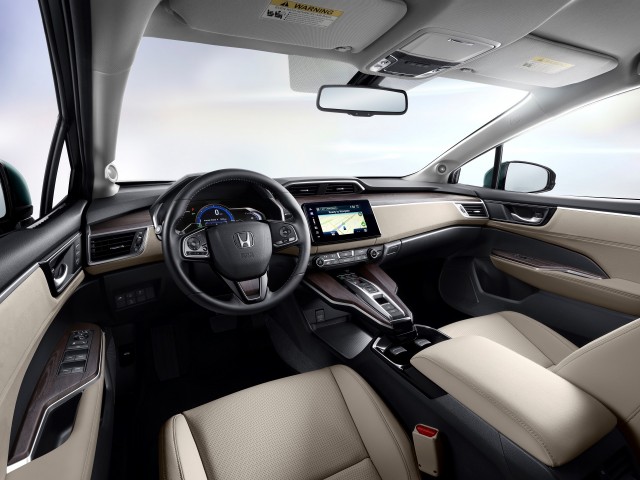
2018 Honda Clarity Plug-In Hybrid


The Volt and the plug-in Clarity are two of the top three plug-in hybrids when rated on battery range, both following the range-extended electric BMW i3 REx with 97 miles of battery range.
All three vehicles are close in energy efficiency, too: When operating in electric mode, the plug-in Clarity is rated at 110 MPGe, against the Volt's 106 MPGe and the i3 REx at 111 MPGe.
Among plug-in hybrid mid-size sedans, however, the Clarity is the clear leader, surpassing the rated range of plug-in hybrid versions of the Ford Fusion, Hyundai Sonata, and Kia Optima

The 2018 Honda Clarity Plug-In Hybrid is offered in standard and Touring trim levels.
All plug-in Clarity sedans come with keyless entry and start, an 8.0-inch touchscreen and eight-speaker audio system, dual-zone automatic climate control with rear vents, heated front seats, 18-inch alloy wheels, and LED lights front and rear.
They also include the LaneWatch video camera that shows the right-hand blind spot in the display, and the Honda Sensing active-safety system.
Honda Clarity Plug-In Hybrid at Honda R&D Center, Tochigi, Japan, June 2017


The Touring model adds a navigation system with charging-station locations built in, an eight-way power adjustable driver's seat and four-way front passenger's seat, perforated leather upholstery and imitation-suede interior, and a leather-wrapped steering wheel.
Recommended prices for the Clarity Plug-In Hybrid Touring line begin at $37,490.
All plug-in hybrid Claritys are powered by a 1.5-liter Atkinson-cycle inline-4 with Honda's two-motor hybrid system, which takes the place of a transmission.

One motor, rated at 135 kilowatts (181 horsepower) and 232 pound-feet of torque, can drive the car itself under many circumstances, especially at lower speeds.
The default driving mode, Normal, runs on battery power until the pack is depleted and then essentially turns into a conventional hybrid car.
A separate toggle for "HV" (or Hybrid Vehicle) mode can be selected with any of the three driving modes; it operates the car and maintains battery charge for later all-electric use.
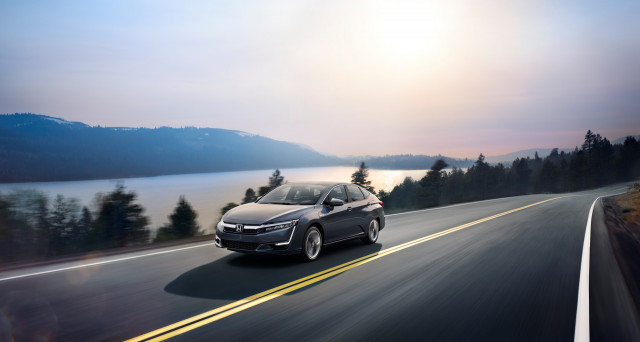
2018 Honda Clarity Plug-In Hybrid


A Sport mode uses the battery and engine more aggressively, while the Econ mode reduces power draw and cabin ventilation to extend the range, along with slower acceleration.
The 17-kilowatt-hour lithium-ion battery pack is located behind the rear seat, with a quoted recharge time of 2.5 hours when using a 240-volt Level 2 charging station.
The challenge for Honda, as it has been for Chevrolet and other makers, is that car buyers generally have no understanding of plug-in hybrids or why they would be advantageous.

Monday, July 31, 2017

Motor Trend Pours Love On Tesla Model 3

Well, Motor Trend’s fairly early and outspoken love for the Tesla Model S certainly hasn’t hurt its Tesla test drive opportunities. The mainstream auto magazine got yet another super exclusive opportunity to test out the Model 3, this time 36 hours before the final reveal last night.
Tesla Model 3
The entire article may be worth your time to read. I have to admit that I found it a little verbose and flowery for my own taste, but just heading over there to check out the photos is a must. Additionally, there were 4 gems in the article that I found super interesting. They almost seemed hidden in the bushes of the overall story and in the midst of all the details we learned from Tesla in the past 24 hours, so I wanted to pull them out for stronger highlighting, discussion, and future reference.
1. The Model 3 Feels More Spacious Than You’d Expect
“Tesla worked hard to increase interior space, and subjectively it succeeded. For a compact car, the Model 3 feels incredibly light and airy,” Motor Trend Testing Director Kim Reynolds wrote.
This surprisingly light & airy feel is something that I find keeps popping up with electric vehicles designed electric from the ground up, not just the Model 3. This is a highlight of the BMW i3 that we discussed at length in a recent #Electrifying webinar.
When it comes to the Model 3, this is something we also got a hint of from the EV Annex boys last year at the first Model 3 unveiling, and again today during our latest #Electrifying webinar. However, it’s nice to see it confirmed and emphasized by another source — and one that has presumably had the most time with the Tesla Model 3 outside of Tesla’s staff.
As Matt Pressman hinted today and I think Elon hinted last night, the back seats of the Model 3 may even feel more spacious and open than the back seats of the Model S, thanks in part to that supersplendulous windshield it stole from the Model X.
2. Slickest Freakin’ Air Vents In The Business
“Interior air (from subtle vents) is aimed by moving spots around on the display, even dividing the airflow to send it past each ear.”
I imagine this may seem like a small thing to many people, but think about it: how many times have you been irritated by the annoying, undesired direction an air vent was blowing? How many times have you or someone else just not been able to get the air flowing in an ideal way for all the car’s passengers? HOw many times has an air vent blasted you in the eye like a Super Soaker?
This “small” improvement in the Model 3, if it’s as it sounds from Motor Trend‘s reporting, is one of those little things that make Tesla just that much better than the luxury car competition. This is actually one of the things I’m most excited to play with when I finally get my hands on a Model 3!
3. The Frunk, Conceptualized
“Up front, the frunk is precisely sized to hold a carry-on suitcase. ‘If it’s too big here,’ Franz says, ‘you’re going to have to check it.’”
How big the frunk actually is, what it can fit, and what it’s ideal for carrying are all questions that frequently pop into people’s heads and out of their mouths. This description from Kim Reynolds (er, from Franz von Holtzhausen) is super useful for answering those questions. It would also be cool if this claim was legitimately correct — it would be awesome to get into a kerfuffle with a Ryanair suitcase Nazi and be able to tell them, “Nah, you’re wrong, it fit in my frunk.” (You Europeans know what I’m talkin’ about.)
4. Incomparable Driving Experience — A New Era
“What’s blanching, though, is the car’s ride and handling. If anybody was expecting a typical boring electric sedan here, nope. The ride is Alfa Giulia (maybe even Quadrifoglio)–firm, and quickly, I’m carving Stunt Road like a Sochi Olympics giant slalomer, micrometering my swipes at the apexes. I glance at Franz—this OK? “Go for it,” he nods. The Model 3 is so unexpected scalpel-like, I’m sputtering for adjectives. The steering ratio is quick, the effort is light (for me), but there’s enough light tremble against your fingers to hear the cornering negotiations between Stunt Road and these 235/40R19 tires (Continental ProContact RX m+s’s). And to mention body roll is to have already said too much about it. Sure, that battery is low, way down under the floor. But unlike the aluminum Model S, the Tesla Model 3 is composed of steel, too, and this car’s glass ceiling can’t be helping the center of gravity’s height. Nearly-nil body roll? Magic, I’m telling you. Magic. And this is the single-motor, rear-wheel-drive starting point. The already boggled mind boggles further at the mention of Dual Motor and Ludicrous.”
Yeah … ’nuff said.
Though, Reynolds also added a note about the car he drove away after the Model 3 was gone:
“By happenstance, associate road test editor Erick Ayapana had penciled me into a 2.0-liter Alfa Romeo Giulia to get here, and it feels like a wet sponge by comparison.”
All images via Tesla

Monday, November 21, 2016

Hyundai Ioniq Most Efficient Electric Car Says EPA

The EPA last week announced that the new Hyundai Ioniq battery electric car has been given an MPGe rating of 136. That is higher than the rating awarded to the BMW i3 (124 MPGe), the Chevrolet Volt (119MPGe) and Spark EV (119MPGe), the Volkswagen e-Golf (116MPGe), and Tesla Model S 60D (104MPGe). What is MPGe? For those who were absent in class that day, here’s a refresher from Wikipedia:
Hyundai Ioniq electric car
“Miles per gallon gasoline equivalent is a measure of the average distance traveled per unit of energy consumed. MPGe is used by the United States Environmental Protection Agency to compare energy consumption of alternative fuel vehicles, plug-in electric vehicles, and other advanced technology vehicles with the fuel economy of conventional internal combustion vehicles expressed as miles per US gallon.
“The MPGe metric was introduced in November 2010 by EPA in the Monroney sticker of the Nissan Leaf electric car and the Chevrolet Volt plug-in hybrid. The ratings are based on EPA’s formula, in which 33.7 kilowatt-hours (121 megajoules) of electricity is equivalent to one gallon of gasoline, and the energy consumption of each vehicle during EPA’s five standard drive cycle tests simulating varying driving conditions. All new cars and light-duty trucks sold in the U.S. are required to have this label showing the EPA’s estimate of fuel economy of the vehicle.”
Got that? The EPA assumes (and we all know about the word “assume,” don’t we?) that 33.7 kWh of electricity is equivalent to one gallon of gasoline. By that measure, if the Ioniq were a traditional car with an internal combustion engine, it could go 136 miles on one gallon of gas.
Here’s more from Korean website Dong-A. “Unlike ‘miles on a single charge’ that extends as the number of batteries with large capacity increases, the MPGe is an economic indicator that considers the cost of charge. The EPA estimated the yearly fuel cost of the Ioniq Electric at 500 dollars, the lowest among other competing vehicles.”
Putting all the technical jargon aside, what it comes down to is that the Ioniq electric car, which is coming to the US in the middle of 2017, is a very efficient machine. Unfortunately, it has a rather limited range of 124 miles. Popular perception is that an EV should have at least 200 miles of range before mainstream shoppers will even consider it.
That is a misconception, of course. Owners of gasoline powered cars don’t start every day with a full tank but owners of electric cars start every day with a fully charged battery — assuming they remember to plug in at night. The saving grace for the Hyundai offering is that it may cost significantly less than than cars with 200 miles or more of range.
Batteries are costly, so a smaller battery should result in a smaller price. Lots of people still vote with their wallets, so the Hyundai may be able to carve out a nice chunk of the EV market if it costs thousands less than competitors like the Nissan LEAF and Chevy Bolt. Hyundai has not yet released pricing information for the car.

Thursday, June 23, 2016

Next BMW i3 Will Come In Two Flavors

Starting this fall, BMW i3 buyers will have three options: a new i3 with upgraded 33 kWh battery pack, a new REx i3 with the larger battery pack and range extender gasoline engine, or an i3 with the original 22 kWh battery pack. Prices are $44,595,, $48,350, and $43,350 respectively.
2017-bmw-i3_100553432_m
All three versions have the same 170 horsepower electric motor rated at 184 lb-ft of torque. 0 to 60 times of just over 7 seconds will remain for both cars without the range extender engine. REx models take about a second longer. With the upgraded battery, BMW will be able to unlock the full capacity of the 2.4 gallon gas tank. In the US, the capacity of the fuel tank was previously limited electronically to 1.9 gallons.
Offering customers different battery sizes is becoming a trend in the world of electric automobiles. The Nissan LEAF is now available either with a 24 kWh battery with 82 miles of range or a 30 kWh battery with 107 miles of range. Tesla has just announced the return of the 60 kWh battery in the Model S. The new model lists for $4,000 less than the original Tesla Model S 60, which was withdrawn from the lineup just a few months ago. The Tesla actually comes with a 75 kWh battery pack, but it issoftware limited to only 60 kWh of capacity. An upgrade to the full 75 kWh capacity is an $8,500 option.
The new i3 battery pack fits in the same space as the old one but uses new 94 amp-hour lithium ion cells with higher energy density than the 60 amp-hour cells used previously. Range is now listed at 114 miles.
The base i3 will continue to be offered in three trim levels—Mega World, Giga World, and Tera World. The i3 with the larger battery will be offered in new Deka World trim level standard. Cars with the 22 kWh battery will not be available with the eye catching Protonic Blue paint that debuted on the i8 last year. They will also not be available with the much sought after sunroof — a $1,000 option on cars fitted with the larger battery.

The 2017 BMW i3 is expected to go on sale in late summer or early fall.

Wednesday, May 4, 2016

BMW i3 Is Getting An Energy Boost From Larger Battery

The BMW i3 is scheduled to get an upgraded battery and more range soon. The increase is thanks to slow but steady improvements in battery technology. When it was first introduced, the i3 had a 22 kWh battery that could power the car for about 80 miles of driving. The new battery is rated at 33 kWh — a 50% increase — but fits in the same space as the original battery.
BMW i3 in Protonic Blue
BMW says range with the upgraded battery will be 114 miles. In addition, for those who order the REx version of the car with the 2 cylinder, 650 cc range extender engine, the size of the gas tank has been bumped slightly from 1.9 gallons to 2.4 gallons. Range for the REx car was listed as 150 miles total. That suggests the total range for the new car should be somewhere close to 200 miles, although BMW has not released any official figures yet.
The new version of the car will also feature faster charging of the battery. Previously, the 22 kWh battery needed 3.5 hours to recharge using a Level 2 240 volt charger. The new battery needs 4.5 hours, but keep in mind it is has 50% more capacity. If a DC fast charger is used, the new i3 can get to an 80% state of charge in 40 minutes. That is a few minutes longer than the 24 minutes needed in the current version of the car, but still an improvement in charging speed per kWh.
BMW has not said exactly when the i3 with the new battery will be available in the US, but when the time comes, it will offer the car  in the same Protonic Blue featured on the i8, the world’s best selling plug-in hybrid sports car. No one is sure what the word Protonic means, but the color looks awesome.
Even with all this added goodness, the BMW i3 will face increasingly stiff competition from the soon to be introduced Chevy Bolt and Tesla Model 3. Those cars will both list for less than the i3 and have greater range. The larger battery has created speculation about whether current i3 owners could swap in a new battery in place of the original. BMW has not said anything specifically about battery swapping, but it’s a good guess the price would be too high to make swapping worthwhile.

Wednesday, November 25, 2015

BMW i3 Getting 130 Mile EV-only Range for 2017

BMW i3 Gets 130 mile EV Range for 2016
Despite being a relatively rare and new sight on the road for most Americans, BMW’s i3 has been around since 2013- which means it’s time for an update, according to BMW’s product cycle. Unlike most models that get snazzier headlights and re-shaped passenger mirrors, however, the 2017 BMW i3 is getting something really useful: a 130 mile all-electric range.
While the news was confirmed by a BMW spokesperson, the full details still aren’t available. Exactly how BMW managed to increase the i3’s range by some 30% will be revealed “by the end of the year”, but it’s believed that the update will steal some thunder from the next-generation Nissan Leaf when that car launches.
Even without knowing all the hows and whys involved, you can bet that the bump in range will make the i3 even more appealing than it today … and it’s already one of BMW’s hottest selling cars, even without the extra battery power!

Source | Images: BMW, via AutoExpress UK.