Showing posts with label 2017 Chevy Volt. Show all posts

Saturday, December 2, 2017

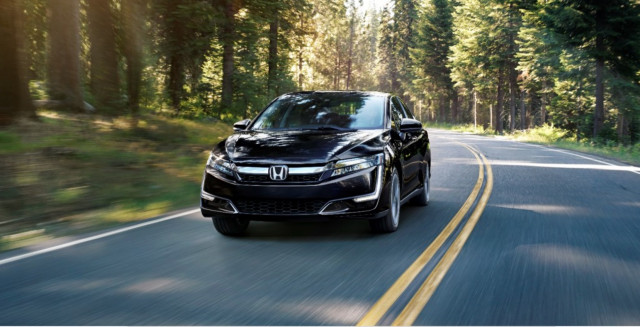
2018 Honda Clarity Plug-In Hybrid starts at $34,290 with 47-mile range

2018 Honda Clarity Plug-In Hybrid


The 2018 Honda Clarity Plug-In Hybrid will start at a recommended price of $34,290 including delivery, making it the least expensive plug-in hybrid sedan on the market this year.
Honda says it will go on sale December 1, and it will be offered at all Honda dealers in the U.S.

That means that for the first time, U.S. buyers can choose between two plug-in hybrids with more than 45 miles of range at prices starting under $35,000.

The 2018 Clarity Plug-In five-seat mid-size sedan is rated at 47 miles of electric range, and 42 mpg combined when operating as a conventional hybrid after the battery is depleted.
The 2018 Chevrolet Volt compact hatchback is rated at 53 miles of range and 42 mpg combined; it starts this year at $34,095, also including the mandatory delivery fee.
While the Volt has a fifth "seating position" on a padded hump between two rear seats, it's functionally a four-person vehicle.
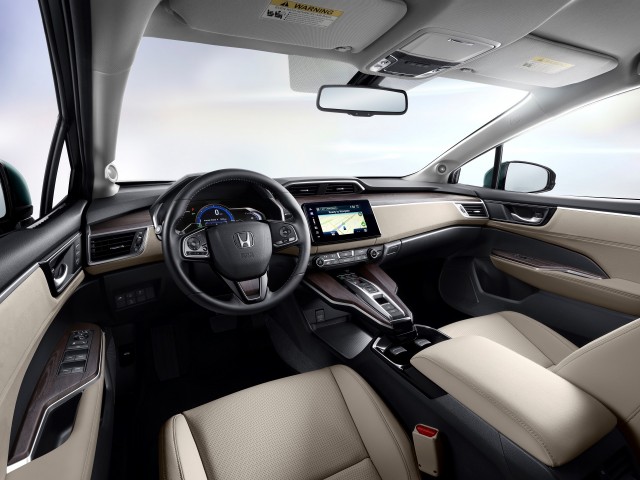
2018 Honda Clarity Plug-In Hybrid


The Volt and the plug-in Clarity are two of the top three plug-in hybrids when rated on battery range, both following the range-extended electric BMW i3 REx with 97 miles of battery range.
All three vehicles are close in energy efficiency, too: When operating in electric mode, the plug-in Clarity is rated at 110 MPGe, against the Volt's 106 MPGe and the i3 REx at 111 MPGe.
Among plug-in hybrid mid-size sedans, however, the Clarity is the clear leader, surpassing the rated range of plug-in hybrid versions of the Ford Fusion, Hyundai Sonata, and Kia Optima

The 2018 Honda Clarity Plug-In Hybrid is offered in standard and Touring trim levels.
All plug-in Clarity sedans come with keyless entry and start, an 8.0-inch touchscreen and eight-speaker audio system, dual-zone automatic climate control with rear vents, heated front seats, 18-inch alloy wheels, and LED lights front and rear.
They also include the LaneWatch video camera that shows the right-hand blind spot in the display, and the Honda Sensing active-safety system.
Honda Clarity Plug-In Hybrid at Honda R&D Center, Tochigi, Japan, June 2017


The Touring model adds a navigation system with charging-station locations built in, an eight-way power adjustable driver's seat and four-way front passenger's seat, perforated leather upholstery and imitation-suede interior, and a leather-wrapped steering wheel.
Recommended prices for the Clarity Plug-In Hybrid Touring line begin at $37,490.
All plug-in hybrid Claritys are powered by a 1.5-liter Atkinson-cycle inline-4 with Honda's two-motor hybrid system, which takes the place of a transmission.

One motor, rated at 135 kilowatts (181 horsepower) and 232 pound-feet of torque, can drive the car itself under many circumstances, especially at lower speeds.
The default driving mode, Normal, runs on battery power until the pack is depleted and then essentially turns into a conventional hybrid car.
A separate toggle for "HV" (or Hybrid Vehicle) mode can be selected with any of the three driving modes; it operates the car and maintains battery charge for later all-electric use.

2018 Honda Clarity Plug-In Hybrid


A Sport mode uses the battery and engine more aggressively, while the Econ mode reduces power draw and cabin ventilation to extend the range, along with slower acceleration.
The 17-kilowatt-hour lithium-ion battery pack is located behind the rear seat, with a quoted recharge time of 2.5 hours when using a 240-volt Level 2 charging station.
The challenge for Honda, as it has been for Chevrolet and other makers, is that car buyers generally have no understanding of plug-in hybrids or why they would be advantageous.

Saturday, April 1, 2017

This Plug-in Hybrid Guide Will Help You Choose The Right Vehicle

As their name suggests, the folks at Plugin Cars have an agenda. They like cars with plugs. Recently, they published a plug-in hybrid guide for people interested in buying or leasing a PHEV. It is so well done, I decided to share it with our readers as a primer on how to go about selecting the right plug-in hybrid for their needs. Author Brad Berman groups his suggestions into four categories. Let’s unpack each one and see what we can learn.

Chevy Volt plug-in hybrid gude

All-Electric Range

Berman suggests the most important factor in his plug-in hybrid guide is how far will that shiny new plug-in hybrid go on electric power alone? After all, the main reason to get a PHEV is to drive with zero tailpipe emissions as much as possible. If you commute 50 miles a day but your car only has 20 miles of range, you will be relying on an old-fashioned internal combustion engine for the majority of your journey (assuming you’re not recharging at work during the day).
The Chevy Volt is the champion today. With 53 miles of range on a full battery, it can handle most people’s daily driving needs without using a drop of gasoline. Several Gas2 readers own a Volt and confirm that the gasoline engine rarely turns on while they are driving. In fact, Chevrolet programs the engine to start automatically every few months just to slosh the oil around to all those critical spaces inside so that it will be ready for use when called on.
By comparison, the Toyota Prius Prime has an all-electric range less than half that of the Volt but lists for nearly $10,000 less. The new Chrysler Pacifica Hybrid is better at 30 miles — pretty good for a large family hauler. Plugin Cars has a handy guide that you can use to sort through the offerings available (not all are sold in every state) to compare prices and features at a glance. It might be a useful tool to bookmark. Gas2 sister site CleanTechnica has a similar EV guide, by the way, but with more filters and European prices as well as US ones. However, you can’t filter by pure EV vs PHEV — you can just sort by total electric range and/or filter by minimum range (100 km vs 200 km vs 300 km), which has a similar effect.

Pick The Car That Fits Your Driving Needs

What is your typical driving day like? Yes, we all want to dream of chucking it all and driving to the West Coast if we feel like it, and yes, we may drive the kiddies to Disney World every few years, but how do you use your car on a daily basis? It might be a good idea to start a log and write down how far you drive every day for a month. That would help you analyze your actual driving needs. If you only drive 15 to 20 miles a day, that makes more plug-in cars suitable for your use without relying on a gasoline engine.
Study your charging options at work. What kind of chargers are available? How are they used? If there is only one and a colleague gets to work early and stays plugged in all day — that won’t do you much good. Does your employer allow workers to go outside during the workday to connect and disconnect from the chargers?
Are there chargers available along your route? If you shop a few days a week on your way home from work, you might be able to plug in while you’re inside and extend your range. Plug-in hybrids usually have small batteries that require less time to charge than the battery in an all-electric car. A little planning could go a long way in helping you decide which plug-in car is best suited to your needs and budget.

How Efficient Is That Plug-in After The Engine Starts?

If your driving needs mean that you will be using the gasoline engine in your plug-in hybrid regularly, it is important to know how efficient it is once battery power is depleted. The Prius Prime gets 54 miles per gallon, making it one of the most efficient cars on the road. It is rated by the EPA at 133 MPGe. The higher the number, the better. By comparison, the Chevy Volt is rated at 42 mpg and has an MPGe rating of 106, which means it will burn more gasoline than the Prius Prime once the engine kicks in. The EPA has a very useful tool that lists the efficiency ratings of all plug-in cars. Once again, it may be worthy of a bookmark if you are in the market for a plug-in car and want to compare one to another.
There is no substitute for a test drive. Some gas-powered range-extender engines may be noisy during operation, which can be annoying after enjoying the quietness of all-electric driving. In my own experience, the engine in the Chevy Volt is almost impossible to detect when it is running.

Choose The Car That Fits Your Lifestyle

Don’t get caught up in statistics. Things like interior room, number of passengers, and how the car feels to drive are still important. Some may like higher seats or need 7 passenger versatility. A car that goes 100 miles on a single charge is no good if it’s uncomfortable or doesn’t satisfy your needs. Take into account factors like price, handling, and cargo capacity. Connectivity is becoming an increasingly important consideration for many drivers. Do you need wireless cell phone chargers, extra cup holders, or a rear-seat screen for children to watch? Are the controls laid out intelligently and do they operate intuitively?
In the end, buying a plug-in hybrid is a commitment to a lifestyle. Hopefully, this plug-in hybrid guide will be useful to you. Do your research, test drive all the cars that fit your requirements, then relax and enjoy the fact that you have made a choice that will help reduce pollution from fossil fuels. Good for  you!
Source: Plug In Cars | Photo by the author


Sunday, March 12, 2017

Kia Niro Plug-in Hybrid Coming To America By End Of 2017

Regular readers know I am a big fan of the Kia Niro. Yes, Kia did fly me down to San Antonio last year to spend a weekend driving the Niro through the Texas hill country outside San Antonio but I am a true journalist and cannot be bought with such things as sumptuous meals, free drinks, and courtside seats to a Spurs game.
Kia Niro PHEV
The truth is, I was impressed with the Kia Niro. It is stylish, comfortable, and best of all, it’s an SUV that gets an honest EPA rating of 51 miles per gallon in its base configuration. It’s best feature is the six speed DSG transmission that makes it feel like a car with true sporting pretensions when the driver fells like playing.
Is it as quick as a Tesla P100D? No, not even close. But it costs one fifth as much. It’s a car even I could afford. And it has a rear seat real people can get in and out of, something that detracts from the overall goodness of the Chevy Volt. There are rumors the Niro PHEV will have a towing capacity of 2,000 lbs or so. No other PHEV offers that.
The Niro, like its corporate sibling, the Hyundai Ioniq, will come with either a hybrid, plug-in hybrid, or electric powertrain. The hybrid is on sale now. The electric car is expected this summer. And the plug-in hybrid will be in US showrooms before Christmas.
With an 8.9 kWh battery, the Niro PHEV will have an EPA electric only range of about 25 miles. For those who think that’s too low, keep in mind the BMW 330e has a paltry 14 miles of range and costs twice as much. The Niro PHEV falls short of the Chevy Volt’s 53 miles of range but then again its battery is half the size and it will likely retail for $7,000 less. 25 miles doesn’t seem too bad when you’re saving 7 grand.
Source: Cleantechnica

Friday, August 5, 2016

Chevy Volt Sales Top 100,000, First In US To Reach That Mark

After a strong sales performance in July, the Chevy Volt is now the first car with a plug to sell more than 100,000 vehicles in the US market.  The Nissan LEAF was leading the sales parade in America until the second generation Volt was introduced last last year. Since then, Volt sales have zoomed while LEAF sales has slowed to a crawl.
Chevy Volt
Volt sales in July were 2,406 — its best month since August 2014.  For calendar year 2016, total sales are 12,214. Since the Volt was introduced in December 2010, 100,964 have been sold. Tesla Motors refuses to report sales by region, so it is impossible to say how many have been sold to US customers, but is assumed to be the third best selling plug-in car in America. The LEAF has now sold 96,447 cars in the US market. It should cross the 100,000 unit threshold in November.
Fourth on the list of plug-in vehicles is the Toyota Prius Plug-In Hybrid at more than 42,300 total. It is no longer sold in the US but its replacement — the Toyota Prius Prime — is expected to go on sale later this year or early in 2017. which goes on sale later this year. Its introduction has been pushed back a few months while Toyota fusses with final specifications. “We decided to reduce initial production from our original plan to make sure we deliver better vehicles,” a Toyota official said, according to The Japan Times.
Ford has enjoyed strong sales of its plug-in hybrid Fusion and C-Max models this year. It will announce 2nd quarter sales numbers tomorrow.

Thursday, June 30, 2016

Nissan Set To Produce A Plug-In Hybrid Compact Car

Will the Nissan LEAF become a plug-in hybrid like the Chevy Volt? At Nissan’s annual stockholders meeting on June 22, CEO Carlos Ghosn told listeners that the company will introduce two new technologies this year. First, it will unveil an autonomous driving system that will guide the car in a straight line and around curves without input from the driver. The system, which will be known as ProPilot, will operate only within one travel lane, which means it will not have the automatic lane change feature available in Tesla’s Autopilot system.
Gripz plug-in hybrid concept
Second on the list is a plug-in hybrid powertrain it calls e-Power. It uses a small engine to generate electricity to charge an onboard battery. The battery, in turn, powers an electric motor that turns the wheels. The e-Power system debuted in the Gripz compact crossover concept revealed at the Frankfurt auto show last fall. Regular readers will recognize the e-Power system as equivalent to the powertrain used in the Chevy Volt. With LEAF sales in the toilet, Nissan seems to be raising the white flag and admitting that Chevrolet had the better idea. Both cars came on the market at about the same time in 2010 and 20111
Some members of the press have reported that the LEAF will now become a plug-in hybrid like the Volt, but Ghosn didn’t actually say that. What he did say is the e-Power system will appear first in a “new compact car.” He added, “This new electric vehicle will meet consumer demand for greater autonomy and fuel efficiency. It will utilize a new e-Power system that matches the agility, quietness, strong acceleration and efficiency of the Nissan LEAF.”
Toshiyuki Nakajima, a manager at Nissan’s advanced vehicle engineering department, says the e-Power system has several advantages. It is less expensive because it doesn’t need as big a battery as a purely electric car requires. Also, the range extender engine doesn’t need to be as big as it would be in a conventional car. It acts solely as a generator and can be tuned to operate only at the most efficient engine speed. “We want to simplify the system,” Nakajima said.
Both the e-Power and ProPilot systems are expected in 2017, based on Ghosn’s remarks, but in which vehicles is unknown at this time. Nissan has not announced any plans to put the highly styled Gripz concept into production, although a plug-in hybrid crossover would be a direct hit on the current sweet spot of the new car market.
Source: Automotive News   Photo credit: Nissan

Monday, May 23, 2016

The Chevy Volt Goes To The Races

I took the Chevy Volt to an autocross today. Not to compete; just to show the flag, so to speak. I was curious what certified gearheads would have to say about Chevrolet’s first electric car. Would they reject it? Make rude comments? Exclude me all together?
IMG_0097
I needn’t have worried. As it turns out, most of the racers on hand were quite interested in it. That included Anthony Ricci, the founder and director of Advanced Driving & Security, Inc, the host of the event. ADSI rents an abandoned runway at what used to be Quonset Naval Air Station in southern Rhode Island. During the week, he and his staff instruct police officers, security personnel, and limousine drivers in the fine art of steering a 5,000 lb car through high speed maneuvers without damaging anything or anyone.
Once a month in the good weather, he opens the course to racers. He likes to call it a “test and tune” day. While lap times are recorded, the objective is to make incremental improvements in your times during the day. Anthony says to try for a 1 second improvement per lap.
Two of the fastest drivers there were highly interested in the Volt. One has a yellow ZO6 Corvette with an aftermarket turbocharger. Add a coilover suspension and race rubber and the car is scary fast. It is owned by Tony, whose daily driver is an ’11 Volt. He loved the new interior and exterior styling. And of course he was thrilled that it had more range than the first generation car. I suspect he may decide to upgrade soon.
IMG_0094Others wandered by to check out the Volt in between runs. The hood was opened. Pictures were taken. People wanted to sit inside.  The consensus was that the Volt was no race car, but a car a racer could be comfortable with as a daily driver.
Toward the end of the day, Anthony asked if I would take him and his photographer around the course on a demonstration run. I had promised the folks from Chevrolet I would not beat on the car, and I didn’t. The fast cars were completing the 1.5 mile long course in about 1 minute, 29 seconds. The Volt went around — quietly — in a shade over 2 minutes.
My passengers were impressed with how quickly the Volt accelerated and how competent it was in the turns. This is not a car with a wimpy suspension like a Hyundai Excel or a Yugo. It negotiated the turns well, changed direction easily, and went where it was pointed during our one fairly low speed lap. I would rate its suspension as surprisingly competent.
During the day, I was reminded of exactly how much misinformation about the Volt there is out there on the streets. I was with people who are into cars. Their mechanical IQ is well above average. Everyone of them knows the difference between a 6 point and a 12 point socket and the advantages of each. But few could say exactly how the Volt worked. I like to think I did a creditable job of educating a few folks. I know several told me they now intend to test drive a Volt themselves. That was pretty much the point of taking the car to the event in the first place.
I only got 45 all electric miles today. Planting your right foot solidly on the go pedal uses up a lot of kilowatts. As I motored silently home, I was proud of the Volt. In the midst of all those hot shoes, it held its head high. It even set the fastest time of the day for an electric car! Today, the Volt was a true champion.

Saturday, May 21, 2016

Chevy Volt, Form And Function

Day Three with my Chevy Volt was eventful if only because I got a call from Fred Ligouri, Chevrolet’s product specialist in Michigan. He is the person who started the whole “How would you like to drive a Volt for a week?” thing. Fred had read yesterday’s story and wanted to give me some tips on using the regen paddle on the back of the steering wheel on the left. I think he was a little incredulous that I hadn’t figured it out on my own!
IMG_0067
The regen paddle is a feature Generation One Volt owners said they wanted. Chevy listened. One of the advantages of the Volt’s electric powertrain is there are no transmission controls needed. The space behind the wheel that would normally be devoted to paddle shifters in today’s ICE cars can be used for other things. The regen paddle goes on the left. The radio volume controls go on the right.
After Fred’s call, I went out for a ride with a neighbor who stopped by in his brandy new Kia Sorrento. By the time he left, I think he was a little sad he hadn’t looked into a Volt before he made his buying decision. Both cars cost about the same money. That test drive gave me a chance to try out the regen paddle. Wow! What a slick piece of engineering it is.
A gentle squeeze on the paddle will bring the car to a virtual standstill from any speed. The longer you squeeze it, the more robust the regenerative braking force becomes. After a few miles to get acclimated to the system, it becomes second nature. I did reach for the headlight stalk a few times by accident, but got the hang of it fairly quickly. Fred tells me that as the deceleration builds, the rear stop lights illuminate automatically to warn drivers following behind that you are slowing.
One thing about the Volt that I like very much is its styling. Beginning at the front, the car has a low, aggressive look. My neighbor called it “taut” and “athletic.” The hood itself is remarkable. It has bulges stamped into it that look like they are intended to direct the air up and over the car to help with aerodynamics.
There is a central tunnel pressed into the front of the roof that expands outward toward the rear of the car. You can almost imagine the aerodynamacists who worked on the Volt sculpting those contours to follow the air flow they could see in the wind tunnel.
I took the Volt over to Walmart in Putnam, Connecticut to pick up a few  items, but it was really an excuse to drive it some more. Cargill Chevrolet is about a mile from the Walmart store. On a whim, I went in and asked the first sales person I found if Cargill had any Volts in inventory. Within minutes he had one painted in Kinetic Blue fired up and ready for me to test drive. The new color is quite handsome and less bright than the blue Chevy used previously.
I used to be in the car business. I know salesmen hate to have tire kickers waste their time. I was very up front with Jason, the salesman I met, about who I was and why I was there. Frankly, I wanted to see for myself if the reports I had heard about clueless, poorly trained sales staff were true.
Chevy Volt Jason
Jasoh at Cargill Chevrolet in Putnam Connecticut is one Volt salesman who knows his stuff.
I needn’t have worried. Jason was polite, informed, and knowledgeable about the Volt. He told me Cargill Chevrolet has a special training program he needed to pass before being allowed to sell the Volt. He answered all my questions and didn’t seem to mind that I had no active plans to buy a car right away. We left as friends and I will keep his card on hand. I have a feeling there might be a Volt in my future sometime this year. So here’s a shout out to Jason and Cargill Chevrolet. Good on both of ya!
The Volt I sat in just came off the truck on Tuesday. It had yet to be serviced and still had all the plastic protective wrappings on it that prevent damage during shipping. It was a base level model that did not have side blind spot warnings or the forward collision warning sensor that my LTZ level loaner features. The interior was solid dark charcoal and looked a bit austere, especially compared to the high zoot interior on my demonstrator with its leather seats and two tone dash.
Speaking of that dashboard, my wife was put off by the butterscotch segments, while my son in law, who is a trained graphic artist, found the interior color scheme very much too his liking. If I was able to chose, I would probably specify an interior that mixed charcoal and lighter gray pieces.
There is no accounting for taste, of course. I’m sure the colors chosen by Chevrolet were exhaustively test marketed in focus groups. I have a friend who drives a Maserati. It has interior colors that look a lot like the ones in the Volt LTZ.
I am just starting to get comfortable with the car after 3 days behind the wheel. My phone is now synced with the car’s audio system. I have the climate controls mostly figured out. I have adapted to one pedal driving thanks to the regen paddle. I find the cabin is comfortable for my just under 6 foot frame. The ride is supple and well damped.
As I was coming in to the house to write this article, I realized I am going to be sad to see the Volt go next week. It is a car that grows on you, which is something the marketing people need to think hard about. It is not just another car. It is a different kind of car, one that takes some getting used to. Now that I have had a chance to experience it, I am thinking a Volt could absolutely fit my lifestyle. I’m keeping your card handy, Jason. You will be the first one I call when the time is right.

Source: Gas2