Showing posts with label Fiat. Show all posts

Wednesday, July 25, 2018

Fiat Chrysler Automobiles CEO Sergio Marchionne dies suddenly

Sergio Marchionne
Sergio Marchionne


Sergio Marchionne, the man who engineered a historic merger between Fiat and Chrysler to rescue the Detroit automaker from financial collapse, died Wednesday in Switzerland. He was 66.
Marchionne died after complications from surgery last week. On Saturday, Fiat Chrysler Automobiles quickly replaced him as CEO with Mike Manley, who most recently led Jeep and Ram brands, when it was clear that Marchionne wouldn't recover. Marchionne is survived by his sons Alessio and Tyler, and his longtime partner Manuella Battezzato.
During his tenure Marchionne was plainspoken and blunt about many topics, including electric cars. He famously dissuaded people from purchasing the electric Fiat 500e, which is sold in California as a "compliance car."
"I hope you don't buy it," he said in 2014, shortly after the car debuted. "Every time I sell one it costs me $14,000." (The 500e, with 84 miles of electric range, sells for $33,990 before tax credits, though Fiat leased a lot of them for $199 a month.)

“Unfortunately, what we feared has come to pass. Sergio Marchionne, man and friend, is gone,” John Elkann, grandson of former Fiat CEO Gianni Agnelli and chairman of Fiat's parent company Exor, said in a statement.
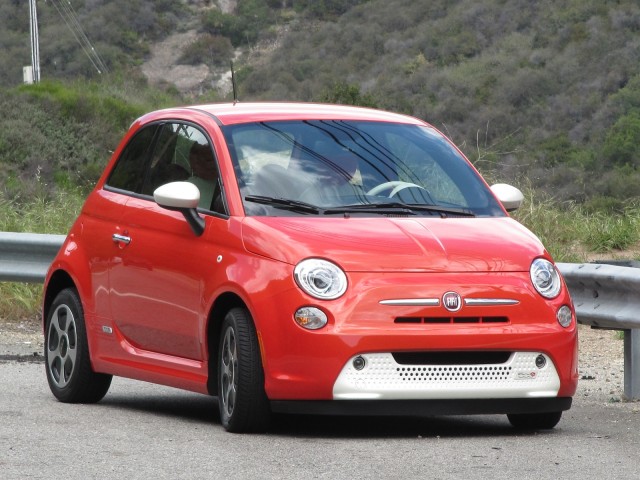
2013 Fiat 500e electric car, Los Angeles drive event, April 2013


A Canadian born in Italy, Marchionne was known as a chain-smoking workaholic among many in the automotive industry. Trained as a lawyer and an accountant, he worked first in finance and as a tax consultant before he was plucked from a Swiss trading firm to work at Fiat. Battered by sagging revenues and skyrocketing costs, Marchionne helped turn Fiat around.
After taking the reins of Fiat in 2004, Marchionne famously unwound a partnership with General Motors and got GM to pay $2 billion for the privilege.
With that money, he turned Fiat into Europe's fastest-growing automaker and developed a range of models for sale worldwide.

He reintroduced the Fiat, Alfa Romeo, and Maserati brands to the U.S. and turned Ferrari into the fastest-growing maker of sports cars, even introducing hybrids to the brand.
In 2009, he negotiated with the U.S. government to take over bankrupt Chrysler Corp.—for free—and merged it with Fiat.
In June, FCA announced it had paid back its sizeable industrial debt and would focus on crossovers, SUVs, and trucks to stay profitable.

Sunday, February 5, 2017

A Biker Chick Runs Wild In The Fiat 500e

When Biker Chicks Drive Cars

Fiat cut me loose on the streets of LA in a 2016 500e to see if it could be as fun around town as it is on the track. I’ve driven both manual & automatic 500s, and a broad range of other electric cars. None of them as fun as the Fiat 500e. And it’s not just one biker chick saying this, plenty of car guys agree too. Charged magazine has the most comprehensive story on the 500e here. Motorcyclists in California (and most of the world) are spoiled. We never have to sit patiently in traffic, we just “get in where we fit in.” I wanted to see if the Fiat was fun enough to enjoy without being able to lanesplit. I managed to squeeze it into some pretty tight spaces, making it fairly exciting.
But of course Fiat doesn’t want you to know how much fun it is. They’re only supplying them to California and Oregon residents because they have to in order to sell their other vehicles here. They claimed in 2014 to be losing $14,000 on each 500e sold. Which is odd, considering that electric motors are much cheaper to build than gas engines, and batteries are getting cheaper every day. And building electric cars is certainly cheaper than being sued for lying about “clean” diesel. Perhaps they’re accounting for future lost income in the repair bay, where dealers make the big bucks. While auto execs think Fool Cell infrastructure will magically appear and render the ‘ol 110v outlet obsolete, battery EVs continue growing in popularity, both with drivers and governments alike.
Yes, the 500e has a J1772 outlet, but also a 110v adapter neatly tucked away under the micro trunk. I could’ve used the public charging station at the park 1/10th of a mile from home, but it was easier to just use the 110v adapter each night. Fiat USA told me that many customers charge at the office, as more offices have charging, even though California apartment buildings and condominiums are required to allow residents to charge in their on-site parking. While Tesla owners are likely to own their home and garage, 500e owners are more likely to be apartment dwellers.
Most of the days I had the car, I traveled about 50 miles around LA, mostly on surface streets (freeways are usually the slower route) and usually plugged in with about 50% remaining at the end of the day. The manual recommends not using an extension cord, but also says the 110v adapter will shut off if it has any problems. So I plugged it into the same extension cord I normally use to charge my Zero FX. The rain and the extension cord never gave me problems, but the fuse on the outlet I used couldn’t handle the car, the XBOX, lights, and a space heater all at once. It was easy enough to unplug the car while warming up the bedroom.

Testing the Limits of Range and Traction

Fiat had originally offered buyers free car rentals for longer trips, but cancelled this program because nobody used it — because range anxiety is a false fear that keeps the oil industry chugging along. Los Angeles had the worst rainstorm ever during the week I had this car, so I was able to test the limits of traction in water, just as I had on their dry autocross course back in 2013*. The low center of gravity (CoG) and short wheel base make cornering a delight.
The CoG is lower than on the gas 500 because of the battery placement. Many features developed for the 500e have been adopted for the gas 500 as well. This is the second quietest car I’ve ever been in, after the Tesla S. Riding in a Prius after driving this, I thought perhaps the owner had off-road tires on the Prius — it was so loud. The 500e also has improved aerodynamics, again adopted by the gas 500. But one of the best features of the 500e is how easy it is to get the tires to squeal. Sound effects always make a stunt more exciting, even when it’s just launching off a green light fast enough to elicit giggles. Here’s a video of a typical morning commute to downtown LA.
On Sunday, during the biggest rainstorm LA has ever seen, I took my boyfriend for a spin up Angeles Crest Highway, to see how far we could go before we’d have to turn around. There are no Level 2 chargers up there, so I had to err on the side of caution. We also had the heater and heated seats going, which can reduce range by about 10%. With 36% remaining after climbing roughly 3500 ft over 18 miles, as fast as I dared in the rain, I turned the car around and we made our way back down the hill. I’m already missing how easy it is to do U-turns in this car.
We spent enough time stuck behind (drafting?) a slow-moving truck that the range increased. We even gained a couple miles range in the 22-mile trip home, thanks to Fiat’s exceptionally accurate range estimator. Fiat designed it to analyze both your 100 mile average and the average of your last 10 miles. When you’ve got a full charge, it mainly relies on your 100 mile average, but as the range decreases, the predictor relies more on your past 10 miles. To let you know if you’re on the right track, it’s also got up & down arrows next to the range number. Up means you might be doing better than estimated, down means your mileage may be worse than estimated. In fact, I felt so optimistic about the range, we made a detour to the best donut shop in LA and still got home with 11% to spare. It’s always a bummer when that happens and you realize you could’ve been less cautious.
As you can see, I drove cautiously on the Crest, as I’d already discovered just how mediocre the tires were in the rain, and didn’t care to find out how well the car tumbles down a cliff. I drove with traction control on most of the time, but played around with it off on a dry day to see what that was like. It was also fun. Here’s a short video of my favorite rainy day activity:

So Much Bang For The Buck

After a week in the 500e, I would still take this over any other car if I couldn’t ride a motorcycle. Even if I had Tesla money, I’d have a 500e for city driving because it’s easier to squeeze into tight spaces. They’re insanely cheap to lease, and relatively cheap to buy as well. Although Fiat Chrysler won’t disclose 500e sales, Fiat US sales are 24% higher than they were last January. This 2013 article matches the lease pricing a dealer quoted me for the 2017 500e.
The only things I didn’t like about the car were:
1) The stereo forced me to listen to radio every time I turned it on, instead of silence while it connected with my phone. Sure, Sirius radio is comprehensive, but I’d rather listen to my Tidal playlists, thanks.
2) The best thing about the 500e is also a problem in America. It’s small. It’s cute. A little girl in her pink toy car/stroller pointed as I passed, while the burly fireman I gushed about the car to told me his ego wouldn’t fit into it. This was after I told him it’s not too small for someone of his stature. Los Angeles is home to some of the most aggressive drivers in the world. Self included. As a motorcyclist, I’ve noticed that size definitely matters. The more threatening your vehicle looks, the more likely people are to respect your right-of-way or let you cut in front of them. This is why so many people drive SUVs here. So, in the Fiat, I did notice that I got less respect from drivers than I do in my old 4Runner. But I can zip around obstacles a lot more easily in the Fiat, which more than makes up for the lack of size. And I’m sure Kenny Scharf could make it look more threatening.
*In 2013 I drove a Fiat 500e on an autocross course they’d set up at Refuel. It was absolutely the most fun I’d ever had on 4 wheels. I knew if I ever had to drive a car, it would be a 500e. Motorcycles & scooters have been my primary form of transport since 1985. I claw my way through LA traffic every day, wondering why so many people let fear rule their lives. After all, bones heal. Last month I broke my wrist because a driver didn’t see me coming. The most painful part of this was driving my gas-powered SUV (I actually use it to haul bikes) around LA in these dark times. Which is why this review is happening now.
Originally published on CleanTechnica.

Thursday, December 29, 2016

Deal of the year? Used Fiat 500e electric cars at $6,500?

2017 Fiat 500e
2017 Fiat 500e


It's well known by now that the used-car prices of low-range electric cars are low.
Any 2011 through 2016 electric car not made by Tesla is likely to be cheap on a used-car lot due to worries about battery degradation and its effect on range.

Used Nissan Leafs, for instance, can often be found for around $9,000, even with only 30,000 or 40,000 miles—thousands of dollars less than a used gasoline Nissan of the same age and mileage.
Now, it appears that the earliest of several thousand Fiat 500e electric cars first leased during 2013 are coming back to Fiat dealers at the end of their leases.
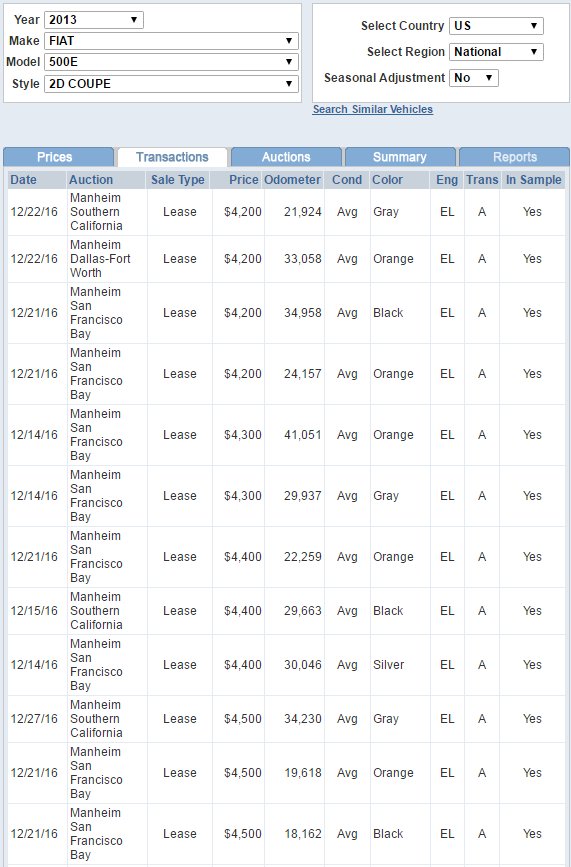
And, wow, are their prices low. How about wholesale auction prices of slightly over $4,000?
The data on those wholesale prices was compiled by auto writer (and occasional Green Car Reports resarcher) Bozi Tatarevic.


The cheap lease returned electrics are coming. The 2013 Fiat 500e is running at a little over $4,000 at wholesale auctions this month.
And, he added, that should translate to a retail price of around $6,500 once the auctioned Fiat 500e hatchbacks hit used-car lots.
That means that you could conceivably pay $6,500 for a fun-to-drive, three-year-old electric car with only 30,000 to 40,000 miles on it.

Now, there's at least one catch: the 500e was only sold in California and Oregon, so Fiat dealers outside those two states will know little or nothing about the electric 500 variant.
While we could imagine some enterprising entrepreneur buying up the electric Fiats and bringing them to electric-car fans in other states, the service issue remains a risk.
2014 Fiat 500e - Driven, July 2014 (NWAPA Drive Revolution)


Still, we liked the little three-door Fiat 500e when we first drove it, and some owners feel it's the best car in the entire 500 range—and just as entertaining as the sporty 500 Abarth variant.
When we went on that first drive, even the Fiat Chrysler engineers who'd worked on the car seemed slightly stunned at how much fun it was.
Deals like this one could last for a while. Fiat won't say how many electric 500s it's sold, but the number could be as high as 13,000 by the end of this year.

That's a whole lot of fun, cheap, low-mileage electric cars that will need to find second homes over the next couple of years.
So what do you think? Can you find it in your heart to provide a "forever home" for a cute little Italian orphan?
Operators are standing by.

Sunday, April 17, 2016

Marchionne Says Fiat Could Build A Model 3 Fighter In 12 Months

Sergio Marchionne has never been a fan of electric cars. His company, FCA, has exactly three models with electric motors in its global lineup at present — the soon to be introduced Chrysler Pacific plug-in hybrid van, the $1.3 million dollar, 949 horsepower LaFerrari, and the lowly Fiat 500e. The 500e is the epitome of a so-called “compliance car,” a vehicle specifically created to meet the mandates of the California Air Resources Board.
Sergio MarchionneCompliance cars are seldom offered for sale in any markets where local regulations don’t require manufacturers to sell them. Marchionne once made headline news when he begged people not to buy a 500e because FCA lost $14,000 on every car it sold.
Marchionne is one of those people whose says whatever is on his mind. Speaking about the recent introduction of the Tesla Model 3, he told the meeting, “I am not surprised by the high number of reservations but you have then to build and deliver them and also be profitable.” Clearly, he is skeptical that Tesla will get the car to market on time or that it can make a profit on the Model 3 when it does.
He told Automotive News, if Musk “can show me that the car will be profitable at that price, I will copy the formula, add the Italian design flair, and get it to the market within 12 months.” The idea of Fiat making a car that can compete with the Model 3 and do so in 12 months is clearly preposterous.
Elon Musk has often publicly challenged other manufacturers to build cars that can compete with Tesla products. The idea of a Model 3 cousin with the styling of an Alfa Romeo may be an appealing prospect. Could Fiat ever pull off such a thing and make money doing it? The thought boggles the mind.
His pronouncement seems even more ridiculous when you realize Chrysler is planning to stop build midsize passenger cars in the US and is actively looking to sell the production rights to another manufacturer.
Marchionne isn’t worried about waiting to see whether the Model 3 is profitable before jumping into the game. He told Automotive News, “better late than sorry.”

Friday, February 12, 2016

50 MPG Kia Niro Hybrid SUV Debuts in Chicago - Press Release

2017-kia-niro_100545241_h
Kia just announced its highly anticipated, all-new for 2017 Kia Niro hybrid SUV at the Chicago Auto Show, and its styling looks set to put the “sport” back in Sport Utility Vehicles. That’s what Kia’s enthusiast-oriented design department wants us to think, anyway, and- to be sure we didn’t miss the sportiness of the Niro- they called the Niro’s look “un-hybrid” styling in their official release.
In bold, no less.
Kia doesn’t need to be be so insecure- their designers absolutely nailed the Niro’s styling. No one looking at it will think “hybrid”, and- if the engineers have done their job- no one driving it will either, except by looking at their gas bills. Thanks to the Niro’s 50 MPG rating, Niro owners’ fuel bills which will be even lower now, in the latest “cheap fuel” era, than they would have been a few years ago.
That stellar fuel economy comes from the Kia Niro’s 103 HP 1.6 liter GDI engine, which is backed up by a 43 HP, high-torque electric motor that gives the car 195 lb-ft of torque when both are in operation. That’s quite a lot for a small SUV, and a good deal more than what’s available from the SUVs at, say, the Chevy or Fiat stores.
You can check out the 2017 Kia Niro’s “un-hybrid” styling in the photos, below, read the (long!) official press release below that, then let us know what you think of Kia’s latest hybrid venture in the comments section at the bottom of the page. Enjoy!

2017 Kia Niro Hybrid | Photo Gallery


    Kia’s Hybrid Utility Vehicle Boasts a Number of Firsts for the Brand, Including an All-New, Dedicated Eco-Car Platform and Unique Hybrid System
    CHICAGO, Feb. 11, 2016 – A key component to Kia Motors’ Green Car Roadmap was unveiled at the Chicago Auto Show today as Kia Motors America (KMA) hosted the global debut of the all-new 2017 Niro Hybrid Utility Vehicle (HUV). A no-compromise vehicle that combines driving enjoyment with eye-catching design, functional utility and hybrid efficiency, the all-new Niro strikes the perfect balance for today’s consumers and stakes claim to a unique position between the hybrid-electric vehicle and CUV segments.
    “The Niro hits the sweet spot by offering the best combination of outstanding mpg, an engaging driving experience, utility, and most importantly, a stunning design that doesn’t shout ‘hybrid,’” said Orth Hedrick, vice president product planning KMA. “The subcompact CUV market continues to be one of the fastest-growing segments in the world, and the Niro offers a uniquely alluring yet practical package that consumers haven’t seen before.”
    The Niro is yet another vehicle introduced under the Kia Motors EcoDynamics environmentally friendly sub-brand and represents a number of firsts. While it was preceded by clean mobility products such as the Optima Hybrid and Soul EV, Niro is the first Kia to make use of an all-new, dedicated eco-car platform and is an important next step on the path to nearly tripling the brand’s global green car line-up by 2020. A plug-in hybrid powertrain is due to be added to the car’s line-up later in its life-cycle.
    An “Un-Hybrid” Design
    Designed at Kia’s design centers in Irvine, California, and Namyang, Korea, the Niro demonstrates that owners don’t have to sacrifice emotionally engaging design or functional utility in the name of efficiency. The HUV’s design language is atypical of a hybrid, appearing strong and confident with subtly sculpted surfaces offset by robust styling cues. The Niro sports wide and low proportions with a long roofline and short overhangs that give it an overall athletic profile. Up front, the Niro bears a familiar front fascia highlighted by Kia’s signature grille and flanked by aggressively shaped headlights that accentuate the Niro’s strong shoulders. Contours on the hood lend visual interest and, along with voluminous wheel arches, rocker cladding, roof rails, and rear skid plate, contribute to a sporty look. Although the Niro has a cohesive crossover theme, it was designed with aerodynamics in mind, with its carefully shaped bodywork contributing to a relatively slippery coefficient of drag of .29.
    Stepping inside the Niro reveals an inviting, modern, and high-tech interior. Glossy white or black accents underline the HUV’s straightforward theme. The instrument panel is uncluttered and clean, with colorful and informative gauges at the forefront and perfectly positioned primary and secondary controls falling readily to hand. Interior roominess comes by way of the Niro’s 106.3-inch wheelbase, body height, and wide stance, which affords ample leg-, head- and shoulder-room. Seats with increased pad density in the cushions ensure a comfortable ride, helping to prevent fatigue on longer trips. With its crossover-like proportions, the Niro boasts an elevated seating position much like the Kia Soul, providing drivers with a more commanding view of the road as well as easy ingress and egress. While the clever packaging of the high voltage battery assists in delivering a desirable driving experience, its location underneath the rear seats also increases cabin and cargo space and allows a flat load floor.
    In addition to spaciousness and comfort, ensuring a quiet interior environment was also a key development focus for engineers. Copious insulation in the Niro’s front structure, optimized suspension bushing stiffness, careful body sealing, and application of expanding foam inside the A- and B-pillars all prevent road and tire noise from entering the cabin. Furthermore, acoustic windshield glass and carefully shaped side mirrors mitigate wind noise.
    Engineers also worked hard to address the innate issues often associated with hybrid powertrains. To that end, they minimized system noise and vibration at the source with specially designed engine mounts, equal-length driveshafts, and even added a damper inside the steering wheel hub to minimize vibrations felt in the steering wheel. Other NVH measures include a special embossed foam in the floor (under the carpet), and a dense insulating pad underneath the hood also help to keep unwanted noise to a minimum.
    Strong and Light Core
    The platform underpinning the Niro has been specifically engineered to accommodate the unique gasoline-electric hybrid powertrain, and with 53 percent of Advanced High Strength Steel (AHSS), including reinforcement in the A- and B-pillars as well as the roof rails, it is both a lightweight and durable structure. Extensive use of hot-stamped components and industrial joint adhesive increase torsional rigidity and structural integrity. As such, engineers are targeting the Niro to earn top honors from the National Highway Traffic Safety Administration (NHTSA) and Insurance Institute of Highway Safety (IIHS).
    Weight reduction was a critical Niro development aspect, and in addition to the body, AHSS was also used to engineer other elements, including novel lightweight seat frames. Further, engineers were able to bring down the overall weight by using aluminum for the hood, tailgate and several suspension elements including the front lower control arms, front and rear knuckles, and in the brake calipers. Even the parking brake pedal contributes to the weight savings through the use of fiber-reinforced plastic construction. Finally, the engineers eliminated the traditional 12-volt battery to reduce weight, instead, utilizing the high-voltage lithium-ion polymer battery.
    Uniquely Engineered Hybrid Powertrain
    Motivating the Niro is a highly efficient and engaging powertrain starting with an all-new, state-of-the-art Kappa 1.6-liter GDI four-cylinder engine, engineered specifically for hybrid applications. Making 103 horsepower, the new engine marks the first combination of the Atkinson Cycle, cooled exhaust gas recirculation (EGR), GDI and a long-stroke-narrow-bore specification to maximize efficiency2. Efficiency and emissions are further improved via the Niro’s exhaust heat recovery system, which speeds engine warm-up by routing coolant to a heat exchanger in the exhaust system. A 43-hp tractive motor, known as the transmission-mounted electric device (TMED), works in tandem with the gasoline engine to produce a robust 146 horsepower and 195 lb.-ft. of torque.
    That power is transmitted through a newly developed, second-generation six-speed dual-clutch transmission (DCT), which not only boosts efficiency but is also a key factor to the Niro’s great driving experience. The transmission delivers smooth, quick shifts for a natural and spirited feel in stark contrast to that of other hybrids equipped with continuously variable transmissions. Bringing the whole system together is a compact and lightweight 1.56-kWh Lithium Ion Polymer battery located underneath the rear seat. Because the high-voltage battery is both power and energy dense, engineers were able to use the downsized gasoline engine to maximize fuel economy and reduce emissions.
    With its unique combination of the lightweight TMED, proven GDI and Atkinson Cycle technology in the internal combustion engine, along with the DCT providing a dynamic driving experience, the Niro offers enjoyment and efficiency all in one, targeting a combined fuel efficiency rating of 50 mpg.
    Driving Fun
    The Niro’s parallel and simplified hybrid system creates seamless transitions of power delivered to the front wheels, resulting in a very un-hybrid-like driving experience. The hybrid system is neither intrusive nor obvious. The Niro accelerates quickly off the line and continues its smooth power delivery, inspiring driver confidence in everyday driving maneuvers like merging onto the highway.
    Special attention was also paid to brake feel. Applying lessons learned through development of two generations of Optima Hybrids as well as the fully electric Soul EV, Kia engineers designed the Niro’s regenerative system to seamlessly blend in hydraulic friction braking. Consequently, deceleration feels more consistent and linear than other hybrids.
    Advanced Hybrid Tech
    Like the rest of Kia’s lineup, the Niro will be offered with a suite of advanced driver assistance and convenience technologies. Familiar features that will be available on the HUV include Blind Spot Detection with Rear Cross Traffic Alert and Lane Change Assist; Advanced Smart Cruise Control; Lane Departure Warning; and Autonomous Emergency Braking3.
    All-new Eco-DAS1 (Driver Assistance System) features Kia’s first application of Coasting Guide and Predictive Energy Control. The Coasting Guide aims at maximizing fuel economy by essentially coaching the driver on when to coast and brake. Predictive Energy Control, meanwhile, uses the navigation system and cruise control to anticipate topographical changes on the road ahead and actively manage energy flow, seamlessly determining when its best to recharge the battery and when its best to expend stored energy to optimize overall efficiency. Similar systems have been seen on German luxury makes, but Kia’s system is the first in the industry to monitor and adjust for both ascending and descending scenarios. Other notable features include Smart Air Intake, which reduces drag by carefully managing the intake of outside air for the HVAC system, and also an accompanying Auto Defog system that prevents condensation from building on the glass by monitoring cabin air conditions to manage the cycling of the A/C compressor.

    Kia’s award-winning infotainment and telematics system aims to keep Niro drivers connected at all times4, with the newest version, UVO3, trickling down from the all-new 2017 Sportage. Complete with Android5 Auto™, Apple6 CarPlay®, and UVO eServices featuring 14 telematics services, the enhanced system features up to 8 GB of music storage, access to onscreen apps such as Pandora®7 and Soundhound and Wi-Fi tethering capability. All this is displayed on a 7-inch capacitive touch screen.
Source | Images: Kia.