Showing posts with label 2016 Chevrolet Volt. Show all posts

Saturday, January 14, 2017

Mary Barra: Bolt EV Will Be Basis For a ‘Huge Range of Vehicles’

Bolt_EV-668x409


A recent comment by General Motors CEO Mary Barra this week has sent EV fans to speculating, as she said a “huge range of vehicles” will be spun off from the Bolt EV platform.
How one defines a huge range of vehicles, how soon these will be, and what really to expect at all were not disclosed, but the question came after being asked about Ford’s announcement of 13 electrified vehicles it has in the works.
“I think what’s important is the Bolt EV follows the second generaton of the Volt; so we had the first Chevrolet Volt, we’ve already launched the second generation,” said Barra from the sidelines of the Detroit auto show. “There’s a lot of learning there, and all those learnings went into the Bolt.”
… Which, she says will be the basis of many more cars – presumably all-electric, but not defnitively stated as such – to come.
“The Bolt is our platform that we’re going to continue on and have a huge range of vehicles,” said Barra, “so we haven’t announced them yet, but you’re going to see more coming.”
2016-volt-cutaway-668x414-668x414


Barra went on to avoid specifics mentioning things GM expects including costs being driven down, improved battery energy density, people liking the new electrified cars, and synergies will happen.
“So, I think that the fact that were doing it right now is pretty significant,” she said.
Implied also by Barra’s response was the Volt is better in key ways than what Ford has yet demonstrated.
Ford’s plug-in hybrid C-Max Energi and Fusion Energi have up to 20-21 miles EV range, whereas the purpose-built Volt has 53, and these cars combined in 2016 had 23,895 sales compared to the Volt’s 24,739.
But Ford, reinventing itself into a “mobility” company as is GM, has promised a 300-plus-mile all-electric SUV, a hybrid F-150, hybrid Mustang, turbocharged hybrids, and Barra predictably sidestepped answering a “future product” question about the potential for a Camaro hybrid.
GM has previously expressed interest in a hybrid Corvette, potentially a plug-in hybrid Corvette, and otherwise it and so many other manufacturers know they’ll need more electrified vehicles to meet global regulations in years ahead.
Fusion-Energi-668x409


“Electrified” is defined as hybrid, plug-in hybrid, or battery electric, and contrary to what the reporter suggested to Barra of Ford’s future product announcement, Ford is bringing 13 “electrified” vehicles, not “13 EVs” (as in battery electric vehicles) by 2020.
As it has for some time now, GM is thus playing its hand closer to its chest, but Barra’s statements imply the company will not be left out – and it will meet competition, demand and all other market realities as it has to.
Barra went on to say GM expects gas prices to stay low in America for quite some time, and this has driven record sales of conventional trucks, SUVs, and crossovers that Americans like to buy when they don’t feel immediate pressure of gas prices.
Yes, one might say there is a reactive mentality among consumers, and carmakers in turn are reacting to regulations, with a goal of making revenues and staying ahead of penalties.
This said, manufacturers including VW Group, Daimler and BMW have all projected 15-25 percent of their products being electrified by 2025, Honda said two-thirds by 2030, and so all carmakers now with toes in the water are being pulled in deeper.
Keeping to the metaphor, or mixtures thereof, if any are yet afraid they’ll be shocked by “electrified” waters, EV fans are splashing around already saying come in, the water is fine. Carmakers are saying trust us, we’ll get there soon.
Proof of consumer demand includes phenomena like over 400,000 pre-orders for Tesla’s “$35,000” and 215-plus mile Model 3, and exuberance anytime mention is made of an affordable or close to mainstream priced larger plug-in, like the Chrysler Pacifica Hybrid.
A father to be.
A father to be.


So, coming back to the Bolt, Barra said its dedicated platform is expandable, and will be expanded to a “huge” number of vehicles. Whether that means a sedan, a larger crossover, a small SUV, or what else is not disclosed.
Something is in the works, what do you think they have up their sleeve?

Thursday, January 5, 2017

Chevrolet Bolt EV Debuts With 579 Sales In December, But Volt Steals The Show With Record 3,691 Deliveries

A new 2017 Chevrolet Bolt EV hits the lot and immediately heads back out with a customer at Rydell Chevrolet in California (via Bro1999)
The time has finally arrived!
Two years after its debut at the 2015 North American International Auto Show (or Detroit Auto Show if you will), the Chevrolet Bolt EV arrived…on time and on budget, with the first deliveries of GM’s 238 mile EV happening on December 13th in the San Francisco Bay area (details).
For the month, 579 Chevrolet Bolts were moved in December.  A decent amount considered the limited selling time, but still a bit of the historical debut record – which was set in November by the Toyota Prius Prime, logging 781 sales.
But pulling itself out of the shadow of the Bolt EV and back into the limelight with a HUGE, record setting month was theChevrolet Volt.
For December, the “best selling” plug-in for America set a new personal best, selling 3,691 copies, which was up 75% from the 2,114 sold in December of 2015.
Once again..that is 3,691 copies.  That is a lot of extended range plug-ins to be sure.
In total, 24,739 Volts were sold for the full year (up 61% overall), eclipsing the model’s previous yearly best, set back in 2012 when 23,461 were sold.  The previous best monthly result for the Volt was 3,351 sold way back in August of 2013.
Hey remember me? I'm that drab gray vehicle off to the side of the Bolt EV!
Hey remember me? I’m that drab-colored gray vehicle off to the side of the Bolt EV, that has only sold like ~110,000 copies in the US so far and an astounding 3,691 in December!
InsideEVs reader Brian's Bolt EV (Bro1999) getting set to be delivered. (One can also follow his adventure son his Bolt EV blog here)
InsideEVs reader Brian’s Bolt EV (Bro1999) getting prepped for delivery. (One can also follow his adventure son his Bolt EV blog here)
Normally during sales reports we would update the inventory situation, but as one might expect on the Bolt EV, almost all new stock is either spoken for upon arrival or shortly thereafter; although we do note at time of press that a couple California dealers do have some unallocated units…so if you want one bad enough (and right now), make some phone calls.
Not in California or Oregon and looking for a Chevy Bolt EV?  Here is GM’s roll-out schedule:
  • EVs are currently in transit to California and Oregon
  • a number of Northeast and Mid-Atlantic States including New York, Massachusetts and Virginia will see first deliveries this winter (late January/February)
  • Bolt EVs arrive at dealerships in additional major metro markets across the US throughout the first half of 2017
  • nationwide at all certified dealers mid-2017
Also of interest in the “random quirky fact” category, a few remaining Cadillac ELRs (3) and Chevrolet Spark EVs (17) were sold out of remaining inventory (both plug-ins are now discontinued), making December the first month GM has sold 4 different models of electric vehicles…only the 3rd OEM to be able to boast such a feat.

Thursday, December 29, 2016

Deal of the year? Used Fiat 500e electric cars at $6,500?

2017 Fiat 500e
2017 Fiat 500e


It's well known by now that the used-car prices of low-range electric cars are low.
Any 2011 through 2016 electric car not made by Tesla is likely to be cheap on a used-car lot due to worries about battery degradation and its effect on range.

Used Nissan Leafs, for instance, can often be found for around $9,000, even with only 30,000 or 40,000 miles—thousands of dollars less than a used gasoline Nissan of the same age and mileage.
Now, it appears that the earliest of several thousand Fiat 500e electric cars first leased during 2013 are coming back to Fiat dealers at the end of their leases.
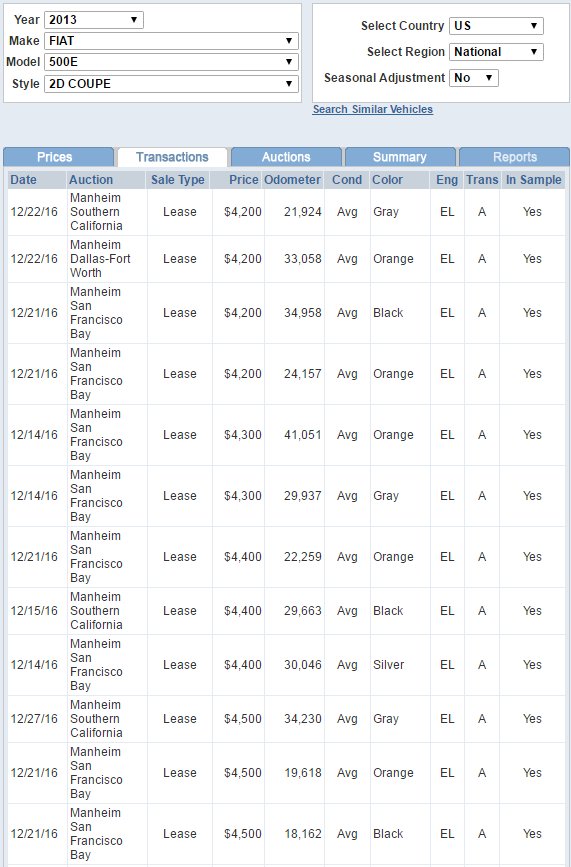
And, wow, are their prices low. How about wholesale auction prices of slightly over $4,000?
The data on those wholesale prices was compiled by auto writer (and occasional Green Car Reports resarcher) Bozi Tatarevic.


The cheap lease returned electrics are coming. The 2013 Fiat 500e is running at a little over $4,000 at wholesale auctions this month.
And, he added, that should translate to a retail price of around $6,500 once the auctioned Fiat 500e hatchbacks hit used-car lots.
That means that you could conceivably pay $6,500 for a fun-to-drive, three-year-old electric car with only 30,000 to 40,000 miles on it.

Now, there's at least one catch: the 500e was only sold in California and Oregon, so Fiat dealers outside those two states will know little or nothing about the electric 500 variant.
While we could imagine some enterprising entrepreneur buying up the electric Fiats and bringing them to electric-car fans in other states, the service issue remains a risk.
2014 Fiat 500e - Driven, July 2014 (NWAPA Drive Revolution)


Still, we liked the little three-door Fiat 500e when we first drove it, and some owners feel it's the best car in the entire 500 range—and just as entertaining as the sporty 500 Abarth variant.
When we went on that first drive, even the Fiat Chrysler engineers who'd worked on the car seemed slightly stunned at how much fun it was.
Deals like this one could last for a while. Fiat won't say how many electric 500s it's sold, but the number could be as high as 13,000 by the end of this year.

That's a whole lot of fun, cheap, low-mileage electric cars that will need to find second homes over the next couple of years.
So what do you think? Can you find it in your heart to provide a "forever home" for a cute little Italian orphan?
Operators are standing by.

Tuesday, October 4, 2016

One More Time: Chevrolet Volt Sales Surge Higher In September 2016

The Chevy Volt found itself in the shadow of the upcoming 2017 Bolt EV this month
Lost in the media blitz surrounding the Chevrolet Bolt EV this month (which was both announced with a 238 mile/383 km range, and a price-tag of $37,495), was the Chevrolet Volt – the most consistent selling plug-in for the US over the past several years. For September, and with some very deep inventories now on hand, 2,031 Volts were sold, a 114% improvement over the949 sold a year ago.
We should note that September of last year (and thus the huge percentage gains this year) gets a big fat asterisk; as a year ago GM found itself fast running out of first generation copies of the Volt, and also dealing with a slight delay in the new iteration’s release, which pushed the gen 2 car’s debut last year back a month to October.
Which means that next month we will see the true start of apples-to-apples, year-over-year comparisons of today’s 53 mile, extended range Volt.  In October of 2015, 2,035 Volts were sold.
Year to date, 16,326 Volts have been sold, which is 76%better than a year ago (9,264).
The 2nd generation Chevrolet Volt has now completed a full year of availability in the United States
Also of interest this month with GM and its EVs (not named the Bolt):
And that's a wrap! Cadillac ELR is now sold-out!
And that’s a wrap! Cadillac ELR is now sold-out!
*- from almost no remaining inventory, GM sold 6 Cadillac ELRs
*- with a still decent amount of stock penned up and to be released into “Bolt season”, GM sold 315 Spark EVs in September
*- all Chevrolet Spark EVs produced between 2014 and 2016 were recalled due to an airbag issue (as well as 4 million other GM cars)
*- GM started an online advertising program/video promotion, entitled “Real Volt Owners. Real Stories”, one can watch the first episode here

Sunday, August 14, 2016

Except For Tesla, Used EV Prices Are Scary Low

Wondering about buying an EV? Maybe you want to do your part to save the planet. Or maybe you are just tired of paying for gasoline. You could be attracted by the instant torque and quiet ride. But how much will an electric car actually cost you?
the price of a used EV continues to fall
Smart shoppers know the true cost of an automobile includes lots of factors. Purchase price is just one of them. They include fuel, interest, insurance, taxes, maintenance, and repairs. Then there is the big one — resale value. Until you know what your car will be worth when you sell it or trade it in, you really have no idea how much it will cost you to own.
Sadly, if we are talking about an EV, the answer is likely to be bad news. According to Anil Goyal, senior vice president of operations for used car pricing service Black Book, a three year old, off lease Nissan LEAF wholesales for between $6,00 and $7,000. That’s less than 20% of its original sticker price. A similar car with a gasoline engine usually sells for around 50% of its MSRP.  A five year old LEAF is worth a dismal 11% of sticker price.
Okay. You’re right. The calculations are skewed because they don’t take into account the federal tax credit available for electric cars. Please don’t shoot the messenger. But there is no denying that low resale values mean the business case for buying a new EV is harder to make.
The only bright spot in the EV picture is the Tesla Model S (there are precious few used Model X cars for sale). Black Book says a 3 year old Model S is worth 62% of MSRP. Why the difference? “To be under 20 percent [for a 3 year old LEAF] is fairly telling,” says Goyal. “A lot of it has to do with demand.” Lots of people want a used Tesla. Not so many want a used LEAF.
There are several reasons for the difference. First, the pace of development for electric cars, especially in battery capacity, is quite rapid. Many people remember when personal computers first became popular. The technology was improving so quickly that the machine you bought in the morning was obsolete by the time you got it home and set up. Only Tesla has over the air wireless updates that keep all its cars as technically up to date as possible.
Second, range is a factor. That used LEAF may only be able to drive about 60 miles before the driver feels the urge to recharge it. Any car that won’t go at least 100 miles on a full battery has limited appeal to used car shoppers, Goyal says. That eliminates the LEAF and the BMW i3, as well as all the battery electric compliance cars like like the e-Golf, Fiat 500e, and Mitsubishi i-MiEV. Every Tesla ever made can go more than 100 miles on a single charge.
Third is styling. Toyota started it by making the Prius look different from other cars on the road. The idea was to make it stand out from “ordinary” cars. It worked well for Toyota, so Nissan did something similar with the LEAF. People who own a LEAF are generally happy with their cars, but few would call it beautiful.
Not so with Tesla. Elon Musk has learned well from Apple. Everything he touches has to be appealing to the eye, even if it is a home battery storage system that sits in the basement. The Model S is an attractive car. It still looks good today, nearly 5 years after it first went on sale. The LEAF just looks dated alongside contemporary cars.
Fourth is the proprietary network of Supercharger fast charging stations that a Tesla owner can access when away from home Buyers of other used electric cars are left to fend for themselves as they try to navigate through a complex maze of charging options. In the final analysis, Tesla’s decision to build its own charging network maybe the most brilliant business decision of the 21st century.
Will used EV prices ever rebound? There are a lot of new models coming to market soon. And of course the supply of used Teslas won’t stay low forever. The bottom line is that people are not going to plump down their hard earned money on a car with awful resale value just to save a few bucks at the pump. Even the most dedicated tree hugger doesn’t want to be stuck with a car nobody wants once the honeymoon is over.
Tesla is eating everybody else’s lunch. The others have to figure out how to make cars that people want to own even after the new wears off. A big part of that would be a commitment to building a charging infrastructure that is simple to use with enough chargers for everyone. Instead, they are sitting around with their hands in their pockets waiting for the taxpayers to shoulder the burden.
It’s a matter of attitude. The traditional companies still see electric cars as a necessary evil, a fad that will pass eventually. They will build enough of them to satisfy regulators, but their hearts are still married to the golden era of the automobile when cheap gasoline for internal combustion engines was the order of the day. By the time the awaken from their long nap, Tesla may be the dominant force in the industry, if it isn’t already.
Source: Car and Driver

Saturday, June 4, 2016

Volt Sales Surge, LEAF Sales Tumble

The Nissan LEAF is the best selling electric car in the world. But for how long? Nissan has been selling essentially the same car since 2010. We have readers here at Gas2 who drive a LEAF and say it is basically a pretty good car. But it is desperately in need of a refresh.
2016 Nissan LEAF will have up to 107 mile range
Way back in 2010, Nissan and Chevrolet thought an electric car should look different. People should be able to look at it and know right away it is an electric car just the way people can instantly identify a Toyota Prius as a hybrid. That strategy works great for early adopters, but the long term goal is to attract mainstream drivers to the world of electric cars.
Chevrolet realized that pretty quickly. It pushed forward with a second generation Volt that has far greater range and a body that looks very much like its four door sedan cousin, the Chevy Cruze. Chevy sold 1,901 Volts last month, an increase of 17.5% compared to May of last year. So far this year, 7,871 Volts have found new owners compared to only 4,397 in the same period in 2015. True, some of that is because Chevrolet announced an updated Volt was coming and some put off their purchase until the new car arrived.
But over at Nissan, sales of the LEAF have gone over a cliff. So far this year, Nissan has sold only 4,697 examples of the all electric LEAF. That is down almost 40% from last year, when 7,742 of them were sold. In May, only 979 LEAFs left showrooms — a drop of 53.5% from last year. Bear in mind the LEAF now features an upgraded battery with 107 miles of range versus 83 miles for the original. But its design, never that appealing to begin with, now looks frumpy and outdated.
As much as we like the Chevy Volt around here, its sales are hardly enough to get excited about. Not when 373,000 people worldwide have plunked down $1,000 a piece to reserve a Tesla Model 3, a car that isn’t even available yet. Why is Chevrolet only selling thousands of Volts when Tesla is projected to sell ten times as many cars? That’s a question executives at both companies should be giving plenty of thought to.
What reasons do you think explain the mania for Tesla cars versus the fairly tepid market response Chevrolet and Nissan have experienced? Please share your thoughts with us in the comments section.
Source: EV Obsession