Saturday, November 4, 2017

Workhorse CEO: $300 million in preorders for plug-in hybrid pickup trucks

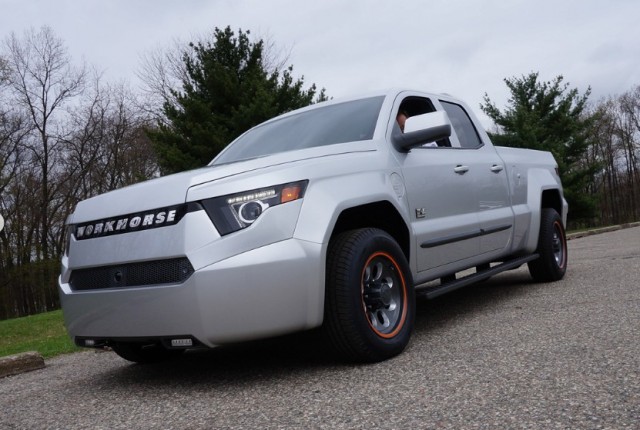
Workhorse W-15 extended-range electric pickup truck


Over seven years of plug-in electric cars and 20 years of hybrids, the pickup truck sector remains largely untouched. GM sold hybrid Chevrolet and GMC pickups for a few years, and Ford plans an F-150 hybrid in 2020. A startup company now called Workhorse (nee AMP) noticed that white space and made a bold play for the market with its W-15 plug-in hybrid pickup truck.

With an estimated 80-mile range on electric power and 32 mpg highway and 28 mpg city with the gasoline engine, Workhorse leads in crowding segment. Though the truck isn't on sale yet, CEO Steve Burns says the company has received $300 million in pre-orders for its plug-in hybrid truck. At an estimated price of $52,500, that's a lot of trucks, but Burns stressed that getting orders up front is a calculated strategy in an interview with Autoblog.
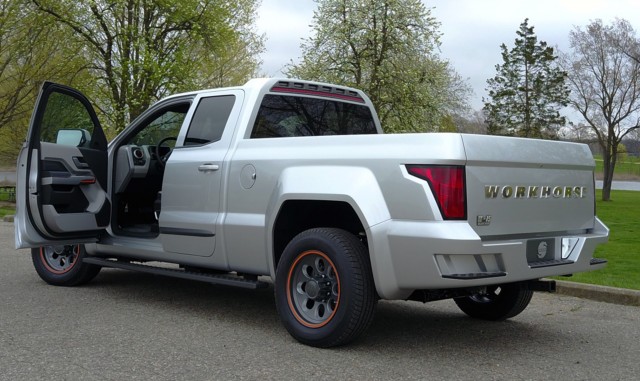
Workhorse W-15 plug-in truck


Although the company had the desire to build a plug-in pickup truck, Burns admits Workhorse didn't have the resources to do it. "We couldn't build it and hope [customers] came," after the announcement. "We wanted to make sure there was an audience of customers." Potentially to his surprise, the audience poured in; Workhorse received 4,560 letter-of-intent preorders at its reveal in May.

Workhorse developed the W-15 with compromise in mind since an all-electric truck may "disappoint" customers in capability, per Burns. The CEO says an all-electric truck's estimated range diminishes as payload and towing ratings increase—it also allows Workhorse to keep costs down with a smaller battery pack with a plug-in hybrid powertrain.
And the W-15's specifications aren't poor, either. Dual electric motors provide 460 horsepower, its payload rating sits at 2,200 pounds and it will tow up to 5,000 pounds.
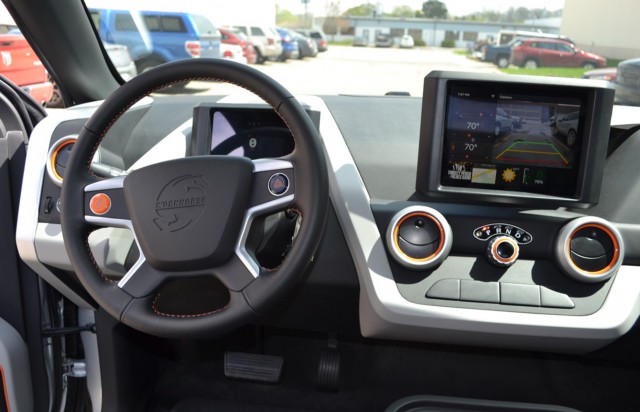
Workhorse W-15 plug-in truck


The battery also serves as a mobile power supply with a standard outlet present to power electric tools. Workhorse wants to deliver its first trucks by late 2018, but it won't necessarily be alone in the market. Canadian company Havelaar plans to build its all-electric Bison; Tesla has said it plans an electric pickup truck in two years; and Bollinger wants to build a a pickup version of its B-1 electric Class 3 utility truck.

None of those companies is a traditional maker, but there's also the chance that one or more large global carmakers could change course and debut its own mass-market electrified pickup. The demand for the Workhorse plug-in hybrid pickup truck speaks volumes, however. After the company satisfies its initial fleet orders, Burns said it will likely turn toward individual customers, whose pre-orders he said could be filled sometime late in 2019.

Chevy Bolt EV Now Leads Volt Sales, Again Hitting All-Time Sales High


Chevrolet’s 238-mile range Bolt EV has again moved the bar upwards with 2,781 sales in October and taken the lead against its sibling, the Chevy Volt.
The front-wheel-drive compact crossover that zips to 60 mph in around 6.5 seconds like a sports car while offering outsized interior space and competent handling is now selling in the 2,000-range like Teslas often have, a positive sign.
Launched in December 2016, the car rolled out to all 50 states by the summer this year, and has consistently risen. In September it saw 2,632 sales, so 2,781 is not a big leap, but August had seen 2,052, and July had seen 1,971, and June was 1,642.
The all-time high-water mark yet belongs to Teslas which has run into the 3,000-4,000 range for the Model X and S sales in the U.S. respectively, but the Nissan Leaf has not gone above middle 3,000s in its hay day, and 2,000-some sales is otherwise respectable at this stage.
As EVs are yet minority products, the Bolt has been the country’s best seller at certain points of this year, and yet ranks up in the top three.
Other EVs sell in far-fewer numbers, and so despite more-modest advertising, the Bolt is doing alright as Nissan awaits its 2018 all-new Leaf with smaller 40-kWh battery for year one.


The Bolt has also stepped ahead of the plug-in hybrid Volt, which was down 37.8 percent year over year with 1,362 sales compared to 2,191 sales in October 2016.
The tally for the Bolt now is 17,083 sales, and the Volt rests at 16,710.
Not hurting things is GM reported its third straight month of crossover sales above 17 percent market share. The last time it delivered three consecutive months at or above a 17 percent retail share was July-September 2011.
The Bolt crossover otherwise appears to be cannibalizing some Volt sales. The Volt’s claim to fame was all-electric when you need it, and no range anxiety.
With its range capable of 250 on an easy drive cycle, the Bolt has little anxiety for a lot of people too, while never having its gas engine come on – because it doesn’t have one!
Pricing is a couple thousand above the Volt, but GM has otherwise thrown its marketing more heavily toward the Bolt, and media are also reporting it more as it’s a newer car.

Enevate Claims New EV Battery Technology Permits Recharging In 5 Minutes

Enevate, located in Irvine, California, claims its latest silicon dominant lithium ion battery technology makes 5 minute charging possible. In a press release, the company says an electric car equipped with one of its batteries can add 240 miles of range in just 5 minutes or 50 miles of range in a minute.
EV fast charging battery technology from Enevate
Fast charging is a hot topic in the world of electric automobiles because most drivers are accustomed to spending 5 minutes or less at the pump to fill the gas tank of their conventional cars. Israeli company StoreDot also claims its EV battery can be recharged in just five minutes.


Enevate cites several advantages for its batteries. Each battery has an energy density of 750 Wh/L and can be safely charged at temperatures as low as -40ยบ Celsius. It can absorb  more energy from regenerative braking than a traditional EV battery. Last, the company claims that eliminating range anxiety due to faster charging times could allow manufacturers to offer smaller, less expensive batteries, which would reduce the cost of electric vehicles and make them more attractive to buyers.
“The benefits of Enevate’s silicon-dominant HD-Energy Technology enable next-generation features that take EVs to the next level,” says founder & chief technology officer Dr. Benjamin Park. “Extreme fast charges for very short and convenient charging times, higher energy density leading to longer driving ranges, and cold temperature operation with inherent safety advantages make this technology ideal for electric vehicles.”
No less an authority than Dr. John Goodenough of the University of Texas in Austin has given his endorsement to the company’s technology. “Enevate’s film-based silicon-dominant anode and cell is a truly novel approach and great practical fit for use in EVs addressing the major barriers to EV adoption,” he says.
Enevate’s silicon dominant anode technology is exciting news, but the company provides no information in its press release about what sort of charging equipment is needed to make the miracle of 5 minute charging possible nor does it say where such chargers can be found, who will build and operate them, or how much they will cost.