Showing posts with label Workhorse W-15. Show all posts

Saturday, November 4, 2017

Workhorse CEO: $300 million in preorders for plug-in hybrid pickup trucks

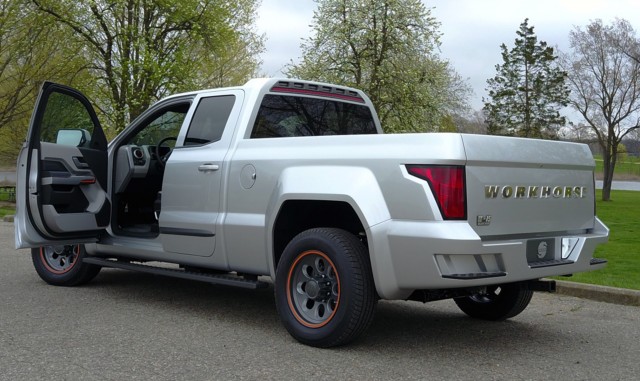
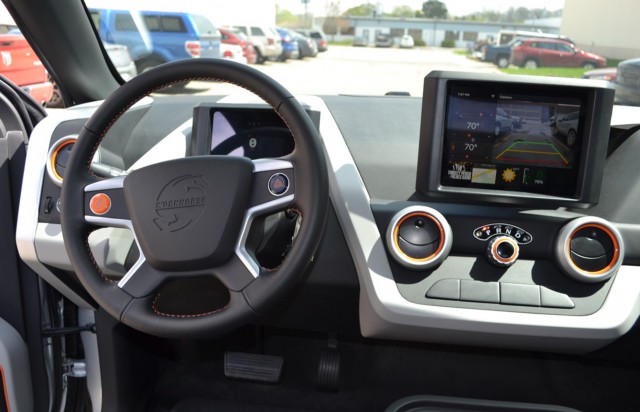
Workhorse W-15 extended-range electric pickup truck


Over seven years of plug-in electric cars and 20 years of hybrids, the pickup truck sector remains largely untouched. GM sold hybrid Chevrolet and GMC pickups for a few years, and Ford plans an F-150 hybrid in 2020. A startup company now called Workhorse (nee AMP) noticed that white space and made a bold play for the market with its W-15 plug-in hybrid pickup truck.

With an estimated 80-mile range on electric power and 32 mpg highway and 28 mpg city with the gasoline engine, Workhorse leads in crowding segment. Though the truck isn't on sale yet, CEO Steve Burns says the company has received $300 million in pre-orders for its plug-in hybrid truck. At an estimated price of $52,500, that's a lot of trucks, but Burns stressed that getting orders up front is a calculated strategy in an interview with Autoblog.

Workhorse W-15 plug-in truck


Although the company had the desire to build a plug-in pickup truck, Burns admits Workhorse didn't have the resources to do it. "We couldn't build it and hope [customers] came," after the announcement. "We wanted to make sure there was an audience of customers." Potentially to his surprise, the audience poured in; Workhorse received 4,560 letter-of-intent preorders at its reveal in May.

Workhorse developed the W-15 with compromise in mind since an all-electric truck may "disappoint" customers in capability, per Burns. The CEO says an all-electric truck's estimated range diminishes as payload and towing ratings increase—it also allows Workhorse to keep costs down with a smaller battery pack with a plug-in hybrid powertrain.
And the W-15's specifications aren't poor, either. Dual electric motors provide 460 horsepower, its payload rating sits at 2,200 pounds and it will tow up to 5,000 pounds.
Workhorse W-15 plug-in truck


The battery also serves as a mobile power supply with a standard outlet present to power electric tools. Workhorse wants to deliver its first trucks by late 2018, but it won't necessarily be alone in the market. Canadian company Havelaar plans to build its all-electric Bison; Tesla has said it plans an electric pickup truck in two years; and Bollinger wants to build a a pickup version of its B-1 electric Class 3 utility truck.

None of those companies is a traditional maker, but there's also the chance that one or more large global carmakers could change course and debut its own mass-market electrified pickup. The demand for the Workhorse plug-in hybrid pickup truck speaks volumes, however. After the company satisfies its initial fleet orders, Burns said it will likely turn toward individual customers, whose pre-orders he said could be filled sometime late in 2019.

Friday, June 2, 2017

Workhorse SureFly Electric Helicopter Concept To Appear June 19 At Paris Air Show

Workhorse, which unveiled its four wheel drive plug-in hybrid pickup truck, the W-15, last month at the ACT Expo in Long Beach, has other irons in the electric transportation fire. On June 19, it will unveil its latest creation, the SureFly electric helicopter designed to get people into inaccessible places quickly and easily. “It’s designed to be a short-hop machine. If you can fly a drone, you should be able to fly this,” Steven Burns, CEO of Workhorse says.
SureFly electric helicopter
On its website, Workhorse describes the SureFly this way: “After 78 years, the helicopter has been reinvented. SureFly is a personal helicopter/VTOL aircraft designed for safe and easy flight. With eight independent motors each driving a single carbon fiber propeller, a backup battery power system, and a ballistic parachute to safely land in the event of emergency, the SureFly provides unparalleled safety for a personal aircraft. SureFly is changing the helicopter industry. Now is the time to discover the affordable, easy-to-pilot, safe answer to personal flight.”
The SureFly electric helicopter has room for two people. Like its W-15 pickup truck, the target audience is utility companies, first responders, and others who need a means of getting critical personnel and services to places that are inaccessible to regular vehicles because of terrain or congestion.
The production model of the Workhorse electric helicopter will be made of carbon fiber to save weight. The company is currently testing a steel prototype at its headquarters near Cincinnati. If the craft goes into production, it will be built at the company’s factory in Union City, Indiana. Burns hopes to have the SureFly flown by a test pilot by the end of this year and is targeting FAA approval by the end of 2019.
Vertical take off and landing aircraft powered by electric motors are suddenly very much in the news. Uber says it is working on flying cars and Lilium, based in Munich, Germany is working on its own version of an electric VTOL machine. “After decades of zero market entrants, there’s a sudden flood of new big ideas,” writes Richard Aboulafia, vice president of analysis for aerospace and defense consulting company Teal Group. “If Dr. Seuss drew air vehicles, he’d be perfect for these newcomers.”
Workhorse is no stranger to drones. Earlier this year it tested its HorseFly delivery drone which is designed to solve the “last mile” problem that UPS and other delivery companies deal with every day. The theory is that a drone could deliver packages to customers who live at the end of long driveways or dead end streets while the package van goes on to the next stop, saving fuel and time — both critical elements to delivery fleet managers.
Some have questioned whether Workhorse will be able to survive in the highly competitive world of building motor vehicles, but there are similarities between it and a certain startup in Silicon Valley that started out building premium electric cars and now seems poised to put some of those legacy automakers out of business. Steve Burns is focused on the future, not the past, and seems to have it all going on right now. Here’s hoping he can keep it up.
Source: Trucks.com 

Friday, May 19, 2017

Workhorse W-15 Plug-in Hybrid Electric Pickup Truck Interview With CEO Steve Burns

When the Workhorse W-15 plug-in hybrid electric truck was unveiled to the public at the ACT Expo in Long Beach, the folks from Inside EVs had an opportunity to sit down with Workhorse CEO Steve Burns for an extended interview. The specs for the W-15 are now known — 60 kWh battery, 80 mile range, 0-60 in 5.5 seconds, stainless steel chassis, on board range extender engine supplied by BMW. What isn’t so well know is how Workhorse began and how it got to where it is today.

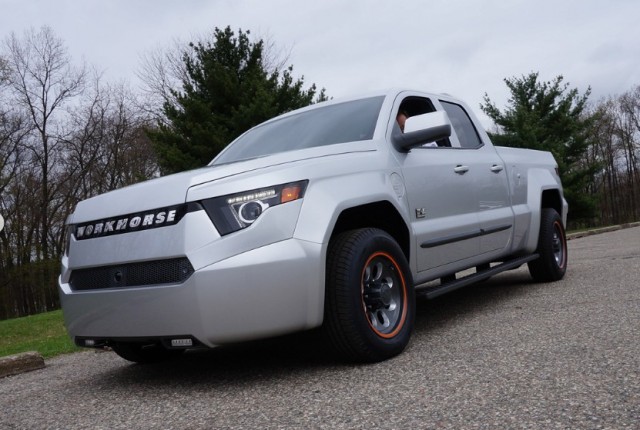
Wrokhorse W-15

Conversions Don’t Work

Burns started out with a company called AMP that converted conventional vehicles like the Chevy Equinox to electric power. “It’s very expensive to be an OEM. So people say, ‘I’ll take something that’s close and I’ll convert it.’ But what happens when the frame cracks in 10 years and you converted a Ford, let’s say, and Ford’s going to say, ‘Well it cracked because you put this heavy battery pack on it. That’s not our fault,’ right?” Burns asks.
Workhorse is concentrating on fleet sales for one simple reason. Individual buyers don’t look at the total cost of ownership. Fleet managers look at nothing else. “What we discovered with our UPS trucks is that you can prove to a fleet manager that your vehicle is less expensive than a gasoline or diesel counterpart. We could save UPS or a company like UPS about $160,000 per truck over a lifetime. Without any government vouchers, it still makes economic sense.”
Workhorse cost of ownership chart

Concentrating On Fleets Generates Pre-orders

Workhorse says it has 1,000 pre-orders from various utility and delivery fleet operators like UPS and Duke Energy. That resonates with lenders when a manufacturer with good ideas but no track record goes looking for financing. “Investors or strategic partners or the government — all those sources of capital want to know the same thing: ‘Do you have a customer base that will buy these if you build them?’ That’s the hardest thing to prove and that’s what pre-orders do.

Working With Detroit Is Part Of The Plan

“One thing that might be a little different with us than Silicon Valley folks is that we’re in the Midwest and as opposed to saying, ‘Hey, we’re a new kind of car company, we don’t want to involve any rust belt thinking or old school thinking from Detroit,’ we’re embracing Detroit. There’s a lot of Detroit vendors that are helping us here, especially with the carbon fiber stuff. What we had is, from the get go, is A, we had to design this so it can be built in our existing factory, and B, even the UPS trucks are basically a body on rails…..We designed it from the get go so that it could be built at our existing factory, which dramatically reduced costs.
“It’s really quite remarkable, our body parts will come from a Detroit company, all painted. If you look under the roll cage that the passenger sits in, that’s all carbon fiber and composite. It comes to us in one piece. You don’t have to dip it in anti corrosion material. It’s quite remarkable what we’ve saved by going composite and carbon. As far as traditional up front costs, we’ll have a stainless steel chassis and a carbon fiber everything else. Well, there’s a little steel in there, like in the door; even though the door is carbon fiber it has a steel band in there. We didn’t want to reinvent everything. The size of the bed, the size of the cab, we didn’t want to mess with that. We kept the outside parameters.”
You may recall that another electric truck start up, Deutsche Post, is building all electric delivery vans using mostly parts that are readily available from mainstream, established automotive suppliers.

The W-15 Will Meet All Certification Parameters

“No exceptions, we’re not going to apply for any exceptions. Because the numbers we’re at, our orders have already exceeded the limit, so we’re going for full certification. Again, that’s why I talk about Detroit. Folks from Detroit are really knowledgeable about these things. For example, crash testing. You hope to model it in software and really refine it in software, and only have to crush a few to make sure that they line up with the software algorithms. There are decades of that experience in Detroit. It’s remarkable how close they get.”

Why Does The W-15 Use A Range Extender Engine?

Burns says, “Our goal is to be known as the electric truck company that caters to fleets. That’s why we arrived at a hybrid, or a range extender. What we did was, same thing we do with UPS trucks. We put a battery in there that should cover them for 360 days a year, but once in a while something weird happens, like it will be minus 20 in Chicago or there’s a hurricane in Charlotte and all the Duke trucks have to head for Charlotte from other cities. By putting a range extender in there, we’re able to tell a fleet that they will always complete their mission. Most days you run all electric and you get 75 miles per gallon equivalent, but you know the truck will do anything you ask of it. What people expect of a modern day pick up truck is essentially it can do anything.
“Anyway, if we crunch the numbers with a battery pack big enough to tow, haul, and have over more than just 200 miles range, it would just be too big and expensive and heavy. We put electric motors in that are big enough to tow and haul. We put a pack in there that gives you 80 miles on a normal day, but let’s say now you’ve got 2,000 pounds in the bed and you’re towing a 5,000 pound generator. You’re not going to get 80 miles on all electric, but on that rare day they are more than happy if the gas engine has to turn on. It’s against the [EV] religion to put gas onboard. But our only religion is making fleets happy and if we have to have an insurance policy in there so they feel comfortable, then that’s what we do.”

Beating The Market

Burns knows that Tesla is working right now on an electric pickup truck of its own. But it will be battery electric only, which means it may not have the same appeal to fleet buyers who want a truck that can go anywhere, anytime, with no excuses.  “The reason we want to beat the market is we think we have a two-to-four-year lead here and we want to establish the brand and get enough miles on the road and enough customers and really kind of establish us as, ‘If you want an electric truck, you know this is the company that specializes in that,'” Burns says.

It’s Not All About No Frills Transportation

Fleet managers are pretty frugal people. No leather interiors or chrome wheels for them. UPS even refuses to equip its vehicles with air conditioning. But performance — that shove in the back you feel when you mash the throttle — is still important. “One spec that seems to get everybody excited, and when we had the ride and drives at the LA show, everybody wanted to feel a pick up truck do zero-to-60 in 5.5 seconds. It handles like no other pick up truck just because you’ve got that battery low like that. We’ve got a huge crumple zone up front.”
Safety, performance, no corrosion, reliability, and low ownership costs — those are all factors that gladden the hearts of fleet managers. The company now has a prototype on the road. Next comes field testing and building pre-production trucks for certification purposes and to show off to prospective customers. Workhorse expects to put the W-15 into production before the end of 2018.
Source: Inside EV

Tuesday, May 2, 2017

Workhorse W-15 Electric PIckup Truck Goes Public At ACT Expo On May 2

Workhorse, an American company with headquarters in Ohio, has taken the wraps off its W-15 electric pickup truck. The reveal took place at the 2017 Alternative Clean Transportation EXPO in Long Beach, California on May 2. Afterwards, fleet managers were able to test drive the innovative W-15 — the first designed as an electric pickup truck from the ground up.
Workhorse W-15 PHEV all wheel drive pickup truck
The first thing anyone thinks about when looking at a new pickup truck is styling and the W-15 has the sort of rugged good looks any truck owner wants. But the beauty of this truck is in how it is built. Composite and carbon fiber body panels are designed to shrug off dents, dings, and corrosion. You won’t see any of these vehicles driving around with gaping holes in the bodywork when they are a few years old. Sadly, many of the trucks from the Big Three automakers are little more than rusted out hulks before the last loan payment is made.
Underneath is a stainless steel ladder type chassis for strength and durability. The front end of the W-15 has 30″ of impact absorbing crush space built in to protect occupants in the event of a frontal collision. The truck also features automatic braking and a lane departure warning system.
The W-15 has a range extender gasoline engine sourced from BMW. It has a range on battery power alone of 80 miles. It can travel more than 300 miles more once the range extender engine kicks in. The battery pack is mounted low in the chassis for excellent stability but the truck still has a generous 12″ of ground clearance.
Here’s where the Workhorse W-15 really shines. It has two electric motors — on in front and one in back — for true all wheel drive capability. Total horsepower is listed as 460 and the company says it can gallop to 60 in 5.5 seconds. It is rated 75 MPGe by the EPA and gets 32 mpg city/28 highway when the range extender engine is operating. Can you think of any other full size all wheel drive pickup that hauls the mail as fast as the Workhorse W-15 and gets anywhere near 30 miles per gallon? Most of them don’t get even half that driving around town.
The W-15 is an electric vehicle first and foremost. It’s range on battery power is greater than most fleet vehicles drive in a typical work day, which means it could burn little to no gasoline in ordinary use. All it needs is to be plugged in at the end of the work day for it to be ready to got to work the following morning. But having the range extender engine means companies never have to worry about one of their trucks being stuck out in the boonies with a flat battery.
The W-15 has a load capacity of 2,200 lbs and can tow up to 5,000 lbs. It also features a 7.2 kilowatt outlet that can power tools and lights in the field directly from the battery without using the engine.Priced from $52,500, its durability, low operating costs, and reduced maintenance expenses should make it an attractive choice for fleet managers who place a premium on keep the total costs of ownership low.

Wrokhorse W-15
Workhorse says it can build up to 60,000 W-15 pickup trucks a year at its factory in Indiana. So far, it has confirmed letters of interests for 1,500 units from a variety of companies including UPS, FedEX, and utility companies. It has no plans to sell the vehicles to private customers at this moment, but that could change once word about the W-15 starts to spread.
In advance of the official unveiling, Workhorse and Ryder Systems have announced a new partnership. According to a joint press release, “Ryder will be the primary provider of service and support for Workhorse vehicles in the United States, Canada and Mexico. Ryder will also serve as the primary distributor of the E-1oo, E-GEN and W-15 electric pickup in North America.
“Ryder is a leading maintenance provider of advanced vehicle technologies that maximize both cost-efficiency and environmental sustainability for our customers. Workhorse brings not only a strong track record in range vextended electric medium duty vehicles with the E-100 and E-GEN, but also a strong future in the light duty market with the range extended W-15 electric pickup,” said Scott Perry, Chief Technology and Procurement officer at Ryder.
“We’re excited to include Workhorse’s innovative range extended electric vehicles into our distribution and service network. This new strategic partnership will help us expand our advanced vehicle technology portfolio of innovative solutions within the commercial transportation industry.”
Source: Workhorse

Friday, April 14, 2017

Workhorse Releases Specs For Its Plug-in Hybrid Electric Truck

The Workhorse W-15 electric truck is specifically designed to meet the needs of commercial fleet operators. 
Workhorse W-15 plug in hybrid electric truck
The Workhorse W-15 is scheduled to be revealed for the first time to the public in early May. Here’s some of the information we have been waiting patiently for about this groundbreaking new plug-in hybrid electric truck:
⊕ 75 MPGe fuel efficiency in all-electric operation
⊕ 80-mile all-electric range
⊕ Gasoline-powered range extender
⊕ 460 horsepower
⊕ 0–60 miles per hour in 5.5 seconds
⊕ True all-wheel drive with dual electric motors
⊕ Collision avoidance features including
o Automatic braking
o Lane-departure warning
⊕ Composite body with carbon fiber
⊕ Double cab
⊕ Standard bed configuration
⊕ 7.2 kw power export that allows tools to be plugged directly into the battery power source without the truck running
The company claims it has 1,000 orders for the W-15 electric truck from such companies as Clean Fuels Ohio, Duke Energy, Portland General Electric, the City of Orlando, and the Southern California Public Power Authority. Workhorse says its factory in Union City, Ohio, will have a capacity of 60,000 units a year. The suggested retail price will be $52,500.
The W-15 will be the “safest pickup ever built,” the company says. The weight of the batteries will be carried low in the chassis for excellent stability. It will feature a ladder-type frame made of stainless steel. In addition to standard electronic stability control, it will have larger than normal crumple zones and the body will be made of composite panels that don’t dent or rust.
The communication from Workhorse doesn’t tell us what the range extender engine will be. Workhorse uses the 2 cylinder engine that BMW uses for its i3 REx in the hybrid parcel delivery vans it makes for UPS, but there is a possibility the company will use a 4 cylinder engine in the W-15 to improve cargo and towing capacity. We will find out more on May 2.

Sunday, March 5, 2017

Workhorse Has 1,000 Orders For Plug-in Hybrid Electric Pickup Truck

Workhorse says a number of potential customers have contacted the company about buying its plug-in hybrid electric pickup truck. In total, it says Clean Fuels Ohio, Duke Energy, Portland General Electric, the city of Orlando, Florida, and the Southern California Public Power Authority have indicated they are interested in purchasing as many as 1,000 examples of the all new hybrid electric pickup truck.
Workhorse plug-in hybrid electric pickup truck
Dubbed the W-15, it will be revealed to the public for the first time on May 2. Workhorse says its factory in Union City, Ohio will have a capacity of 60,000 units a year. As of this time, the suggested retail price will be $52,500.
The Workhorse W-15 is similar to other light duty pickup trucks like the Ford F 150, Chevy Silverado, and Dodge Ram in size, payload, and towing capacity. It will be rated for 2,200 lbs of cargo and come with a 5,000 towing capacity.  The prototype has a 4 door cab and seating for 5. It also features an extra wide load bed.
What sets the W-15 apart from anything else on the market is a relatively long 75+ mile electric only range and four wheel drive capability. It has two electric motors, one for the rear wheels and one for the front wheels. It will also feature an on-board gasoline powered range extender engine, either the 0.7 liter two cylinder unit from the BMW i3 sedan or the 1.5 liter 3 cylinder from the BMW i8 sports car. The lithium ion battery pack will use battery cells manufactured by Panasonic and will be mounted in the center of the vehicle where its weight will not adversely affect the handling of the vehicle.
The W-15 should have exceptional offroad capability with its 11 inches of ground clearance, generous electric motor torque, and all wheel drive characteristics — features not available in the up-fitted Ford F-150 plug-in hybrid pickup trucks from XL Hybrids.
The W-15 will be the “safest pickup ever built,” the company says. The weight of the batteries will be carried low in the chassis for excellent stability. The pickup will be built on a ladder type frame made of stainless steel. In addition to standard electronic stability control, the truck will have larger than normal crumple zones and the body will be made of composite panels that don’t dent or rust.
Workhorse already provides a plug-in hybrid powertrain to UPS for its package delivery vans. It claims those vans are five times more fuel efficient than the standard vans in the UPS fleet and will cost 60% less to maintain. UPS has been testing the Workhorse system and has just placed an order for 125 more.
There is no word yet when or if Workhorse intends to sell its W-15 to private customers. Perhaps it will have enough commercial customers to keep its factory busy for a while. But interest from the general public should be quite high when and if the company decides to address that market.
Source: Truck Trend