Showing posts with label Tokyo Motor Show. Show all posts

Tuesday, November 3, 2015

2018 Nissan LEAF Will Have 200 Mile Range

Nissan IDS concept
Just before the Tokyo Motor Show last week, Nissan did something highly unusual. It invited members of the press to visit is super-secret Advanced Technology Center in Atsugi, a town in the mountains southwest of Tokyo. Up to that point, most people assumed that when the second generation LEAF goes on sale in 2018, it will have double the range of the original. Since 2011, the LEAF has come with a 24 kWh battery good for about 82 miles of all electric driving. Everyone thought the new car would have a 48 kWh battery with about 160 miles of range. But in fact, the new car will have a 60 kWh battery that is said to permit as much as 500 kilometers of range in the rather optimistic Japanese test cycle.
500 kilometers translates into 300 miles, but that number is typically about 1/3 less using EPA standards, so we can expect roughly 200 miles of range in US trim. The new battery not only has more than double the power of the original, it fits in the same space as the battery from 2010. How is that possible?
The credit goes to scientists at the Department of Energy’s Argonne National Laboratory. They started working back in 2011 on a new battery cathode made from an allow of nickel, manganese and cobalt that permits significantly higher energy flow and higher voltages. The new cathode makes it possible to more than double battery power and slash recharging times in half. It’s a closely guarded secret, but Bertil Schmitt of the Daily Kanban says he was told the new battery is the result of a collaboration between Nissan and LG Chem. Sharp eyed readers will remember that LG Chem also supplies the battery for the Chevy Volt and is partnering with Chevrolet on its upcoming Bolt electric car.
While Nissan offered few hints about what the second generation car would look like, it did say the new car would incorporate several features from its IDS Concept car that was featured on its stand in Tokyo. That car makes extensive use of carbon fiber body parts. Nissan showed the journalists a carbon fiber A pillar from the IDS Concept. Is it possible that part will find its way into the next LEAF? The component is much narrower than a conventional steel A pillar, which enhances outward visibility for the driver, but the A pillar is critical to passing all 5 IIHS crash tests. Is a lighter, thinner carbon fiber component able to withstand that kind of punishment?
Nissan also says the next generation LEAF will have an autonomous driving system that is more advanced than the one Tesla uses, because it includes more cameras for a true 360 degree view around the entire automobile. More cameras mean more data. More data means more accurate control of the car. Nissan says the 2018 LEAF will be able to drive itself on the highway and that intown autonomous driving will be available by 2020. That’s 5 years sooner than Klaus Froehlich, BMW’s R&D chief says self-driving in the city will be possible.
The big question is, how much will all this goodness cost? If Nissan can bring the car to market for a price close to the current car, that will be a stunning achievement.

Monday, October 26, 2015

Nissan Hints At Future Of Its LEAF electric car

Nissan LEAF Concept
Ahead of the Tokyo motor show this week, Nissan is dropping hints about what the future of its LEAF electric car might be. We know that the LEAF will have a more powerful battery for 2016. The SL and SV models will have 107 miles of range, while the entry level S model will stick with the current battery that gives 83 miles of range. That actually is a pretty smart marketing move for Nissan. People who buy the S are more likely to be content with a basic people mover for getting back and forth to work and won’t need a lot of expensive options on their cars. Those willing to pay for more features will get longer range as a bonus.
According to Green Car Reports, Nissan may also have plans to offer the LEAF in several body styles, much as Toyota does with its Prius. Nissan executive vice president Trevor Mann told AutoCar recently, “There could be more than one Leaf. We’ve always said it needn’t be one car.” Mann hinted broadly that a crossover SUV model may be coming. Nissan has also released a teaser photo of what may be a smaller 3 door hatchback similar to the Prius C. That photo hints at what the second generation LEAF may look like when it gets here in 2017.
Tapping into the crossover market is very much on the mind of every manufacturer, and why not? It is the hottest segment of the automotive market, not just in the US but around the world. People are hungry for cute utes, so why not give them electric versions of the vehicles they want most? Tesla’s Elon Musk hinted a few weeks ago in a tweet (later deleted) that his company is working on an SUV version of the upcoming Model 3 with falcon wing doors. He suggested the car might be called the Model Y, which would make the full Tesla lineup S3XY. Get it? Musk may be an eccentric multi-billionaire, but he is not without a sense of humor.
Nissan executives Akiko Hoshino and Hiroto Saikawa told the press in Japan that Nissan expects EVs will account for 5% of Nissan sales soon and 10% “in the near future. And if we would use a wider definition of electrification and also count hybrids, more than half will be electric cars.” Presumably they mean plug-in hybrids, not Toyota Prius type hybrids. They say manufacturers will need to rely on electric vehicles to meet strict new emissions regulations coming soon. “The fuel consumption targets will become very stringent, and that will kick in at around 2019/2020, especially in the United States,” said Saikawa. “Suddenly there will be surge of demand.” They also say the price of automotive batteries will have come down enough by then to make the cars affordable.
Nissan is known to be working on longer range batteries for its electric cars. Company CEO Carlos Ghosn told shareholders in June that cars with a range of 500 kilometers (more than 300 miles) will be available from Nissan by 2018, according to GOEVGO. It is also developing autonomous driving software of its own. Bertil Schmitt, editor of the The Daily Kanbahn, says, “At the Tokyo Motor Show, Nissan is planning to put more than 100 journalists, foreign and Japanese, in a true autonomous drive Nissan LEAF, and will send them through thick Tokyo city traffic. Freeway is easy; city traffic is the holy grail of autonomous,” Schmitt says.
Clearly, Nissan is not standing still while the rest of the automotive world zooms ahead into the future. It is planning for a time when 50% of the cars it sells will be electric or plug-in hybrids and a family of electric vehicles based on the LEAF. Which raises the question: If there are two or more Nissan electric cars, are they called Nissan LEAFS or Nissan LEAVES? Such are the weighty concerns that prey on a the mind of an automotive blogger these days.

Wednesday, January 8, 2014

Toyota hydrogen vehicle visits CES, on sale in US in 2015


If there was ever any doubt that Toyota loves hydrogen vehicles, just listen to some of what Bob Carter, senior vice president of automotive operations for Toyota Motor Sales, USA, said today at the Consumer Electronics Show (CES) in Las Vegas:
  • "Fuel cell electric vehicles will be in our future sooner than many people believe, and in much greater numbers than anyone expected."
  • "Hydrogen works beautifully with oxygen to create water and electricity and nothing more."
  • "This [hydrogen] infrastructure thing is going to happen."
  • "I believe what I'm going to tell you about today is going to change our world."
Sounds like love is in the air.

In all seriousness, Toyota is incredibly bullish on the future of hydrogen as a part of the automotive landscape, and is now gearing up for the 2015 launch of its hydrogen sedan. The concept version of the carwas shown for the first time at the Tokyo Motor Show last fall and is making its North American debut at CES today, alongside the still-under-camo engineering prototype. The reasons for Toyota's hydrogen confidence? The debut vehicle is supposed to be a "reasonably priced" car that has a range of 300 miles and a refueling time of about five minutes. Carter highlighted the engineering work that Toyota has done over the past decades to get the fuel cell system downsized while upping power output to over 100 kW. He also said the vehicle will have carry enough energy to power a house for a week, so company engineers are working on an export power supply device.

The H2 Toyota sedan will start sales in California (the only state in the US where there are currently any hydrogen stations) next year. The automaker is working with the University of California Irvine's Advanced Power and Energy Program (APEP) to figure out where to build the next series of public hydrogen fueling stations. Today there are ten, but the model Toyota is using "is based on the assumption that owners want to reach a refueling station within 6-minutes" and shows that 68 stations would be able to serve around 10,000 hydrogen vehicles.
Show full PR text
News Source: Toyota

Sunday, November 3, 2013

Mitsubishi Storms Tokyo with Three Hot Concepts


Mitsubishi Concept Tokyo 2013

If you’re an American, you probably feel like Mitsubishi has fallen off the map in recent years- but rest assured, the brand has just been gathering strength, building the highest non-hybrid MPG car you can buy in the US and developing innovative new diesel-hybrid technology that could find its way into the next, all-conquering Evo supercar. You can see it in the company’s Pike’s Peak record-runner, and you’ll be able to see it in the three hot new concepts (above) coming to the Tokyo show later this month.
Don’t take my word for it, though- take theirs! You can check out Mitsubishi’s full Tokyo press release, below. Enjoy!

MITSUBISHI MOTORS LINEUP AT THE 2013 TOKYO MOTOR SHOW
Mitsubishi Motors Corporation (MMC) will unveil three world premiere concept cars at the 43rd Tokyo Motor Show 2013 on November 20. Incorporating a new design that symbolizes the functionality and reassuring safety inherent to SUVs, the three concepts take as their theme MMC’s @earth TECHNOLOGY*1 and point to the direction MMC’s development and manufacturing will take in the near future.
The MITSUBISHI Concept GC-PHEV is a next-generation full-size SUV with full-time 4WD. It is based on a front engine, rear-wheel drive layout plug-in hybrid EV (PHEV) system comprising a 3.0-liter V6 supercharged MIVEC engine mated to an eight-speed automatic transmission, with a high-output motor and a high-capacity battery to deliver all-terrain performance truly worthy of an all-round SUV.
The MITSUBISHI Concept XR-PHEV is a next-generation compact SUV developed to take driving pleasure to new levels. The MITSUBISHI Concept XR-PHEV uses a front engine, front-wheel drive layout PHEV system that is configured with a downsized 1.1-liter direct-injection turbocharged MIVEC engine and a lightweight, compact and high-efficiency motor with a high-capacity battery.
These two concepts feature PHEV systems optimally tailored to different market and segment requirements.
The MITSUBISHI Concept AR is a next-generation compact MPV which combines SUV maneuverability with MPV roominess. It uses a lightweight mild hybrid system which includes a downsized 1.1-liter direct-injection turbocharged MIVEC engine.
All three concepts feature MMC’s latest “e-Assist”*2 active safety technologies and the advanced “connected car” technology that utilizes next-generation information systems. These functions include a danger detection system which activates the corresponding safety functions and a failure/malfunction early-detection system which urges the driver to seek repairs or other maintenance when necessary.
Including the three concept models, MMC will be displaying a total of 17 models (13 on press days) at its booth at the 43rd Tokyo Motor Show 2013. Joining the concepts will be the new eK Space “super height wagon” minicar due for launch in Japan at the beginning of next year, motorsport vehicles and some current production models.

Source | Photos: Mitsubishi.

Sunday, June 30, 2013

2015 Toyota hydrogen fuel cell car will have 300-mile range, Tokyo debut


The details on the hydrogen fuel cell vehicle that Toyota will be offering in 2015 remain woefully scarce, but as we get closer to some sort of reveal at this year's Tokyo Motor Show in November, a few details are emerging. For one, that we will see the car at the Tokyo show.

That's the word from Bloomberg, anyway, which goes on to say that Toyota could introduce the fuel cell sedan to the US in 2014 as a 2015 model, "for a price comparable to a mid-size BMW or Tesla Model S." That narrows down the previously hinted-at price of between $50,000 and $100,000 a bit. Last month, Toyota's Chris Hostetter, Toyota USA's group vice president of strategic planning, told reporters the car will cost in the neighborhood of $50,000, "depending on how big your neighborhood is" and that it will have a range of 300 miles. That's the kind of math that led Tesla CEO Elon Musk to say fuel cells were really "fool cells," last month (see Bloomberg for more).

Toyota revealed the FCV-R fuel cell vehicle concept (pictured) at Tokyo in 2011. This week, it is leading a "Future of Mobility Conversation" at the 2013 Aspen Ideas Festival and is once again talking about hydrogen fuel cell vehicles with Toyota's Fuel Cell Hybrid Vehicle – Advanced (FCHV-adv) in tow.
Show full PR text
News Source: Toyota, Bloomberg

Thursday, November 10, 2011

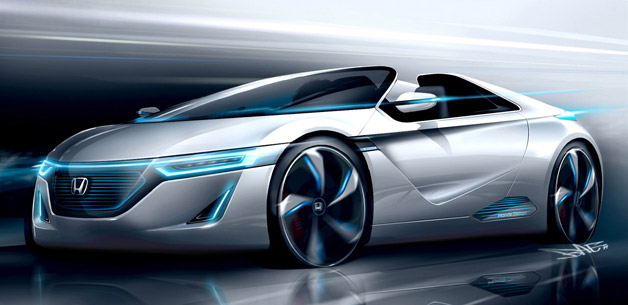
Honda previews Small Sports EV and AC-X plug-in concepts for Tokyo


Honda plans to take to the Tokyo Motor Show this December with the largest display of any automaker in attendance. The company will show off a range of production and concept vehicles, including a slew of motorcycles.

Honda RC-E electric motorcycle concept
The car side of the line will offer visitors the chance to get cozy with a new plug-in hybrid concept as well as an EV. The ACX offers plug-in enthusiasts a vehicle that can function equally as well in urban environs or on the open highway thanks to a two-mode drive system with an engine drive mode for a sportier experience and an automatic drive mode for everything else.

Meanwhile, Honda says that the Small Sport EV Concept "maximizes the fun of driving while achieving excellent environmental performance." Details are markedly absent other than that brief description, so we're hoping Honda will shed more light on the model once it debuts in Tokyo.

The company is also planning to pull the sheets off of a new electric motorcycle based on a 250cc chassis. The RC-E is meant to show off the kind of riding enjoyment that can come from an all-electric drivetrain on two wheels.


Source: Autoblog Green