Showing posts with label Shanghai. Show all posts

Tuesday, January 8, 2019

Tesla breaks ground on China factory for Model 3 and Model Y

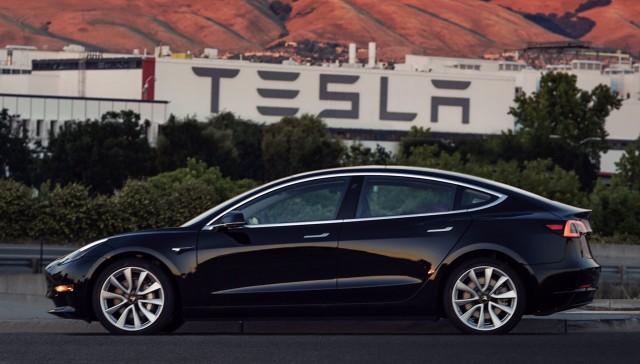
2017 Tesla Model 3, in photo tweeted by Elon Musk on July 9, 2017


Tesla CEO Elon Musk announced on Twitter Sunday night that the company would break ground on its new Chinese factory on Monday.

Musk said the plant, known as Gigafactory 3, will produce up to 500,000 Model 3 and Model Y vehicles for China and other nearby markets when it is completed in 2020.
Initial construction, however, planned to be completed this summer, will allow the factory to begin producing Model 3 sedans by the end of the year. Musk said it will reach volume production of the Model 3 next year.
Looking forward to breaking ground on the @Tesla Shanghai Gigafactory today!
Aiming to finish initial construction this summer, start Model 3 production end of year & reach high volume production next year
694 people are talking about this
The said the plant will produce "affordable versions" of the Model 3 and Model Y, while more expensive versions, such as the Model 3 Performance, along with the Model S and Model X will continue to be produced at the company's main factory in Fremont, California, and exported to China.
Shanghai Giga production of Model 3/Y will serve greater China region
Shanghai Giga will produce affordable versions of 3/Y for greater China. All Model S/X & higher cost versions of Model 3/Y will still be built in US for WW market, incl China.
1,029 people are talking about this
As the company's troubled ramp-up of existing Model 3 production showed, Tesla is in dire need of more manufacturing space than the Fremont factory affords. (When it needed a second assembly line for the Model 3, it famously constructed one in a tent in the Fremont parking lot.)

Musk has also said the company needs the Chinese factory, outside Shanghai, to reduce tariffs that China imposed on imported cars in retaliation for President Trump's tariffs on Chinese steel.
Tesla's next model, the Model Y small SUV, was originally slated to go into production in 2019, but the company currently has no factory space to produce it. The company has also promised a new roadster, as well as a pickup and a semi in coming years.

The factory is dubbed Gigafactory 3, following the company's designation of its giant battery factory—the largest factory under a single roof—in Nevada as Gigafactory 1, and a Solar City factory to produce solar cells outside Buffalo, New York, as Gigafactory 2.
The company secured the site in Shanghai's free trade zone in October. Pictures of the bare site, and videos of construction of a fence around it have been circulating since November.

Friday, March 2, 2018

ECUB 2 = RETRO CLASSIC MOPED W/ AN ELECTRIC HEART

Combining advanced li-ion batteries from Tesla development partner Panasonic and the best-selling and beloved Honda Cub chassis, the eCub 2 is a retro electric moped from the genius motorcycling minds at Shanghai Customs.
The ECub 2 was built in response to the recent Chinese regulations on the formerly ubiquitous internal combustion motorcycles and mopeds in large city centers like Beijing. The pollution caused by those millions of bikes each day was immense- and not just because of their numbers. Many of the small-displacement commuter bikes were oil-burning two-strokes or catalyst-free four-strokes. Heavy carbon producers, in other words … and there are millions and millions of them. There are 100 million Honda Cubs alone. Like, without exaggeration.
As for the bike itself, Shanghai Customs fitted the classic Honda Cub moped chassis with a 1000 Watt electric motor in the rear wheel hub good enough to get the eCub 2 to 35 MPH with a 25 mile (40 km) range. The powerful motor is powered by a bespoke removable battery pack that’s made up of Panasonic 3.7v 3.400 mAh lithium-ion 18650 cells. It’s an idea that Honda, itself, has played with recently with its battery-swapping Honda PCX electric scooter, but the SC guys have made it happen now.
It’s not a hack, though- even if it is ready now, it has been in development for over two years by industry and production experts. Experts like New Zealand ex-pat Matthew Waddick, who has been working with Shanghai Customs to rapidly prototype new designs and parts, work with high-end factories, and monitor QC closely … in fluent Mandarin.
It’s an impressive machine built by very, very impressive guys, in other words. You can find out more about the ECub 2, and see a few more photos of the production-ready bike “in the wild” over at the Silodrome. Check it out, then let us know if you think the little electric DIY moped might be worth paying for in the comments.

Shanghai Customs Electric Honda ECub 2

Source | More ImagesShanghai Customs, via Silodrome.

Wednesday, October 25, 2017

Tesla Factory In Shanghai Confirmed

After months of speculation, it’s now official. According to the Wall Street Journal (subscription required), Tesla will build its first factory outside the US in the free trade zone outside Shanghai, China. Perhaps it would be more accurate to say the factory will be Tesla’s first factory in  China. If the market for electric cars continues to soar, as Chinese officials hope it will, there could be other Tesla factories in China in the future.
Tesla China
The news was widely anticipated. What was not known until now is that Tesla will be the sole owner of the factory. Until now, China has required all foreign manufacturers to partner with a Chinese company before building a factory within the country. Tesla will be the first to take advantage of the new policy.
But — there’s always a “but”, isn’t there? — not having a local partner means the cars produced in China will still be subject to the same 25% tariff that applies to all cars imported into China. Tesla apparently feels that not sharing its technology with a local company is worth more than avoiding the 25% fee would be. The question now is whether other manufacturers will follow Tesla’s lead and build factories in China without a local partner.
Tesla has declined multiple requests from the global media to comment on the Wall Street Journal story, leaving us to ponder its last official statement on the matter from back in June:
“Tesla is working with the Shanghai Municipal Government to explore the possibility of establishing a manufacturing facility in the region to serve the Chinese market. As we’ve said before, we expect to more clearly define our plans for production in China by the end of the year. Tesla is deeply committed to the Chinese market, and we continue to evaluate potential manufacturing sites around the globe to serve the local markets. While we expect most of our production to remain in the US, we do need to establish local factories to ensure affordability for the markets they serve.”
Tesla watchers expect Tesla will announce that it will build a factory in Europe shortly, as it advances its plan to rule the automobile marketplace in coming years.
Source: TechCrunch

Friday, September 22, 2017

Shanghai Home To World’s Largest Tesla Supercharger Facility

China is a huge market for Tesla and it has committed to having 1,000 Superchargers installed and operating within the country by the end of 2017 to support its sales efforts there. From the evidence supplied by a new video uploaded to YouTube by German source TeslaMag, somewhere between 40 and 60 of those Superchargers will be located in the parking garage below the Lilacs International Commercial Center in Shanghai.

They won’t be the new compact 72 kW chargers Tesla announced just last week. Looking at the video, these appear to be Tesla’s conventional chargers rated at 125 kW of power. A Tesla spokesperson has confirmed to the folks at Teslarati that installation of the charging equipment is underway but declined to give any further details until after the process is complete. On Reddit, the new location is being referred to as a “superstation” that will serve as an important link for those travelling between Beijing and Hong Kong.
At the present time, the largest Tesla Supercharger facility is located in Nebbenes, Norway, a rural town 40 miles outside Oslo. It features 20 stalls. Several similar installations are underway in the US, particularly in California as Tesla races to fulfill its promise to have 10,000 Superchargers in operation worldwide by the end of 2017.
The Tesla Supercharger network is one of the most powerful sales tools for the Silicon Valley startup, as many of its competitors are sitting on the sidelines waiting for someone else to take the issue of electric car charging infrastructure seriously. Porsche’s new electric 4 door sedan is said to be capable of an 80% recharge in only 15 minutes using its proprietary 800 volt charging equipment. The problem is, there are fewer of those than there are real Fabergé eggs.
When stock analysts rave about how much Tesla stock will be worth in the future, they often overlook the importance of the Supercharger network the company has created and continues to expand aggressively. That infrastructure, though, is what allows Tesla to sign up hundreds of thousands of new customers for its automobiles when other companies are running around complaining that no one wants to buy electric cars.
No. What people don’t want is to buy electric cars if there is no convenient way to recharge them away from home. That’s the simple fact that most auto company executives can’t seen to grasp.
Source: Teslarati

Wednesday, June 21, 2017

Tesla Close To Announcing New Factory In Shanghai

Rumors of a new Tesla factory in Shanghai, China, have been flying around the internet for months. And just as quickly as they popped up, Tesla batted them away, saying they were just speculation, there was nothing official, it was looking at several locations in China, it had made no decision yet, and things of that nature.
Tesla China plans
Now, according to Bloomberg, an official announcement will come as soon as next week. Unnamed sources say the company has reached an agreement with the city of Shanghai to construct a new factory in the Lingang development zone. Under Chinese law, Tesla will be required to enter into a joint venture with a local Chinese company in order to get permission to build a factory there. The Silicon Valley–based company is anxious to avoid the 25% import duty it currently pays to bring its cars into China.
The reports so far do not reveal who Tesla’s partner might be. Nor do they indicate whether another battery factory will be constructed either at the manufacturing site or at a separate location in the country. Elon Musk said recently that Tesla is considering up to 12 new battery factories in various locations around the world in coming years.
With the Chinese government apparently sticking to its plan requiring all automakers to sell enough “new energy vehicles” to garner credits equal to 8% of total sales starting in 2018, the Chinese market for electric cars, which already dwarfs other electric car markets, could get that much bigger. It’s a business opportunity that Tesla cannot afford to miss. The Chinese new car market is also the largest in the world, with more than 23 million new vehicles sold annually.
Tencent Holdings, China’s biggest internet company, purchased a 5% share in Tesla earlier this year. Having support from such a high-profile Chinese company has to be good news for Tesla in a country where up to 200 companies have expressed interest in building electric cars.