Showing posts with label 2015 Kia Soul EV. Show all posts

Sunday, July 12, 2015

Kia prepping Washington and Oregon for Soul EV launch; dealers and charging network w/ fast-chargers

Kia Motors America (KMA) is continuing its progressive launch of the Soul EV and adding to the electric vehicle ecosystem in the Pacific Northwest with 20 Soul EV-certified dealers and a charging network. Of the 20 dealers in the region, 12 will be located in Washington and eight in Oregon.
In addition to each being equipped with two Level-2 chargers (40 total in the PNW region), 10 of the dealers will also be up-fitted with 50kW Signet FC50K-CC-S DC fast chargers, increasing Kia’s overall network of fast-charging stations. This fast charger can charge the Soul EV’s battery from empty to 80% in about 33 minutes. As an added value, select Kia dealers will allow Soul EV owners to charge at no cost.
10341_2016_Soul_EV
Kia’s addition of six new DC fast chargers to Washington’s already-existing network of 414 DC chargers will increase fast-charger availability by 40% in the Seattle metro area and 15 percent statewide. The four new chargers added to Oregon’s current network of 815 DC fast chargers will increase fast-charger availability by 15% in the Portland metro area and 5% statewide.
Similar to California’s infrastructure program, Kia has partnered with Greenlots in the Pacific Northwest to offer flexibility and on-the-go access to large networks of charging stations. Through the Greenlots partnership, Soul EV owners will be provided a Kia “ChargeUp” Card, giving them access to multiple DC fast charger networks.
When it comes to locating charging stations, the Soul EV offers UVO EVServices, Kia’s telematics system. Available at no cost for the first five years of ownership, UVO EV Services utilizes an embedded connectivity solution powered by the Verizon wireless network and an integral smartphone app to provide Soul EV owners with an innovative, real-time, in-vehicle connectivity experience that includes navigation and a number of added convenience features.
Washington dealers authorized to sell Soul EV include Auburn Valley Kia, Auburn; Hanson Kia, Olympia; Jerry Smith Kia, Burlington; Smith Kia of Bellingham, Bellingham; Dick Hannah Kia, Vancouver; West Hills Kia, Bremerton; Kia of Puyallup, Puyallup; Performance Kia; Everett; Chuck Olson Kia, Shoreline; Renton Kia, Renton; Car Pros Kia, Tacoma; Lee Johnson Kia, Kirkland.
Oregon dealers authorized to sell Soul EV include Kiefer Kia, Eugene; Butler Kia, Medford; Weston Kia, Gresham; Team Kia of Bend, Bend; Beaverton Kia, Beaverton; Ron Tonkin Kia, Gladstone; Power Kia, Salem; Broadway Kia, Portland.
The 2016 Soul EV is Kia’s first all-electric car to be sold in the US. The Soul EV earned an EPA-estimated range rating of 93 miles (150 km) when the 27 kWh, 360 V, 192-cell lithium-ion polymer battery is fully charged. The regenerative braking system captures up to 12% of the Soul EV’s kinetic energy when coasting and braking to also help recharge the battery.
Soul EV owners can choose between four different regeneration modes: “Drive” or “Brake” modes in Eco-mode “Off,” and “Drive” or “Brake” modes in Eco-mode “On” (the “Brake” setting with Eco-mode “On” produces the most regeneration).
The Li-ion battery features a nickel-cobalt-manganese cathode, which helps increase capacity, and a graphite-based anode, which increases durability while reducing weight. Additionally, the cells use a gel electrolyte, and each cell contains ceramic separators to improve thermal stability and safety.
The Soul EV plugs into any standard 120v outlet or a conventional 240v EV charger. Two charging ports are standard, including a SAE J1772 port for Level-1 and Level-2 AC charging, and a CHAdeMO 480v DC fast-charging port, both found behind a sliding door located in the grille.

Friday, February 6, 2015

Kia Trail’ster e-AWD Concept Teased Again

Kia-Trail'ster-Concept
The Kia Soul EV is the Korean automaker’s first attempt at building and selling an electric car in the U.S., but the electrification train isn’t stopping there. At the Chicago Auto Show the Kia Trail’ster with a new e-AWD system will make its world debut, and the automaker has dropped the second teaser ofits turbocharged and rugged off-roader.
Yes, the word turbocharged was thrown around in the latest press release, indicating that this is not an all-electric off-road runabout like I had hoped. Instead, the press release says that the e-AWD system is a “smartly integrated rear electric all-wheel drive system” that will work in conjunction with a conventional petrol engine. Additionally, the “bold” Kia concept will use a retractable canvas to allow urban adventurers an unfettered view of the outside world.
Beyond that though details are scarce, and there’s no word on whether the e-AWD system is merely a concept designed to tickle our imaginations, or a product actually planned for production. It seems to me this mild hybrid system could give the Kia Trail’ster both more stability in off-road conditions, and better fuel economy in day-to-day driving. That’s what we like to call a win-win situation.
Who would have thought that the funky Kia Soul would end up being one of the most popular and versatile vehicles on the market today?

Saturday, January 31, 2015

Kia Soul e-AWD Teased Before Chicago Debut

kia-e-awd
At this year’s Chicago Auto Show, Kia will pull back the veil on an as-yet-unnamed e-AWD concept based on the Soul crossover. The press release says the concept will have an “advanced and capable” electric all-wheel drive system and that it will be a “bold off-roader” allowing for the ultimate in urban escapism.
Beyond that, all we have is a close-up of the front quarter of this Kia concept, which has some aesthetic changes like blacked-out body cladding, red-trimmed wheels, and what looks like some chunk fog lights on the front bumper. An electric version called the Soul EV just went on sale here in the states, though I have a feeling this will be an electric AWD system that supports a more conventional drivetrain.
An all-wheel drive option for the Soul would definitely boost its appeal, and depending on how the e-AWD system is setup, it could result in much better fuel economy too. While I’m of the opinion that all-wheel drive is more a crutch than a necessity in most places and situations, the fact remains that it’s a popular feature with many buyers. I know people who won’t even consider non-AWD vehicle, because they’ve become so reliant on them, and now is a great time to get on the electrification train.
Is the Kia e-AWD concept more than just a concept though? Is Kia testing the waters, or planning on actually producing this option? Those answers will have to wait for the Chicago Auto Show.

Saturday, November 15, 2014

Kia Soul EV UK first drive review

Kia Soul EV UK first drive review

The Soul EV is Kia's first global electric car


What is it?

This is Kia's first production electric vehicle, based on the familiar high-roofed Soul hatchback. Like all other Kia models, the Soul EV will get the same seven-year warranty which is a market first for battery-powered vehicles and should help reassure potential purchasers.
In the conversion to battery power, the core of the Soul – the conventional internal combustion engines, transmission and heating system – have all been dumped, the front and rear styling revamped and the structure reworked. 
While the upper body structure is carried over, it has been further beefed up with extra strengthening in the B-pillars and sills. Five extra crossmembers have also been bolted across the floorpan to increasing the rigidity of the bodyshell by 27 per cent.
The Soul EV also gets a restyled front end and a plastic insert in the grille space, which opens up to revealed the twin charging sockets. The rear bumper and tailgate have also been restyled and LED rear lights have been added.
Inside, the dash is all new and built of higher-quality materials than the conventional models. The EV version gets OLED digital instruments, a large centre touch screen, a rather shapely steering wheel and a new shift lever and surround.
The 27kWh lithium ion polymer battery pack is packaged under the floorpan. Charging from a UK domestic socket could take up to 13 hours. Kia UK is, however, suppling owners with a wallbox charger, which should reduce charging time to around five hours. It is also fitted with a Japanese-standard Chademo fast-charging socket, which can deliver an 80 per cent charge in 33 minutes.
Kia engineers created a new low-energy heating and ventilations system based on the heat pump principle which also allows heating and ventilation to be restricted to just the driver, saving energy.
The 109bhp, 210lb ft electric motor drives a single-speed transmission and Kia claims a 0-60mph time of 10.8sec and a top speed of 90mph. The combination of the polymer battery cells and the new heating system will stretch the potential driving range out to 132 miles. 

What is it like?

While the Soul EV delivers the typically compelling electric car dynamic of smooth and torquey performance and a quiet cabin, the whole package feels somewhat dated. 
Had this car been launched three years ago, it would have been easily class-competitive with the Nissan Leaf. But the world of the EV has moved on rapidly and the new Volkswagen e-Golf and Mercedes-Benz B-Class Electric Drive are better cars than the Soul EV. 
The two German models feel more refined both in terms of cabin ambience and ride quality, the drivetrains perform better and both cars have far superior handling.
The cartoonish looks might, of course, not matter to many potential buyers, but the clinching argument is that the entry-level VW e-Golf is only just over £1000 more than the Soul EV; the B-Class Electric Drive costs around £2000 more, and the excellent BMW i3 only a few hundred pounds more.
That's not to say the Soul EV has nothing going for it; quite the opposite, in fact. In addition to its EV driving and performance traits, the lofty driving position and boxy styling make it easy to position in busy city-centre traffic.

Should I buy one?

If you are going to buy an electric car, it would be hard to find a compelling argument for the Soul over rival models. It does everything pretty well, aside from suffering a somewhat disturbed ride on poor roads, but is short of EV class leadership. 
Kia has modest sales targets for the Soul EV, with next year's sales tipped to be 100-200 units, the cars only being sold through a select 13 dealers who applied. Despite the £24,995 price (including government grant, battery pack, wall charger, Chargemaster account and generous standard spec), Renault’s Zoe and the Nissan Leaf also benefit from buying packages that make EV ownership even more affordable.
As it stands, the Soul EV, as competent as it is, is neither the best to drive nor the best value.
Kia Soul EV
Price £24,995 (after government grant); 0-60mph 10.8sec; Top speed90mph; Range 132 miles; CO2 0g/km (tailpipe); Kerb weight 1588kg;Engine AC synchronous electric motor; Power 109bhp between 2730-8000rpm; Torque 210lb ft between 0-2730rpm; Gearbox Single-speed automatic

Source: Autocar.uk

Tuesday, October 28, 2014

Kia Soul EV Range Autonomy Demonstration Nets More Than 100 Miles


Today, we tested a new Kia Soul EV for range autonomy. I met the car’s owner, Andrew, at a Walgreens drug stein Gardena, California at the appointed time of 9am. It was an absolutely beautiful Saturday morning as I drove my 2014 RAV4 EV up from San Diego, about 115 miles (184km), to meet Andrew and his fully charged and ready-to-go car. It was interesting to learn that Andrew had started his professional career as an 18 year old employee of General Motors working on the EV-1 project. He had lots of interesting stories about that program!
In addition, he had owned not one, but two previous Chevrolet Volts, both of which were returned (voluntarily) to the auto manufacturer due to service issues. It was with some trepidation and resolve that he stepped back into the electric vehicle arena to buy a brand new model from a manufacturer who had not previously offered an electric car for public consumption.
TEST FORMAT
Kia Soul EV Gets Ready To Go Out (RAV4 EV That Got Us To Test In Background)
The Range Autonomy Demonstration is a standardized test that we perform on electric vehicles, with a purpose to more accurately compare the actual range between different models of electric cars in a very common scenario; the operator needs to know how far the vehicle will really go when stretching range in a steady speed highway situation compared to other cars. The parameters are always the same: two occupants for the test, in this case, both the owner Andrew and myself. The combined total crew weight is always close to 450 pounds (205 kg), plus or minus about 10%. There is no baggage allowed. We always use the manufacturer’s recommended tire pressure, which in this case is 33 psi (2.275 bar).
The ambient air temperature is always near 70F (20C), plus or minus a handful of degrees, and the wind is always light. We drive in a loop specifically to mitigate the effect of any wind that may exist. Here in sunny southern California, the wind is predominantly out of the west. We drive to maintain 62mph (100kmh) ground speed as measured by GPS. The windows are either all the way up, or one may be slightly open for ventilation. If the vehicle is equipped with cruise control, we use it. In the case of the Kia, the actual ground speed matched the indicated speed of 62mph perfectly and the car has an excellent cruise control, which we used.
The cars are always unmodified in as close to “as-new” condition as is possible, and the test is always done with the climate control off. This last issue seems the most confusing to some EV drivers. Any climate control must consume energy to heat of cool the cabin (or battery), therefore no improvements or changes to the method of providing that heating or cooling will improve ultimate range. Those heating and cooling methods will merely change the amount of range that is lost, compared to an electric vehicle with the climate control off.
CABIN CLIMATE CONTROL
If you wanted to drive the maximum range of any electric vehicle where electricity is used to heat or cool, you would turn cabin climate control off to get the maximum range. Period. Plus, for testing, there are far too many variables that affect the energy used to heat or cool a cabin. How many people are in the cabin, solar radiant heating, temperature maintained, any cabin vents that may be opened or closed, cabin preheating or cooling that was performed, etc. For all those reasons, and to provide the most accurate comparisons between the vehicles tested, we never use climate control.
REGEN (REGENERATION, RECUPERATION, ETC)
Just Heading Out On The Test
Another issue that is frequently discussed in relation to range is “regen”. That is the ability of the motor on the car to become a generator and put energy back into the battery, typically during slowing, stopping, or going down a hill. Of course, our test specifically eliminates regen because we drive at a constant speed on level ground. Like climate control, there are far too many variables with regen to make a simple test viable. All electric vehicles will limit the amount of regen based on battery capacity, battery temperature, or other programmed or user selectable variables. Cars that have user selectable regen profiles include the Tesla Model S, Volkswagen e-Golf and Mercedes Benz B-Class ED.  Other cars have non-adjustable, yet strong regen profiles, like the BMW i3. Finally, some cars have a “B” or “E” mode included with the gear selector that arbitrarily increases regen by some preset amount when selected. That feature is in cars like the Nissan LEAF and Toyota RAV4 EV.
Regen is never 100% efficient. It’s not even close to 100%. If you consume the energy, you can NEVER put it back in the battery as efficiently as not consuming the power in the first place. For around the town type driving, with lots of stops and starts, it will ALWAYS be more efficient to anticipate the stops and slow-downs so that you need neither brakes nor regen. Obviously, this isn’t practical in modern cities with impatient drivers around you, so we need a way to capture that energy that would otherwise be lost to braking; regen does that.
The singular instance where regen is viable from a purely efficiency standpoint is going down a hill with either a stop at the bottom (where you could not stop without braking) or when the vehicle is going down a hill too fast and either braking is required to limit speed, or the velocity has reached a point where it is better to use regen instead of “wasting” the energy on increased aerodynamic drag at the higher speed.
THE COMPETITION: NISSAN LEAF
The Kia Soul EV’s closest competition is the Nissan LEAF, now with over 150,000 sold worldwide, so it’s easy to make comparisons between the two. At the 100kmh ground speed we would be driving, and since both cars are nearly the same weight, I expected that the Soul EV would be very close to the historical consumption rate of the LEAF in this test, which consistently has been 4 miles per kWh (250 watts per mile) or 6.437 km per kWh (155 watts per km) without climate control.
Of course, the Nissan LEAF has a significantly smaller 24kWh battery than the Soul EV, and of that 24kWh, only about 21.3kWh is usable to propel the car. The Kia Soul EV properly advertises the size of the battery that the consumer cares about; the useable stored autonomous energy. We found that to be almost exactly 27kWh useable, which means that the actual Kia Soul EV battery size is about 30.5kWh total.
Since the Kia Soul EV battery is fully 25% larger than the LEAF, we expected a range quite close to 25% farther than the 84 – 88 miles that a LEAF can perform (when in new condition) under these parameters. That would put the Soul EV at an estimated range of 105 – 110 miles. But, there’s a problem. We know that the Kia doesn’t slip through the air quite as smoothly as the LEAF, therefore the boxy looking car’s consumption rate would be expected to be slightly below the LEAF’s 4 miles per kWh. How much below 4, we would find out.

Center Console "Heading Out" Data
Center Console “Heading Out” Data
RANGE AUTONOMY FORMULA
Range autonomy in any thing that moves over land, through the sea, or in the air is always a product of autonomous stored energy (gasoline, diesel, jet fuel, nuclear “stuff”, rocket fuel, or electricity) multiplied by the consumption rate (economy) of that stored energy (miles per gallon, km per liter, tons per hour, or miles / km per kWh consumed).
So, the range in a test like ours is always:
(Usable kWh stored)* (miles / km per kWh consumption rate) = (range in miles / km)
WEATHER and AIR DENSITY
The weather was absolutely perfect for the event with close to 70F (21C) degree weather, clear blue skies and light breezes. In short, another perfect day in southern California.
Weather between 8:53am and 11:53am at the Long Beach, California airport:
- Time — Temp. – DewPt-Pressure – Visibility-Wind Dir-Wind Speed – Gust Speed
8:53 AM — 70.0F – 62.1F – 30.04 in – 10.0 mi – northwest — 4.6 mph — N/A
9:53 AM — 73.0F – 61.0F – 30.05 in – 10.0 mi – calm ———- calm —— N/A
10:53 AM —73.9F – 62.1F – 30.05 in – 10.0 mi – variable —– 5.8 mph — N/A
11:53 AM —79.0F – 55.9F – 30.04 in – 10.0 mi – west ——-– 5.8 mph — N/A
Density Altitude Calculation
Density Altitude – 1117 feet, 340 meters
Absolute Pressure – 29.94 inches Hg, 1013hPa
Air Density – 0.074 lb/ft3, 1.185 kg/m3
Relative Density – 96.77%

Kia Soul EV Range Test Journey Hits The Highway
THE TEST COURSE
The course selected was a 90 mile (144 km) loop that ended at the intersection of the 105 freeway eastbound and the 110 freeway southbound, just east of Hawthorne airport (home of the Tesla Design Studio and Space X), the point that I expected to be the earliest that the car may run out of power. We would then turn south on the 110 freeway, where we would drive by the starting point (where my car was waiting for me) for the shortest towing distance if the vehicle physically stopped.
Mapping It Out
Mapping It Out
All distances below per Google Maps linked above.
Walgreens Store Gardena – ChargePoint J1772 charging station
1344 W Redondo Beach Blvd, Gardena, California
— 1.8 miles (2.9 km) – accumulated miles: 1.8 (2.9 km)
California 91 freeway east to Interstate 5 freeway south:
— 18.4 miles (29.4 km) – accumulated miles: 20.2 (32.3 km)
Interstate 5 freeway south to California 133 freeway south:
— 19.3 miles (30.9 km) – accumulated miles: 39.5 (63.2 km)
California 133 freeway to Interstate 405 freeway north:
— 1.0 miles (1.6 km) – accumulated miles: 40.5 (64.8 km)
Interstate 405 freeway north to 105 freeway east:
— 43.2 miles (69.1 km) – accumulated miles: 83.7 (133.9 km)
105 freeway east to 110 freeway south:
— 5.2 miles (8.3 km) – accumulated miles: 88.9 (142.3 km)
110 freeway south to Anaheim Street freeway exit:
— 10.5 miles (16.8 km) – accumulated miles: 99.4 (159 km)
Anaheim Street exit to Carl’s Jr, fast food restaurant, 1360 W 190th St, Torrance, California – Blink J1772 charging station
— 6.7 miles (10.7 km) – accumulated miles: 106.1 (169.7 km)

THE VEHICLE SET-UP
Trip odometer “A” was used to record miles driven. The odometer is currently reading 1.5% low compared to Google maps. As the tires get worn and ever so slightly reduced in their diameter, this will get more accurate. The speedometer was perfect compared to the two GPS’s that were used for the test, and as the tires wear, it will read slightly faster than the car is really going.
The headlights were turned off, climate control off (except fan) and tires set to 33 pounds per square inch (2.275 bars) pressure, which is the auto manufacturers recommendations. It’s likely that one or more percentage points of range could be gained by inflating the tires to the maximum recommended pressure, in exchange for a slightly less comfortable ride and possibly irregular wear on the tires.
The elevation profile of the route is nearly flat (virtually no hills of any kind), and very close to sea level. The dash display showed “98% battery” after driving 1.7 miles, however the percent was not observed at the start. Presumably, it read 100%. Finally, the “Distance to Empty” (DTE) meter, which I generally refer to as the “Guess-Oh-Meter” (GOM), was observed displaying 112 miles after having driven 1.7 miles.
We got underway at about 9:34am and finished about two hours later.
RESULTS
Kia Soul EV Test Results

Amazingly, The Range Journey Ends With More Than 100 Miles In The Books For The Soul EV...And At A Functioning Blink Charger (we'll let you decide which of those two things were amazing)
Amazingly, The Range Journey Ends With More Than 100 Miles In The Books For The Soul EV…And At A Functioning Blink Charger (we’ll let you decide which of those two things were amazing)
CONCLUSIONS
Some Previous Real World Tests (click to enlarge)
We drove a total of 104.5 miles, however 100 miles from the odometer reading was at 62mph (100kmh). With the Google Maps correction of 1.5% added to the odometer, we will therefore award 101.5 mile (162.4 km) autonomous range at 62mph (100km)given our test parameters.
With an ending economy / consumption rate of 3.9 miles per kWh (256.4 watt hours per mile), or 6.24 km per kWh (160 watt hours per km) divided into the distance of 104.5 miles results with 26.8 kWh of usable energy consumed from the battery. Kia advertises the battery as 27kWh. For comparison, the Nissan LEAF advertises 24kWh, however that has led to confused consumers when the battery really only has 21.3kWh of usable stored energy when new.
We have not physically measured the energy consumption with external instruments, however using a common 200 – 240 volt charge station that can provide the Kia Soul EV with 30 to 32 amps, I would expect approximately 85% charger efficiency. Therefore, to recharge the car from a depleted battery to full would require approximately 32 kWh as measured from the charge station. We expect the maximum capacity of the battery to be 30.5kWh (typically the “advertised” capacity of other manufacturers).
26.8kWh * 3.9 miles per kWh = 104.5 miles total range for this test, with a correction of 1.5% increase equals 106 miles of ultimate range given these parameters.
This car is very well suited to take on the world leader in this class, the Nissan LEAF, both in range autonomy, but also in regard to a host of other small improvements (like the heated and cooled seats). I think the folks at Nissan better look over their shoulder! Congratulations to the Kia folks for a truly well done car.

Saturday, September 13, 2014

2015 Kia Soul EV Priced At $33,700

Kia recently jumpstarted enthusiasm about the 2015 Kia Soul EV with a new commercial featuring horny furry lab hamsters. Now it has gone a bit further (and in a more practical direction) with the unveiling of the 2015 Kia Soul EV price. About a year and a half ago, the estimate was that the price would be ~$35,000. Not a bad estimate at all, wherever it came from, as the base price announced today is $33,700 without any incentives (so, $26,200 after the $7,500 federal tax credit; and $23,700 after that tax credit and the $2,500 California EV rebate).
That’s for the Kia Soul EV Base. The higher Kia Soul EV+ trim is a little more at $35,700 ($28,200 | $25,700).
The Kia Soul EV also has an “expected introductory lease price” of $249/month. That may be the most attractive option to many consumers who would like to drive the Kia Soul EV right now but would also like to wait and see what options they have in a few years without being stuck with a used EV that can’t compete with the new EV competition and thus has a low resale value.
Other key stats are that the 2015 Kia Soul EV has a range of 93 miles on a full charge and has a MPGe rating of 105 (92 on the highway and 120 in the city).
The Soul EV is the first in the industry to receive environmental validation by Underwriters Laboratory (UL), which it has received for its use of bio-based materials.

Kia-Soul-EV
2015 Kia Soul EV Price


The Kia Soul is a very popular vehicle, and its style seems to fit that of someone who might want to jump into an electric drive vehicle but hasn’t yet. It’s a good addition to the EV world that adds some more diversity, and at a good price.
Kia has argued that it intends to actually market and sell this vehicle. In other words, it claims that it isn’t a “compliance car.” The price certainly makes it competitive. It is just above the US- and world-leading Nissan LEAF (priced at a low of $28,800 before incentives), but offers quite a different style and its own benefits. We’ll see if Kia actually produces enough for demand and if it brings the car to all corners of the US rather than just a few markets.
Aside from the sweet torque/acceleration, smooth ride, and near silence of an electric motor, the interior goodies of the 2015 Kia Soul EV Base include: “navigation, Rear Camera Display, Bluetooth® hands free operation, power windows, power driver’s seat, cruise control, 6.6kW on-board charger and an exclusive HVAC system designed to extend driving range by minimizing energy draw… [as well as] UVO EV Services, which provide real-time battery-level status, distance to empty, and the ability to search for nearby charging stations.” Of course, as with most EVs, the Soul EV can be controlled a bit with a smartphone app.
What’s extra when you buy the 2015 Kia Soul EV+? “EV-unique leather trimmed seats, which are tri-level heated and ventilated for front passengers, while the rear outboard seats are heated for added comfort,… projection-style fog lamps and power-folding outside mirrors.”
I’m excited to get my hands on one of these to test drive it and compare it to a Nissan LEAF and the (certainly higher quality) BMW i3. Or perhaps Chris will get to do that for us since he’s the one based in the US….

Thursday, February 27, 2014

Full Details Released on 2015 Kia Soul EV’s “Advanced Battery”

Soul EV Live in Chicago
The 2015 Kia Soul EV is set to launch in the US in Q3 of 2014.
Most of the details on the upcoming electric Soul are known, excluding price:
    • 109 HP
    • 210 Pound-feet of torque
    • 27 kWh lithium polymer battery pack
    • Target range of 80 to 100 miles according to Kia
    • Recharge in under 5 hours on 240 volt (via 6.6 kW on-board charger) or 80% in 33 minutes via 50 kWCHAdeMO quick charge
    • 0 to 62 MPH in less than 12 seconds
    • Top speed of 90 MPH
    • Projection type headlamps
    • LED positioning lamps
    • LED rear combination lamps
    • Aerodynamically shaped 16-inch alloy wheels.
Here’s what Kia says in regards to the US launch:
Kia Soul EV Battery
Kia Soul EV Battery
 “The Soul EV will initially be sold in California and Oregon in the West and several Eastern states including New York, New Jersey and Maryland, the regions with the largest EV markets and infrastructure. KMA will look to offer the vehicle in other markets in the near future as infrastructure and demand grow. Pricing for the Soul EV will be announced closer to the vehicle’s launch.”
Ahead of its launch, Kia has informed us of the battery technology found in the Soul EV:

Advanced battery for Kia Soul EV

  • Class-leading battery cell energy density of 200 Wh/kg ensures driving range of up to 200km
  • Innovative application of Nickel-rich high capacity cathode material
Soul EV power pack features lithium-ion polymer battery cells supplied by SK Innovation
The forthcoming Kia Soul EV is to come with a class-leading battery energy density of 200 Wh/kg as a result of a three-year joint development programme between Kia Motors Corporation and SK Innovation in Korea.
Kia engineers have developed the outstanding power pack featuring 192 lithium-ion polymer battery cells in eight modules, delivering a total battery capacity of 27 kWh. The pack incorporates state-of-the-art thermal control technology to maintain individual cells at optimum temperature and structural design to enhance crash worthiness.
Nickel-rich NCM (nickel-cobalt-manganese) cathode material is used in the mass production of the battery cells for Soul EV. Energy density, which is dependent on cathode capabilities, is a core performance factor deciding EV driving range. By exploiting the class-leading energy density of its battery, the Soul EV offers a driving range of around 200 km on a single charge.
High performance electrolyte additive and anode materials were also developed to meet various performance requirements, such as safety and lifecycle, while maintaining high energy density.
Soul EV Live in Chicago
In addition, a special secure separator is used in the Kia Soul EV’s battery cells. The separator determines the safety and the charge/discharge speed of the battery. It has improved thermal resistance, which helps to keep the cell secure from exposure to heat or fire by preventing the shrinking of the separator if the temperature of the cell increases beyond normal levels.
Soul EV Live in Chicago
Together, the low electrical resistance battery cell, proper battery system thermal control and accurate state-of-charge calculation improve the charging performance, thereby enabling an outstanding ‘fast charge’ time of 25 minutes (100 kW DC) or 33 minutes (50 kW DC). Full recharge time, depending on power source, takes up to five hours (6.6 kW AC).
The electrolyte additive used in the Soul EV will prevent the degradation of battery performance at both low and high temperatures, expanding the temperature range of the battery usage and reducing the fluctuation of the driving range according to the weather.
Cold weather is notoriously hostile for a battery and the Soul EV features a battery heating system, which warms-up the battery while the car is plugged into the grid, prior to use. This helps to maintain optimum battery performance regardless of external temperature.
For maximum ‘active safety’ the battery module is fitted with an overcharge protection device that cuts the high voltage circuit if ever the battery cell swelling phenomenon should occur due to overcharging.
Optimisation of the raw materials used to create the cathode morphology control and surface coating, the anode surface coating and electrolyte additive, plus the excellent mechanical strength of the separator, ensure best-in-class durability and safety of the cell.
Soul EV Live in Chicago
Background to Batteries
A lithium-ion battery is a rechargeable battery which saves the electric power as chemical energy and uses it when necessary. The lithium-ions move from cathode to anode during charging and from anode to cathode during discharging. The electrolyte is necessary as a medium for the transfer of the lithium-ions and the separator is necessary to separate the anode and cathode electrically.
Generally the cathode consists of heavy oxides and can store less electricity per weight than the anode which consists of light carbons. To increase the energy density (energy to weight) of the battery pack it is important to increase the quantity of the electricity stored by the cathode, since the quantity of electricity should be balanced between the cathode and anode.
Lithium-ion polymer is the common name for the battery type which uses ‘pouch film’ as a packaging material. The name lithium-ion battery refers to the battery type which uses a metal can as a packaging material.
The advantages of a lithium-ion polymer battery – over normal lithium-ion batteries – include: greater efficiency due to the simple cell structure (fewer parts), lower costs, increased safety and reliability (thanks to better thermal diffusion and internal pressure control), ease of manufacture in a variety of capacities and shapes.
The Kia Soul EV had its global debut at the 2014 Chicago Auto Show on 6 February and will have its European debut at the 2014 Geneva Motor Show on 4 March. The vehicle is expected to go on sale in European markets, including the UK, in the Autumn.

Friday, February 7, 2014

2015 Kia Soul EV Electric Car: Chicago Auto Show Live Photos


Yes, they're still selling these things with hamsters.

If you can get over the rodent-based adverts, Kia's new electric Soul, the 2015 Soul EV, is quite an interesting vehicle, and it's the first electric car sold by Kia in the U.S.
It's making its debut at the 2015 Chicago Auto Show, and gives buyers yet another body style for their electric needs, the Soul's boxy body hiding useful interior space and an upright driving position not found in many other electric vehicles.
An 81 kilowatt (109 horsepower) liquid-cooled electric motor powers the front wheels. It also develops a healthy 210 pounds-feet of torque, and the 0-60 mph acceleration benchmark is accomplished in "under 12 seconds".

Juice comes from an air-cooled 27 kilowatt-hour lithium-ion battery pack. Like most electric vehicles, it lies flat under the car's floor, leaving the passenger compartment and the trunk relatively unobstructed--legroom has decreased a little next to other Souls.
Charging is handled by both a Level 2 J-1772 standard charging port and a CHAdeMO quick-charging port, each hiding behind a sliding door in the car’s stubby nose. Charging from empty takes around five hours using Level 2 charging and up to 24 hours from a 120-Volt household outlet.

Quick charging, like many EVs of its type, gives you an 80 percent charge in around half an hour. Also in common with its peers, range is said to be 80-100 miles--though we'll have to wait for EPA ratings to emerge to get a handle on its true capabilities.
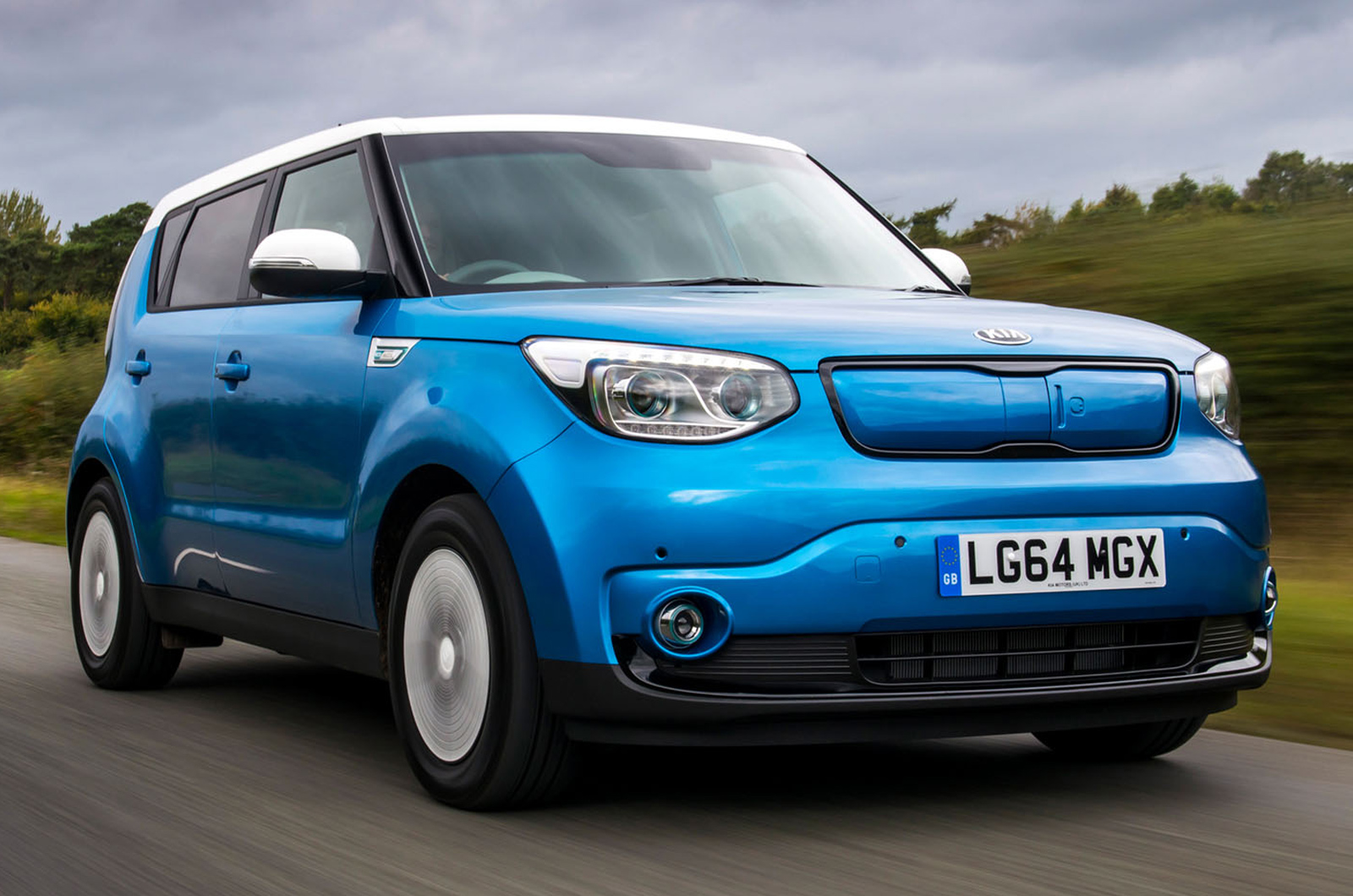
As you can see in our live photos from the Chicago show floor, the Soul EV's exterior is largely similar to that of regular gasoline Souls.
There's a new color scheme of course, a blanked-off front grille panel (behind which you'll find the charging ports) and a unique aerodynamic wheel design.
Click through the gallery for more photos of the Soul EV, or head to our Chicago Auto Show page for more news and images from the show.


Source: Green Car Reports