Showing posts with label 2018 Chevrolet Bolt. Show all posts

Thursday, October 25, 2018

Chevy Bolt EV Survey Hints At Cold Weather Package With Heat Pump

Chevy Bolt EV

Greater EPA range is suggested in the survey as well

Earlier this week, new Chevy Bolt EV owner and chevybolt.org user jvandonsel posted about a survey he received from Chevrolet. The options presented in the survey hinted that a cold weather package might be in the works:
I just took an interesting survey from Chevy asking about cold-weather performance of the Bolt and how much I’d be willing to pay for various cold weather packages.
What’s interesting is that this is a peek into some of the technologies that GM is working on or considering working on. Some of the interesting ones from the survey are:
  • Radiant floor heating
  • Wiper parking heater
  • Heat pump
  • Cold weather battery pack
  • Heated front windshield
Having only owned my Bolt for a month, I didn’t have much wisdom to impart, but it will be interesting to see how it makes it through its first New England winter.
 But jvandonsel was not the only Bolt owner to receive the survey. Several other members on the site did as well. Forum user cleavet was kind enough to provide screenshots of the survey options:
Chevy Bolt EV survey winter package options 2Chevy Bolt EV survey winter package options
The Bolt has decent winter range but it can absolutely be improved. A heat pump and heated windshield would surely increase range in cold weather. At moderate winter temperatures many other electric models outperform it in efficiency.
Interestingly, a 300 mile EPA range is listed as well as a 200 mile EPA range. This might materialize as multiple Chevy Bolt battery pack options. Or it could represent a currently unreleased model.
These types of surveys do not guarantee a feature makes it to production. But they can hint towards future product changes.
For instance, in late 2016 and early 2017 several new Bolt owners received a survey on preferred options for a hypothetical user defined maximum charge level.  This feature ended up in the 2019 model year of the Chevy Bolt.
Source: chevybolt.org

Wednesday, October 24, 2018

Chevy Bolt EV Owners On Rural Texas Ranch: This Car Has Got Guts

Chevy Bolt Cargo Hauler On Texas Ranch

“I want to be a cowboy baby! Where my Chevy Bolt’s charged by the sunshine shinin’.”

Harry and Elizabeth Akers are proud new owners of the Chevy Bolt EV. The couple lives in rural Merkel, Texas about 20 miles from Abilene and 200 miles west of Dallas. They own 200 acres of land and 40 cattle on their property.
And now the Bolt is their primary mode of transportation for errands and hauling cargo. So far, Elizabeth Akers loves the range of the Bolt and its 56.6 cu ft of cargo space:
It’s about a 55-mile round trip to pick up feed for the cattle. We got the Bolt EV mainly for that reason—to go into town, run errands, and pick up what we need. We can go into town three times on a single charge, and it’s got more than enough room.
Chevy Bolt Texas Ranch
Hauling feed for the cattle or other items they need from town is a daily trip. So the cost of driving to and from town on gas was becoming a burden. Now with their new electric, their fuel comes from geothermal power and a solar panel installation. Hopefully they took advantage of the $2,500 Texas Plug-In rebate as well. The switch to a greener lifestyle is going to pay for itself in no time. According to Harry Akers:
The numbers just made sense when I looked at what we’d save with the Bolt EV. Bottom line is that we invest in things that reinvest in us, and we can put the money we’re saving back into things we want to do—like going on vacation and taking cruises.
The long range of the Bolt means a trip to Dallas/Fort Worth, Austin/San Antonio and Midland/Odessa are all more than do-able thanks to their centralized location. As charging infrastructure fills in, travel will become even easier. In fact, the Akers purchased their Bolt from Classic Chevrolet in Grapevine, TX near Dallas. The dealership is well known for Electric Avenue, a section dedicated solely to sale of hybrid and plug-in vehicles.
But it’s not just the energy savings, range and cargo capacity the couple appreciates. The electric Chevy is also fun to drive. Of the vehicle’s performance, Harry says “This car’s got all kind of guts to it.”
Thanks to electrics like the Tesla Model 3 and Chevy Bolt, people all over are starting to see the value of electric cars.

Saturday, September 15, 2018

Best deals on hybrid, electric, fuel-efficient cars for September 2018

2018 Honda Clarity Plug-In Hybrid


This month's best deals list includes a newcomer among plug-in hybrids. That could be a great thing for buyers who want the best deal along with the latest technologies.
Our partners at CarsDirect.com, now focus the list of best deals on models that are widely available, not "compliance cars" available only in token quantities in select locations.
Experts expect regulatory changes this year to bring a wider selection of electric and plug-in models to states outside of California. New models are also expected to arrive with longer-range batteries, as well as some electric SUVs. 
Some buyers may be better off waiting for those longer range electric cars and SUVs.
For those who need a car now, or who just want a more efficient hybrid, plug-in, or conventional car, read on.
2018 Nissan Leaf
2018 Nissan Leaf


Electric car
The Nissan Leaf is the granddaddy of modern electric cars. As such, it often offers the best deals among widely available electric models.
This month, lessees interested in a Leaf can drive home a base S model for $219 a month for three years and 36,000 miles, after putting down $3,979 at signing.
That represents a huge $10,025 lease discount (the same as last month). Counting the up-front payment, that amounts to an effective cost of $330 a month, about $70 less than a Chevy Bolt EV.
California buyers and current Leaf owners may be eligible for even steeper discounts.
The deal isn't quite as good on higher trim levels. The Leaf SL gets only an $8,400 discount. The Leaf deals end Oct. 1.
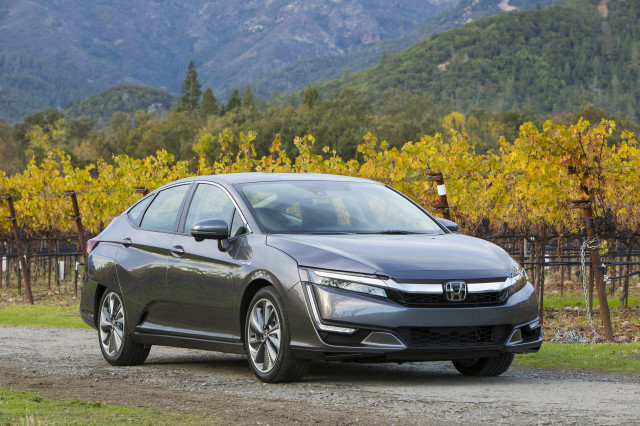
2018 Honda Clarity Plug-In Hybrid drive, Napa Valley, Caifornia, Dec 2017


Plug-in hybrid
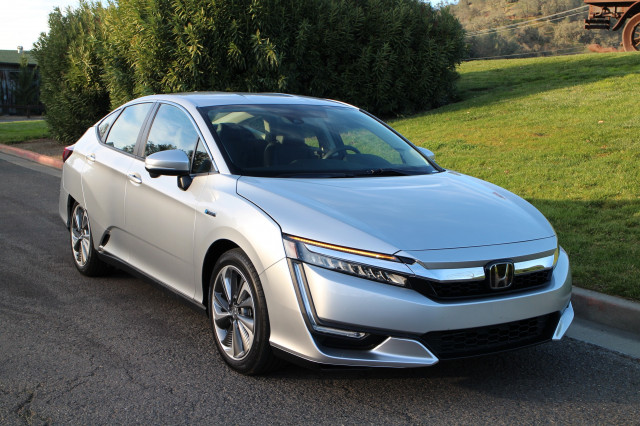
With deals on the Chevy Volt expiring early this month, the best plug-in hybrid lease deal goes to a newcomer, the Honda Clarity Plug-in Hybrid.
Along with the Volt, the Clarity Plug-in Hybrid has among the longest electric range of any plug-in hybrid.
For September, lessees in eight Northeastern states that follow California emissions standards can lease a Clarity Plug-in Hybrid for $209 a month for 36 months, with $2,299 due at signing. That gives customers an effective cost of $273 a month.
For those who'd rather buy, Honda is offering 0.9 percent financing for up to 60 months in those states, or for 36 months elsewhere.
2017 Ford Fusion Hybrid


Hybrid
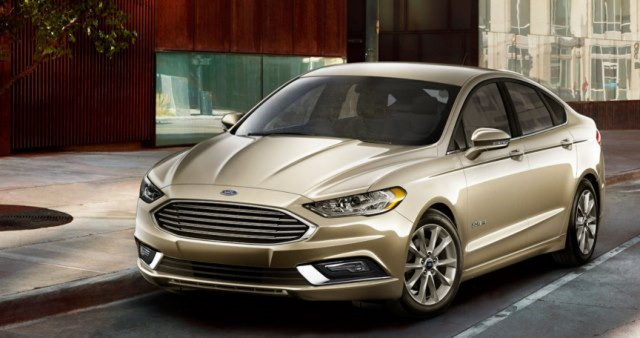
The most affordable hybrid is also a mainstay among hybrid models: The Ford Fusion Hybrid.
The best deal on the Fusion Hybrid is focused on buyers, rather than lessees.
Ford has extended its $3,000 cash back, plus an interest-free financing offer. That financing runs for six years, which is becoming increasingly rare for such a discount. For comparison, the Toyota Prius is only eligible for a $1,000 rebate, with no financing rate discount.
Buyers have to finance through Ford Motor Credit to get the cash back as well as the free financing, so the deal won't work for buyers who pay cash. The good news is, this deal actually makes it cheaper to finance.
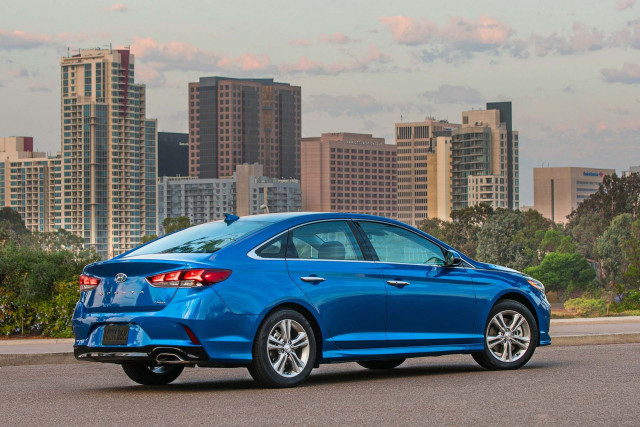
2018 Hyundai Elantra


Fuel-efficient gas car
The Hyundai Elantra takes the prize for the most affordable fuel-efficient car, joining the Fusion Hybrid as one of the few models available with zero percent financing for 72 months along with cash back.
In the Elantra's case, the cash discount is only $1,000, but it's still a rare bargain to come with free financing.
Buyers can also choose a larger $2,500 rebate without the free financing, but Cars Direct's analysis shows that buyers can save $23 and get two extra years to pay off the car by taking Hyundai's financing with the lower discount.

Monday, July 16, 2018

Chevy Volt First Plug-In To Reach Cars.com Most American-Made List


Bolt EVLEAFTesla Model 3 and others don’t make list due to global sourcing of batteries and other vehicle parts.

Determining just how “American-Made” a car is isn’t a simple task. In fact, not all organizations that attempt to make such a determination agree. Last month, Cars.com released their 2018 American Made Index (AMI) list.  Their evaluation considers five factors: assembly location, domestic-parts content, engine sourcing, transmission sourcing, and factory jobs provided by the automaker’s U.S. plants.
While Cars.com has published the AMI for over a decade, in 2017 they updated their methodology. Prior to 2017, the AMI was based more heavily on the American Automobile Labeling Act (AALA) that does not distinguish between U.S. and Canadian parts. Their new analysis is focused purely on U.S. sourced components. In 2018, the Chevy Volt has made the list for the first time. In fact, the Volt is the first plug-in vehicle to make the list with 66% U.S.-sourced materials and labor.
Chevy Volt battery helps it become the first plug-in to rank in the top-10 on the AMI list.
Regarding the Chevy Volt and why most plug-ins do not make the list, Cars.com states:
The Chicago-built Ford Taurus ranks No. 4, followed by the AMI’s highest-ranked newcomer, the No. 5 Chevrolet Volt. Plug-in cars, be they fully electric or a plug-in hybrid like the Volt, often lack high domestic content amid global sourcing for batteries — one of the most cost-intensive aspects of any car with a significant electric driving range. But the Volt’s battery is assembled near Detroit, with cells from a plant in western Michigan.
GM recently announced a series of upgrades at their Brownstown battery assembly plant near Detroit. In Cars.com’s survey of 1,000 drivers, 83% claimed assembly location was an important factor in determining a cars economic impact. However, 7 in 10 respondents said other factors impacted their purchase decision more. They also found only ~53% of passenger-vehicle sales were assembled in the United States.

CHEVY VOLT

2017 Chevrolet Volt
15 photos
Chevrolet Volt2016 Chevrolet VoltChevrolet Volt2016 Chevrolet VoltThe New 2016 Volt Features 53 Miles Of All-Electric Range, And A 1.5L Generator That Nets 42 MPG ThereafterUnder The New CVRP Program, The Unemployed Person In San Francisco Can Now Get A $3,000 Rebate Off The 2016 Chevrolet VoltNext Generation Chevrolet Volt2016 Chevrolet Volt2016 Chevrolet VoltThe Most Famous E-REV - 2017 Chevrolet Volt2016 Chevrolet Volt2016 Chevrolet Volt2017 Chevrolet Volt Interior
Source: Cars.com

Thursday, July 12, 2018

Tesla sells car number 200,000, starting phaseout of federal tax credits

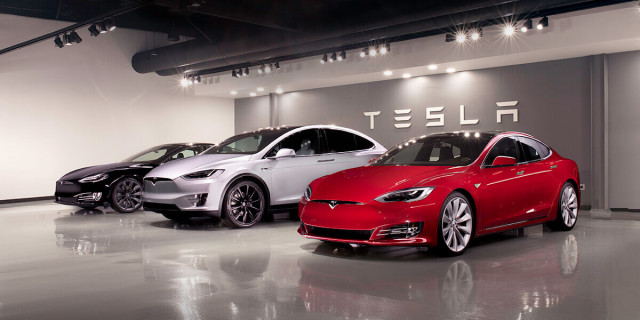
2018 Tesla Model S and 2018 Tesla Model X


Tesla's vehicle purchase incentives web page on Thursday morning reported that the wind-down of incentives for buyers of its cars has begun. The change was first noted and reported by Jalopnik.
Following the change, Tesla buyers will only be eligible to receive the full $7,500 federal tax credit until Dec. 31. After that, the credits will halve, first to $3,750 in the first six months of next year, then to $1,875 in the second half of 2019.

A Tesla spokeswoman confirmed the change to us, but declined to comment further.
The phaseout was triggered when Tesla delivered its 200,000th car to a customer in the U.S. this week.
The change represents a net price increase for Tesla buyers.
The incentives were designed to boost electric car sales by giving buyers a tax credit that would bring prices in line with competitive gas cars.
Each manufacturer is allotted 200,000 credits before the phaseout begins. The reasoning behind the law was that by the time the credits start to phase out, battery costs will be lower and the cars will naturally command less of a premium relative to conventional cars.
Those automakers like Tesla who were early to market would have a head start not only in building electric cars, but also in reducing their battery costs.
With more than 400,000 customers holding deposits on the Tesla Model 3, many of those customers will likely not receive any federal tax credit.
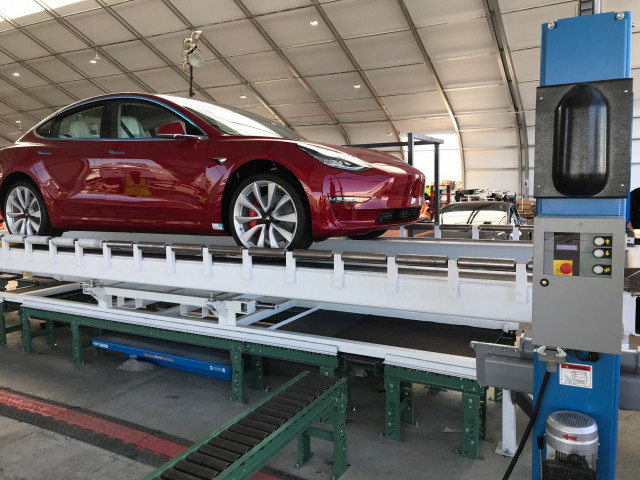
Tesla Model 3 all-wheel drive Performance rolls off a new assembly line in a temporary structure


Many of those same buyers who have not yet received their cars have waited for Tesla to follow through on its promise to build a car for $35,000. So far, the company is only building high-end versions of the Model 3 for significantly higher prices.
For example, a buyer today who purchases a Model 3 for $50,000 (representing a long-range battery, rear-wheel drive car with the required Premium Package), would get a tax credit that will bring the effective price down to $42,500. When the base Model 3 becomes available, many may sell for about that price with Autopilot, all-wheel drive, or the premium package, plus an optional paint color or wheel choice. Without the tax credit, those later buyers may get less car for the same effective price.
Earlier this year, analysts debated whether Tesla or GM would be first sell 200,000 cars first and trigger the tax-credit phaseout for their buyers. In the past couple months,  Tesla has ramped up production of the Model 3 and it became clearer that Tesla would reach the trigger first.
Sales reports show that the company pulled out all the stops to avoid selling its 200,000th car in the U.S. until after July 1, to maintain the full tax credit for one extra quarter, by pushing more sales to Canada among other things. After that, reaching the target this quarter became inevitable.
GM is still expected to be the next automaker to cross the 200,000 threshold, which could happen later this quarter.