Tuesday, January 16, 2018

ALL-NEW, 2019 FORD RANGER IS FINALLY HERE

After years of watching the world-market Ranger do tricks like towing trains and playing in the mudand generally being awesome, we are thrilled to announce that Ford has launched an all-new, US market Ford Ranger at the 2018 North American International Auto Show!
There’s not a whole lot more for me to add that doesn’t sound like crazy fangirl squeals, at this point. Suffice it to say, however, that I will be following Range-based developments very closely in the coming months. Bronco ones, too, while we’re at it- and, maybe, Ford will recapture some of the magic it used to have when guys like Bob Glidden were flying the blue oval flag way back when. Here’s hoping.
So, until one of us here at Important Media gets a chance to drive the thing or it gets caught cheating on its emissions tests or something, check out Ford’s official press release. I’ve also included 30 high-resolution photos and a PR video of the all-new Ford Ranger, below. Enjoy!

    AN AMERICAN FAVORITE REINVENTED: NEW FORD RANGER BRINGS BUILT FORD TOUGH INNOVATION TO U.S. MIDSIZE TRUCK SEGMENT

  • Built Ford Tough: Ford answers the call from truck customers looking for an affordable, rugged, and maneuverable midsize pickup that’s Built Ford Tough; torture-tested alongside Ford F-150 trucks, Ranger quality starts with a rugged high-strength steel frame backbone, proven Ford-built 2.3-liter EcoBoost® engine and class-exclusive 10-speed automatic transmission
  • Ready for adventure with innovative technology: New features make driving easier and more fun, both on- and off-road; available FX4 Off-Road Package adds protective skid plates, upgraded tires, off-road-tuned shocks and suspension, while Terrain Management System™ and Trail Control™ help navigate challenging conditions; a suite of innovative technologies includes standard Automatic Emergency Braking to help avoid collisions
  • Strong new choice for midsize truck fans: Ranger brings American truck lovers an all-new choice; production begins late this year at Ford’s Michigan Assembly Plant as the U.S. industry sees continued growth in midsize pickups

  • DETROIT, Jan. 14, 2018 – Ford today reveals the all-new 2019 Ford Ranger for North America, bringing midsize truck fans a new choice from America’s truck sales leader – one that’s engineered Built Ford Tough and packed with driver-assist technologies to make driving easier whether on- or off-road.
    Production begins late this year at Ford’s Michigan Assembly Plant as customer demand is growing for midsize trucks. U.S. sales are up 83 percent since 2014 as a new generation of midsize truck buyers seek more maneuverable, fuel-efficient pickups.
    The 2019 Ford Ranger answers the call with an all-new midsize pickup featuring a new exterior design, chassis and power train developed specifically for North American truck customers. Powerful and strong, with a high-strength steel frame, Ranger is equipped with a proven 2.3-liter EcoBoost® engine mated to the only 10-speed automatic transmission in the segment.
    “Ranger has always held a special place in the hearts of truck fans,” said Hau Thai-Tang, Ford executive vice president, Product Development and Purchasing. “The all-new Ranger is designed for today’s midsize truck buyer, delivering even more utility, capability and technology for those who blend city living with more off-the-grid adventures on weekends.”
    Ranger comes in entry-level XL, mid-level XLT and high-level Lariat trim series with available Chrome and Sport appearance and FX Off-Road packages, and in SuperCab or SuperCrew cab configurations.

    Built Ford Tough

    Built Ford Tough is engineered in Ranger’s DNA – from its high-strength steel frame backbone to its frame-mounted steel front and rear bumpers. Ford engineers put Ranger through the same torture testing as the legendary F-150 goes through.
    Even its design is tough. Ranger’s muscular body features a high beltline that emphasizes strength, while a raked grille and windshield provide an athletic appearance – designed to aid in aerodynamics and reduce wind noise. Short overhangs are functional off-road for clearing obstacles.
    From the rear, the Ranger nameplate stamped in the tailgate conveys strength, and the tailgate itself is designed to handle people and cargo. A rugged steel bumper with an available integrated trailer hitch receiver helps make towing campers, ATVs or watercraft a breeze.
    Inside, Ranger blends comfort and functionality with room for up to five people, their gear and accessories. A center stack includes an 8-inch touch screen for the available SYNC® 3 system, while the instrument cluster features dual LCD productivity screens for real-time vehicle, navigation and audio information.
    Ranger’s twin-power dome hood houses its 2.3-liter EcoBoost engine designed for efficiency and capability thanks to direct fuel injection, a twin-scroll turbocharger and 16-valve design. For added durability, the engine features a forged-steel crankshaft and connecting rods, and chain-driven dual overhead cams.
    “Ranger’s proven 2.3-liter EcoBoost provides a torque target on par with competing V6 engines, but with the efficiency of a four-cylinder,” said Thai-Tang. “When you pair that with its 10-speed transmission, you’ve got one of the most versatile, powerful and efficient power trains in the segment.”

    Adventure-ready
    Ranger is designed for a new generation of midsize truck customers who head off-road to recharge.
    Ranger prioritizes ground clearance to help climb over off-road obstacles. The FX4 Off-Road Package provides additional trail capability with off-road-tuned shocks, all-terrain tires, a frame-mounted heavy-gauge steel front bash plate, frame-mounted skid plates and FX4 badging.
    To give customers a great all-terrain driving experience, Ranger’s FX4 Off-Road Package features an innovative Terrain Management System™ similar to the F-150 Raptor’s. It includes four distinct drive modes – normal; grass, gravel and snow; mud and ruts; and sand. The system can shift on the fly to automatically change throttle responsiveness, transmission gearing and vehicle controls to tailor traction, drivability and performance to any given terrain or weather condition.
    The FX4 Off-Road Package introduces Ford’s all-new Trail Control™ technology. Like cruise control for the highway but designed for low-speed, rugged terrain, Trail Control takes over acceleration and braking – sending power and braking to each individual wheel to allow drivers to focus on steering along the course.
    Power is distributed through Dana® AdvanTEK® independent front and solid rear axles on both 2WD and 4WD models with an available electronic-locking rear axle (standard on FX2 and FX4) for increased all-terrain traction. Ranger four-wheel-drive versions feature 2-high, 4-high and 4-low.

    Innovative technology
    Ranger incorporates smart driver-assist, passenger convenience and connectivity technologies. Advanced driver-assist technologies include standard Automatic Emergency Braking, while Lane Keeping Assist, Lane Departure Warning, a Reverse Sensing System and class-exclusive Blind Spot Information System with trailer coverage are standard on XLT and Lariat trim levels. Additional driver-assist technologies standard on Lariat include Pedestrian Detection and Adaptive Cruise Control.
    Available SYNC® 3 features Apple CarPlay and Android Auto compatibility, Ford+Alexa personal assistant functionality and optional navigation. An available FordPass™ Connect 4G LTE modem provides Wi-Fi access for up to 10 devices. Available AC power outlets allow for charging of laptops and USB outlets provide more options for passengers to connect. Available B&O PLAY premium audio is specially tuned for the Ranger cab to deliver a rich and engaging listening experience.
    Additional features include optional LED headlamps and tail lamps. Optional exterior lighting includes puddle lamps and lighting for the cargo bed, while Ford’s available Smart Trailer Tow connector alerts drivers to faulty trailer connections.


Source | ImagesFord.

Thursday, January 11, 2018

CES 2018: KIA NIRO EV DEBUTS 238 MILE RANGE

Kia has just launched a fully autonomous, all-electric concept that it says shows the potential of its current Kia Niro hybrid crossover. The concept features a futuristic interior, a new electric power train, and updated sheet metal that hints at the design direction Kia wants to take its cars in as it continues to move up market. As cool as those things all are, however, there is one thing that should catch your attention above all the others: the 238 mile driving range.
That 238 number for the Kia Niro EV trumps both Tesla’s claimed range of 220 miles for its Model 3 and Nissan’s claim of 225 miles for its updated LEAF. If the final number is even close to 238, Kia might just be able to score a PR coup. Or, you know, at least steal some LEAF sales.
Check out Kia’s official CES press release for the new Kia Niro EV, below, then let us know what you think of Kia’s odds against Nissan and Tesla in the comments section at the bottom of the page. As for the pictures- you know the drill: click to enlarge.

    BOUNDLESS FOR ALL | KIA NIRO EV PRESENTS VISION FOR FUTURE MOBILITY

    Las Vegas – January 8, 2018 – Kia Motors today presents its future mobility vision at the 2018 Consumer Electronics Show (CES) in Las Vegas. Under its new ‘Boundless for all’ vision, Kia will bring a future in which opportunities for mobility and transportation are limitless. To broaden horizons with its mobility services, Kia is also demonstrating a range of new technologies as part of its new ‘ACE’ strategy to make its cars more Autonomous, Connected and Eco/Electric.
    “‘Boundless for all’ is Kia’s future vision – where everyone has the opportunity to enjoy the infinite value that future mobility will bring. This is Kia’s manifesto for its role as a mass mobility provider in the future. Consumers are bound today by the idea that a car is ‘just a vehicle’, but Kia is committed to providing a broader solution to mobility. ‘Boundless for all’ represents a future in which a vehicle can be so much more than the sum of its parts,” said Dr. Woong-chul Yang, Vice Chairman and Head of Kia R&D Center.
    Kia’s ‘ACE’ strategy is based around three core elements, presenting Kia’s vision for future personal transportation:
  • Autonomous – Kia plans to commercialize Level 4 autonomous driving technology, with ‘Smart City’ autonomous vehicle testing due to commence in 2021
  • Connected – By 2025, Kia will adopt connected car technologies across every vehicle segment, and aim to make every single model a connected car by 2030
  • Eco/Electric – Kia will introduce 16 new advanced powertrain vehicles by 2025, including a range of new hybrids, plug-in hybrids and electric vehicles, as well as an all-new fuel-cell electric vehicle in 2020
  • Alongside these technologies, Kia announced its plans to roll-out its ‘WiBLE’ car-sharing service – launched in Korea in 2017 – to new regions from 2018, starting with Europe.
    Beyond Autonomous Driving: Kia’s exhibition theme for ‘connected’ vehicles
    At CES 2018, Kia is presenting a range of interactive exhibits which combine existing and future technologies. These demonstrate how vehicles could be optimized for enhanced connectivity as they become more autonomous.
    Kia’s exhibits at CES 2018 hint at a future ‘Beyond Autonomous Driving’. Visitors can interact with Kia’s developing autonomous drive technologies through a VR simulator, while also experiencing a V2X diorama demonstrating how cars could connect with other vehicles and the urban environment.
    The company plans to operate a large-scale test fleet for autonomous technology on public roads from 2019, paving the way for commercial production of the technology. Kia aims to commercialize Level 4 autonomous vehicles in smart cities from 2021 with a new Smart City pilot project.
    “Kia’s connected cars will be both boundless and connected and offer a new kind of mobility experience. Virtual reality, self-driving cars, and ‘vehicle-to-everything’ connectivity were all once considered technologies of the distant future. As they rapidly become a reality, Kia is exploring how to deploy these new technologies for its customers. Our strategy and vision for future mobility is demonstrated by a range of interactive displays, showing what our customers can look forward to,” said Vice Chairman Yang.
    16 new electrified vehicles by 2025
    Kia will continue to expand its range of environmentally-friendly cars in the coming years, and plans to offer a total of 16 electrified vehicles by 2025, including a fuel-cell electric vehicle (FCEV) in 2020.
    “By 2025, we will offer a total of 16 advanced powertrain vehicles, with five new hybrids and plug-in hybrids, five new battery EVs, and an all-new mass market FCEV. Due to launch in 2020, this FCEV will spearhead Kia’s efforts to realize a zero-emission future for mobility,” said Vice Chairman Yang.
    As part of this strategy, Kia is exhibiting the Kia Niro EV Concept at CES 2018. Combining the stylish design of a modern compact SUV with the high efficiency of an advanced battery-electric powertrain, the Kia Niro EV Concept represents the next step in the brand’s ongoing journey to electrification.
    Created by Kia’s design studio in Korea, the Niro EV Concept is a fully-electric compact SUV. Its aerodynamically-efficient body allows air to slip over, around and beneath the vehicle with ease. The traditional grille – no longer required for engine cooling – is replaced by a smooth interactive display panel, combined with ultra-slim lamp technology in the overall front. In profile, the concept draws inspiration from the current Kia Niro, with a modish compact crossover silhouette, elevated body and wide C-pillar. The Niro EV Concept’s seamless rear aspect has clean and sharp trailing edges allowing air to flow more easily off the back of the car.
    With a silent electric power train, and the anticipation that such a car would be driven most frequently on urban and suburban roads, the Kia Niro EV Concept boasts new technologies to enhance safety for pedestrians.
    The concept’s new Active Pedestrian Warning System (APWS) features a combination of front view cameras, object recognition technology and front speakers. If the system detects a pedestrian or cyclist crossing in front of the car, the speakers sound an alert targeted specifically at that person, warning them of the car’s presence. APWS is matched by the Niro EV Concept’s new interactive lighting system, which offers users and pedestrians a highly-intuitive visual communication with vehicle.
    Inside, the cabin has been designed with a pure, minimalist and digital appearance, creating greater user interaction with new technologies and features. With a wrap-around design to cocoon the driver and passengers, the dashboard’s horizontal layout has broad and smooth surfaces. The effect is an innate sense of space and calm in the cabin, enhanced by the soft shades of silver, grey and bronze covering every surface.
    The Niro EV Concept is powered by a next-generation electric vehicle powertrain, using new production technologies earmarked for near-future EVs from Kia. Energy is provided by a high-capacity 64 kWh lithium-polymer battery pack, paired with a powerful 150 kW electric motor. The Niro EV Concept suggests a driving range of 238 miles (383 kilometers), with zero tailpipe emissions.

Source | ImagesKia.

Wednesday, January 3, 2018

Tesla delivers 1,550 Model 3s in Q4; Models S, X over 100,000 in 2017

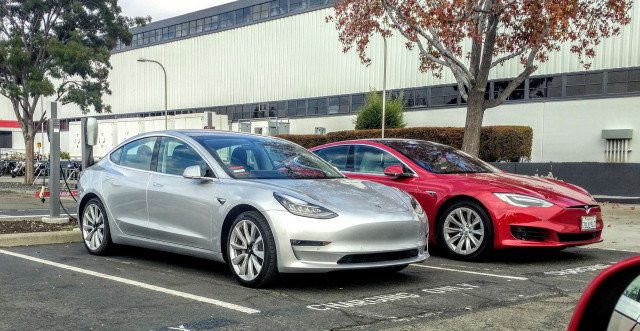
2017 Tesla Model 3 and Model S in Tesla assembly plant parking lot, Fremont, CA, November 2017


Tesla said it delivered 1,550 Model 3 electric cars between October 1 and December 31 last year, but built 2,425 over the same period.
That compares to a total of 260 Model 3s delivered in the third quarter, after a splashy "handover event" in which the first 30 cars were delivered to buyers.

The Model 3, the electric car starting at $35,000, is intended to take the Silicon Valley startup to hundreds of thousands of vehicles a year, but it has been in "production hell" for several months, in the words of CEO Elon Musk.

Deliveries of the mainstay Model S hatchback sedan and the Model X crossover utility vehicle were essentially on target.
It delivered 15,200 Model Ses and 13,120 Model Xes, 9 percent more than the third-quarter totals of 14,065 and 11,865 respectively.
The latest numbers for the two larger cars, plus the 1,810 Model 3s delivered since July, put total Tesla deliveries for 2017 at 103,122 vehicles.
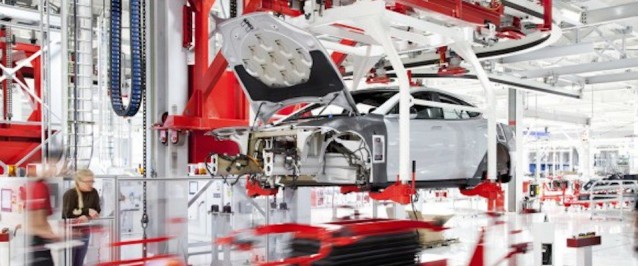
Tesla Motors production line for Tesla Model S, Fremont, California


That makes 2017 the first year in which Tesla crossed the six-figure mark; its 2016 deliveries were 76,000 Model S and Model X electric cars.
Tesla confirmed that it had "slightly reduced" its Model S and Model X production rates to redirect resources toward solving the production bottlenecks that had bedeviled the Model 3 in the second half of the year.
It has made "major progress" toward that goal, it said. It built 793 Model 3 cars in the last seven working days of the fourth quarter, according to the press release issued Wednesday afternoon.

The late burst of Model 3 production explains, Tesla said, why it wasn't able to deliver many of the Model 3s it has now built.
The company now has 860 further Model 3s in transit to buyers (as well as 2,520 Model S and X cars).
Deliveries of the Model 3 are now "accelerating rapidly" to non-employee buyers, Tesla said, adding that "we’re confident our customers will love them."
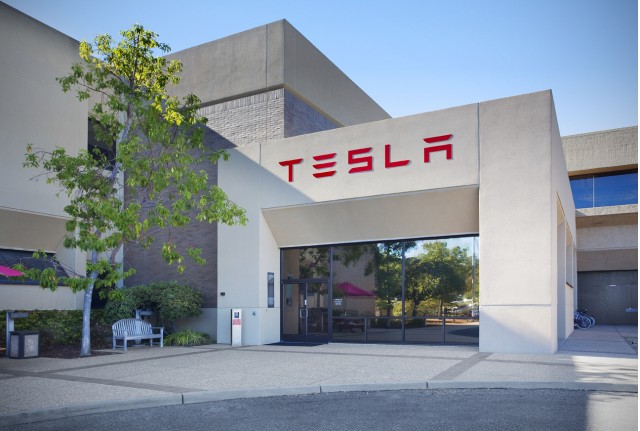
Tesla Motors, Palo Alto, California


However, the company's goal of producing 5,000 electric cars a week has been pushed back again, to the end of June 2018.
CEO Musk promised in July that Tesla would hit that pace by the end of last year. That goal was pushed out to the end of the first quarter by last fall, and now it's moved to the end of the second quarter.
Tesla attributed the delay to a continued "focus on quality and efficiency rather than simply pushing for the highest possible volume in the shortest period of time."

Tesla closed its press release with a note of gratitude:
We’re very grateful to everyone at Tesla who has poured their heart and soul into helping with the Model 3 ramp and creating the progress we are seeing.
We’re also very appreciative of our Model 3 customers, who continue to stick by us while patiently waiting for their cars.
The company will release its fourth-quarter financial results in early to mid February.